Kepler to Müller, 17/27 October 1629
Johannes Kepler, “Kepler to Müller, 17/27 October 1629,” Nova Kepleriana 4, October 27, 1629, 65–67, transcribed in Plain Old Text, https://sources.vjbe.net/stable/pqxke.
Nova Kepleriana 4 27 Oct, 1629, p. 65–67 Summary
Part of Die Keplerbriefe auf der Nationalbibliothek und auf der Sternwarte in Paris
Amid the ruin of the war, Kepler sends two journeymen to Leipzig to buy a press, have type cast and paper made for printing Tycho Brahe's observations, and asks Müller to advance money from his and Bartsch's funds; with a note on the Danish astronomy of Longomontanus.
Source: Johannes Kepler's letter to Philipp Müller, professor of mathematics at Leipzig, written at Sagan on 17/27 October 1629, about setting up a press for the edition of Tycho Brahe's observations. The original is lost; the copy is in the Bibliothèque de l'Observatoire, Paris (B, 1, 9 (89); 89, 8. K). First printed in Nova Kepleriana 4, ed. Walther von Dyck and Max Caspar, Abhandlungen der Bayerischen Akademie der Wissenschaften, Math.-naturw. Abteilung 31, no. 1 (Munich, 1927), 65–67.
Transcribed from: the page images of the 1927 printing.
Only the letter is given; the editors’ German summary and notes are left out. Square brackets are the editors’. ♀ ☿ are the signs for Venus and Mercury, ♄ ♃ for Saturn and Jupiter, ☉ for the sun.
English translation of the letter as printed in Nova Kepleriana 4 (1927), made for Plain Old Text. Each paragraph translates the corresponding paragraph of the original.
S. P. D.
Many greetings.
Clarissime amicissimeque Vir.
Most famous and most friendly Sir.
Inter ruinas oppidorum, provinciarum, rerump[ublicarum], domuum antiquarum, novarum, inter metus irruptionum barbaricarum, oppressionum domesticarum, cogor tamen ego, Martis quippe alumnus et tantum non pullus, typographos conducere, editionem Obervationum Braheanarum vel simulare, vel inchoare etiam, dissimulato strenue omni metu. Id quidem et faciam cum bono Deo, more militari, hodie imperiis exultans saeviens furens, curam meae sepulturae crastino transmittens.
Amid the ruins of towns, provinces, states and houses old and new, amid fears of barbarian invasions and of oppression at home,The Thirty Years’ War (1618–1648), then in its twelfth year. Silesia, where Sagan lies, had been crossed by Mansfeld’s and Danish troops in 1626–27 until Wallenstein, the imperial general and Kepler’s patron, drove them out. I am nevertheless compelled, as a nursling of Mars, indeed all but his chick, to hire printers, and either to pretend to begin the edition of Brahe’s observations or even actually to begin it, stoutly hiding all fear. And I shall do it, with God’s help, in the soldier’s fashion: today exulting in orders, raging and storming, and leaving the care of my burial to tomorrow.
Mitto duo adolescentes, collectorem et impressorem, qui praelum emant Lipsiae, indicante M. Aviano, quodnam ibi venale, typos etiam fundendos locent, et papyrum conficiendam.
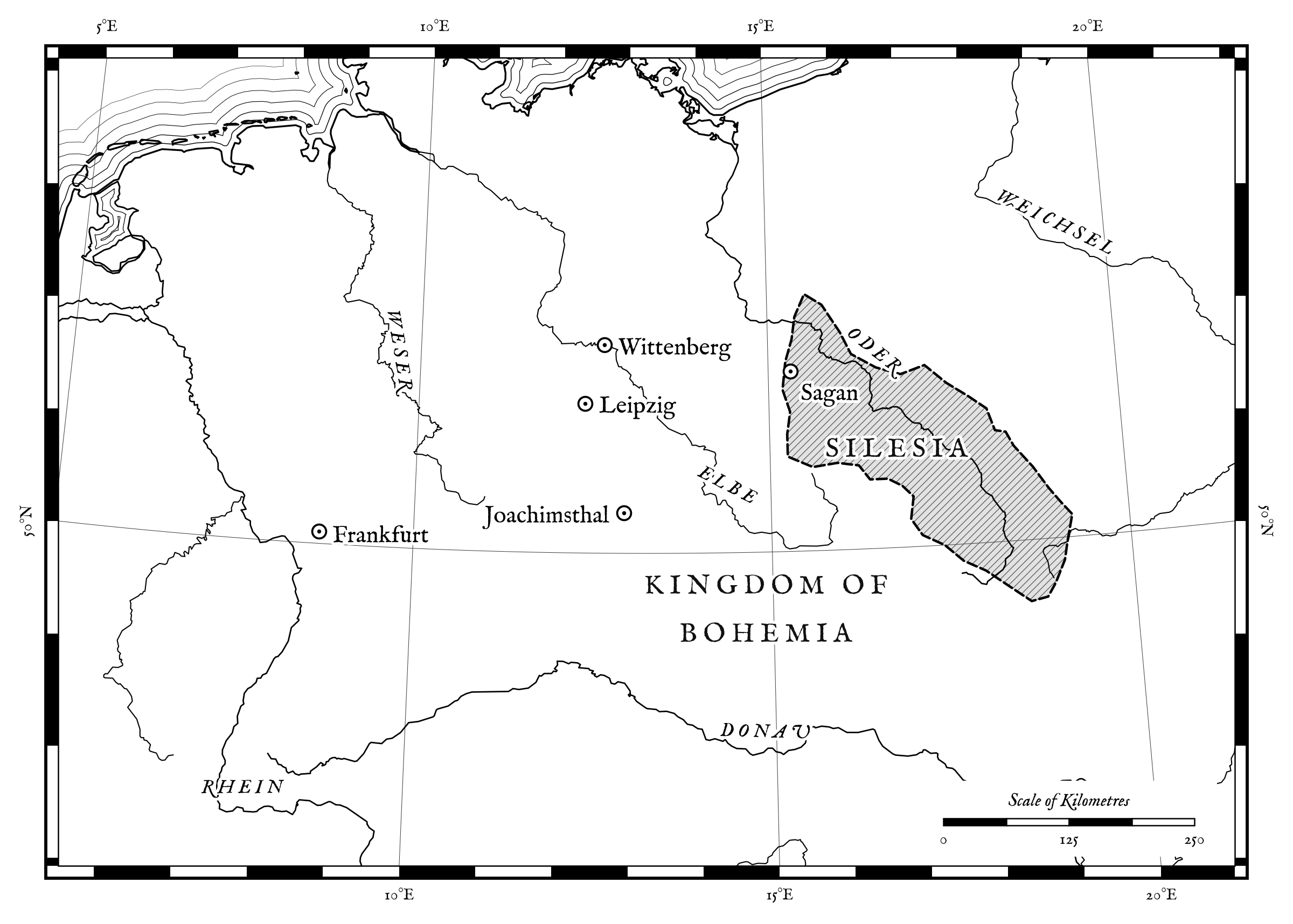
I am sending two young men, a compositorCompositor (collector): the workman who sets the type, letter by letter, into pages. and a pressman,Pressman (impressor): the workman who inks the set type and pulls the sheets on the press. to buy a pressPress (praelum, also spelled prelum): from premere, “to press”; originally a wine or olive press, taken over for the printing press. at Leipzig,See the map of the cities mentioned in this correspondence. with M. Avianus showing them what is for sale there, and also to have type castType (typus, here the plural typi): the individual metal letters, from Greek týpos, “impression.” They had to be cast by a typefounder (fusor, from fundere, “to pour, cast”), so the young men were to place an order (locare) rather than cast it themselves. and paper made.Paper (papyrus): in classical Latin “papyrus,” but used by early modern writers for ordinary paper, alongside charta.
Scripsit vero noster M. Bartschius de 10./20. octobris ista verba:
Our M. Bartsch, however, wrote these words on 10/20 October:
„D. Lic. Mollero, cum tua proxime indicata pecunia, triginta sex Joachimicorum custodiendos dedi, jam centum Joachimicos; poteris igitur a Dn. Lic. etiam meos repetere, quando volueris, et ego ipsius Chirographum reddam.”
“To the Licentiate Müller, besides your money lately mentioned, the thirty-six joachimstalers,Thalers, named after the silver coins of Joachimsthal in Bohemia. A thaler was roughly four days’ wages for a Leipzig carpenter. Allen’s Leipzig series, taken from M. J. Elsas, Umriss einer Geschichte der Preise und Löhne in Deutschland, vol. 2 (1940), gives prices and wages in pfennig (Denar). At 24 groschen of 12 pfennig, a Reichsthaler was 288 pfennig, against a carpenter’s summer wage of 72 pfennig a day in 1630. (See “Leipzig 1564–1914 (Allen)” in the Global Price and Income History Group’s data files.) I have now given a hundred joachimstalers for safe keeping; so you can also claim mine from the Licentiate whenever you like, and I shall return his receipt.”
Petit quidem, si fieri possit, ut prius ipsi significem, quid mihi placuerit. Ego vero in praesens opus habeo pecuniis, nec ipsum Francofurtum avolantem possum consequi. Rogo itaque, si fidis necessitudini inter nos contractae tantum et de mea et de Bartschiana pecunia exponas, quantum erit opus secundum quod habet instructio data operariis dictis: sin autem mavis res tuas habere securas consumptis igitur 36 Joachimicis, qui mei sunt, de reliquo sponsionem interponas interim, dum tempus habeamus, ego et Bartschius, per literas conveniendi.
He does ask, if possible, that I first tell him what I have decided. But I need the money now, and cannot catch him as he flies off to Frankfurt. So I ask you, if you trust the bond we have formed, to pay out of my money and Bartsch’s as much as will be needed under the instructions given to the said workmen; or, if you would rather keep your own affairs safe, then, once the 36 joachimstalers that are mine are spent, to give your guarantee for the rest for the time being, until Bartsch and I have had time to come to terms by letter.
Imprimis autem, veluti si major inter Dn. L. et me hactenus intercessisset necessitudo et familiaritas, totus in hanc spem recumbo, fore ut consilio et authoritate tua adolescentibus praesis, meo nomine contrahentibus, ut caute et quam poterit fieri, parce contrahant. De aptitudine instrumenti judicium ipsis permitto. Quicquid factum fuerit, ratum habebo sine omni querela. Ad typos, si Lipsiae non poterunt, Witebergae ergo fundendos Lipsia sumptus erunt transferendi. Hic aliter non possum, quam Ex. T. rogare, ut Cambianas alteri eo concessuro literas det ad aliquem necessariorum, quorum de promptitudine ad hoc genus officii certus sis. Aut si minus inter literatos vigent hujusmodi commercia, non deerit Lipsiae e notis mercator, qui ad tuam petitionem cum mercatore Witebergensi agat, aut melius typographus Lipsiensis cum fusore Witebergensi. Fidem et sponsionem tuam interpones sine periculo, dum in deposito habebis pecunias Bartschii, vel etiam mihi fidens. Etiam de viatico adolescentibus dato, rationes ad te remitto; nam si videris aliquid deesse, alteri Saganum, alteri Witebergam, addes iis aliquid, mihique imputabis, quicquid manu sua testabuntur: non plus enim quatuor Joachimicis a me acceperunt. Quodque ei, qui Witebergam abit, non consulto in medium iter credetur, id saltem Witebergae tuo rogatu et sponsione is qui caeteros sumptus erogabit adjicere poterit.
Above all, as though a closer bond and friendship already existed between you, Sir, and me, I rest my whole hope on this: that you will direct the young men with your counsel and authority as they make contracts in my name, so that they contract carefully, and as sparingly as they can. I leave it to them to judge whether the press is fit. Whatever is done, I shall ratify without any complaint. As for the type,Kepler sends a compositor and a pressman to buy type. if it cannot be cast at Leipzig, it will have to be cast at Wittenberg, and the money sent there from Leipzig. Here I can only ask Your Excellency to give the one going there a letter of exchange to someone you know, whose readiness for this kind of service you are sure of. Or if such dealings are not usual among scholars, there will be no lack at Leipzig of a merchant of your acquaintance to deal, at your request, with a Wittenberg merchant, or, better, of a Leipzig printerPrinter (typographus): the master of a printing house, who employed compositors and pressmen. Celebrated master printers included Regiomontanus, Aldus Manutius, Robert Estienne, Oporinus, Plantin, Louis Elzevir and Blaeu (Eisenstein, 1980, p. 691; Eisenstein, 2002, pp. 92, 99–100). to deal with the Wittenberg founder. You can give your word and guarantee without risk, since you hold Bartsch’s money on deposit, or even trusting me. I also refer to you the account of the travelling money given to the young men: if you see that anything is lacking, for the one going to SaganNow Żagań, in western Poland. or the other going to Wittenberg, add something, and charge me with whatever they attest in their own hand; for they have had no more than four joachimstalers from me. And whatever it is unwise to trust to the one going to Wittenberg for the road, the man who pays out the other costs at Wittenberg can at least add there, at your request and on your guarantee.
De Danico calculo quod scripsit Bartschius, nihil miror. Principia sunt hinc et inde talia, ut haud sciam, an plus duobus totius Epicycli ♀ ☿ locis longitudo eccentrica ab aequinoctio circa solem, possit esse eadem. Non habet Danica Astr[onomia], puto, Epicyclum hunc eccentricum, non motus inaequalis circa punctum aequatorium, et forte neque variabili distantia ejus puncti affixionis a terra, ut penes me; incompertum etiam mihi, an Epocha long[itudinis] Epicycli utrobique eadem: quam ego quidem circumspectissime ad nostra tempora, probabilissime ad Ptolemaica, nec sine testimonio ejus observationum constitui: indulsi tamen Epochae creationis, supponens aequabilem motum vero aequabilem, sine scilicet aequatione saeculari, quae in ♄ ♃ omnino est aliqua, in ☉ probabiliter: de quo alias.
I am not at all surprised at what Bartsch wrote about the Danish calculation.The tables of Longomontanus's Astronomia Danica (1622). The principles on either side are such that I hardly know whether the eccentric longitude from the equinox about the sun can be the same at more than two places on the whole epicycle of Venus and Mercury. The Danish Astronomy,“The Danish Astronomy” is a book: the Astronomia Danica (1622) by Christen Sørensen Longomontanus, Tycho Brahe’s longest-serving assistant at Hven, later professor at Copenhagen. I think, does not have this eccentric epicycle, nor the unequal motion about the equant point, nor perhaps the varying distance of that point of attachment from the earth, as mine does; nor do I know whether the epoch of the epicycle’s longitude is the same in both. I fixed it most circumspectly for our own times, most probably for Ptolemy’s, and not without the witness of his observations; but I allowed myself the epoch of the Creation, assuming the uniform motion to be truly uniform, that is, without a secular equation, which in Saturn and Jupiter certainly exists to some degree, and probably in the sun: but of that another time.
Unum addo de praelo. Rebus Patroni mei salvis utcunque periculosis, omnino mihi pergendum est in contractu. Si tamen, ut fortuna belli fert, talis aliquis casus interea existeret, quo fons ejus liberalitatis certo obturatus appareret, quod bono Christianitatis, longe absit, opto: cunctandum sane censuerim: Eoque Cl. D. Tuae, ut intimo, in arcanis concredo mandatum hoc, uti tunc non ultra arrham aliquam modicam illos progredi patiaris, ratificationem mihi usque ad eorum reditum reservatam praestes; dispositis tamen ante abitum illorum omnibus, quae ad sequentem meam postulationem erunt transportationi necessaria, ut etiam sine custode comite praelum salvum transferri possit. Quanquam hyems adest, et hiberna, nec tale quid facile expectandum porro: neque rumoribus incertis fides leviter habenda. Denique scias, omnino me ratum et gratum habiturum, etiamsi sine tali cautela, quae fere impossibilis, concluseris, aut contractum pecunia expensa consummaveris. Nec enim haesitandi tibi hic materiam objectam velim, rebus incertis, sed saltem consistendi, rebus ex inopinato certissimis.
One thing I add about the press. As long as my Patron’s affairsWallenstein, Duke of Friedland and Sagan, who paid for Kepler's press. are safe, however dangerous, I must certainly go on with the contract. If, however, as the fortune of war goes, some event should meanwhile occur by which the source of his generosity plainly appeared to be stopped (which, for the good of Christendom, I pray be far off), I should certainly think we must hold back. And so I entrust Your Excellency, as an intimate, in secret, with this instruction: in that case, do not let them go beyond some modest deposit, and keep the ratification reserved for me until they return; but before they leave, have everything arranged that will be needed for transport when I next ask, so that the press can be brought here safely even without an escort. Though winter is here, and winter quarters, and nothing of the kind is easily to be expected now; nor should uncertain rumours be lightly believed. Finally, know that I shall certainly ratify and welcome it even if you have concluded without such a precaution, which is all but impossible, or have completed the contract and paid out the money. For I would not give you grounds here for hesitating while things are uncertain, only for stopping, if things suddenly become quite certain.
Vale Deo commendatus
Farewell, commended to God.
17./27. Oct. 1629. Sagani.
17/27 Oct. 1629. Sagan.
Cl. D. Tuae
officiosissimus
Joannes Keplerus
Mathematicus.
Your Excellency’s
most dutiful
Johannes Kepler,
Mathematician.
Clarissimo Excellentissimoque Viro Dno.
Philippo Mollero Medicinae Licent.
Mathematices in Academia Lipsiensi
Professori celeberrimo Dno. amico meo
veteri fide colendo
Lips.
To the most famous and most excellent Mr
Philipp Müller, Licentiate of Medicine,
most celebrated Professor of Mathematics
in the University of Leipzig, my friend,
to be honoured with old loyalty,
Leipzig.
References
- Eisenstein, Elizabeth L. The Printing Press as an Agent of Change: Communications and Cultural Transformations in Early Modern Europe. Vol. 2. 1980.
- Eisenstein, Elizabeth L. “An Unacknowledged Revolution Revisited.” The American Historical Review 107, no. 1 (2002): 87–105. https://doi.org/10.1086/ahr/107.1.87.