Kepler to Müller, 17/27 October 1629
Johannes Kepler, “Kepler to Müller, 17/27 October 1629,” Nova Kepleriana 4, October 27, 1629, 65–67, transcribed in Plain Old Text, https://sources.vjbe.net/stable/pqxke.
Nova Kepleriana 4 27 Oct, 1629, p. 65–67 Summary
Part of Die Keplerbriefe auf der Nationalbibliothek und auf der Sternwarte in Paris
Amid the ruin of the war, Kepler sends two journeymen to Leipzig to buy a press, have type cast and paper made for printing Tycho Brahe's observations, and asks Müller to advance money from his and Bartsch's funds; with a note on the Danish astronomy of Longomontanus.
Source: Johannes Kepler's letter to Philipp Müller, professor of mathematics at Leipzig, written at Sagan on 17/27 October 1629, about setting up a press for the edition of Tycho Brahe's observations. The original is lost; the copy is in the Bibliothèque de l'Observatoire, Paris (B, 1, 9 (89); 89, 8. K). First printed in Nova Kepleriana 4, ed. Walther von Dyck and Max Caspar, Abhandlungen der Bayerischen Akademie der Wissenschaften, Math.-naturw. Abteilung 31, no. 1 (Munich, 1927), 65–67.
English translation of the letter as printed in Nova Kepleriana 4 (1927), made for Plain Old Text. Each paragraph translates the corresponding paragraph of the original.
Many greetings.
Most famous and most friendly Sir.
Amid the ruins of towns, provinces, states and houses old and new, amid fears of barbarian invasions and of oppression at home,The Thirty Years’ War (1618–1648), then in its twelfth year. Silesia, where Sagan lies, had been crossed by Mansfeld’s and Danish troops in 1626–27 until Wallenstein, the imperial general and Kepler’s patron, drove them out. I am nevertheless compelled, as a nursling of Mars, indeed all but his chick, to hire printers, and either to pretend to begin the edition of Brahe’s observations or even actually to begin it, stoutly hiding all fear. And I shall do it, with God’s help, in the soldier’s fashion: today exulting in orders, raging and storming, and leaving the care of my burial to tomorrow.
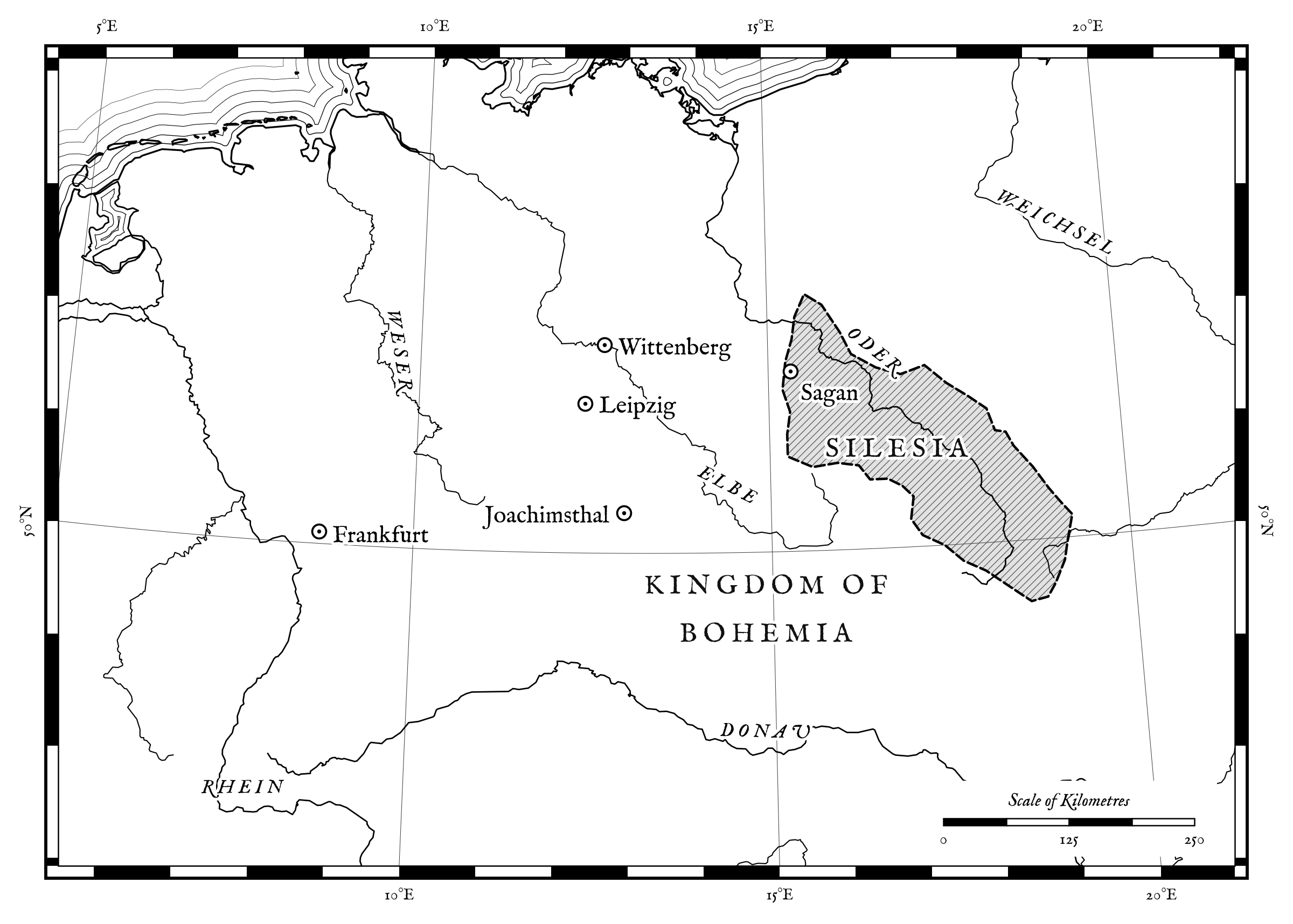
I am sending two young men, a compositorCompositor (collector): the workman who sets the type, letter by letter, into pages. and a pressman,Pressman (impressor): the workman who inks the set type and pulls the sheets on the press. to buy a pressPress (praelum, also spelled prelum): from premere, “to press”; originally a wine or olive press, taken over for the printing press. at Leipzig,See the map of the cities mentioned in this correspondence. with M. Avianus showing them what is for sale there, and also to have type castType (typus, here the plural typi): the individual metal letters, from Greek týpos, “impression.” They had to be cast by a typefounder (fusor, from fundere, “to pour, cast”), so the young men were to place an order (locare) rather than cast it themselves. and paper made.Paper (papyrus): in classical Latin “papyrus,” but used by early modern writers for ordinary paper, alongside charta.
Our M. Bartsch, however, wrote these words on 10/20 October:
“To the Licentiate Müller, besides your money lately mentioned, the thirty-six joachimstalers,Thalers, named after the silver coins of Joachimsthal in Bohemia. A thaler was roughly four days’ wages for a Leipzig carpenter. Allen’s Leipzig series, taken from M. J. Elsas, Umriss einer Geschichte der Preise und Löhne in Deutschland, vol. 2 (1940), gives prices and wages in pfennig (Denar). At 24 groschen of 12 pfennig, a Reichsthaler was 288 pfennig, against a carpenter’s summer wage of 72 pfennig a day in 1630. (See “Leipzig 1564–1914 (Allen)” in the Global Price and Income History Group’s data files.) I have now given a hundred joachimstalers for safe keeping; so you can also claim mine from the Licentiate whenever you like, and I shall return his receipt.”
He does ask, if possible, that I first tell him what I have decided. But I need the money now, and cannot catch him as he flies off to Frankfurt. So I ask you, if you trust the bond we have formed, to pay out of my money and Bartsch’s as much as will be needed under the instructions given to the said workmen; or, if you would rather keep your own affairs safe, then, once the 36 joachimstalers that are mine are spent, to give your guarantee for the rest for the time being, until Bartsch and I have had time to come to terms by letter.
Above all, as though a closer bond and friendship already existed between you, Sir, and me, I rest my whole hope on this: that you will direct the young men with your counsel and authority as they make contracts in my name, so that they contract carefully, and as sparingly as they can. I leave it to them to judge whether the press is fit. Whatever is done, I shall ratify without any complaint. As for the type,Kepler sends a compositor and a pressman to buy type. if it cannot be cast at Leipzig, it will have to be cast at Wittenberg, and the money sent there from Leipzig. Here I can only ask Your Excellency to give the one going there a letter of exchange to someone you know, whose readiness for this kind of service you are sure of. Or if such dealings are not usual among scholars, there will be no lack at Leipzig of a merchant of your acquaintance to deal, at your request, with a Wittenberg merchant, or, better, of a Leipzig printerPrinter (typographus): the master of a printing house, who employed compositors and pressmen. Celebrated master printers included Regiomontanus, Aldus Manutius, Robert Estienne, Oporinus, Plantin, Louis Elzevir and Blaeu (Eisenstein, 1980, p. 691; Eisenstein, 2002, pp. 92, 99–100). to deal with the Wittenberg founder. You can give your word and guarantee without risk, since you hold Bartsch’s money on deposit, or even trusting me. I also refer to you the account of the travelling money given to the young men: if you see that anything is lacking, for the one going to SaganNow Żagań, in western Poland. or the other going to Wittenberg, add something, and charge me with whatever they attest in their own hand; for they have had no more than four joachimstalers from me. And whatever it is unwise to trust to the one going to Wittenberg for the road, the man who pays out the other costs at Wittenberg can at least add there, at your request and on your guarantee.
I am not at all surprised at what Bartsch wrote about the Danish calculation.The tables of Longomontanus's Astronomia Danica (1622). The principles on either side are such that I hardly know whether the eccentric longitude from the equinox about the sun can be the same at more than two places on the whole epicycle of Venus and Mercury. The Danish Astronomy,“The Danish Astronomy” is a book: the Astronomia Danica (1622) by Christen Sørensen Longomontanus, Tycho Brahe’s longest-serving assistant at Hven, later professor at Copenhagen. I think, does not have this eccentric epicycle, nor the unequal motion about the equant point, nor perhaps the varying distance of that point of attachment from the earth, as mine does; nor do I know whether the epoch of the epicycle’s longitude is the same in both. I fixed it most circumspectly for our own times, most probably for Ptolemy’s, and not without the witness of his observations; but I allowed myself the epoch of the Creation, assuming the uniform motion to be truly uniform, that is, without a secular equation, which in Saturn and Jupiter certainly exists to some degree, and probably in the sun: but of that another time.
One thing I add about the press. As long as my Patron’s affairsWallenstein, Duke of Friedland and Sagan, who paid for Kepler's press. are safe, however dangerous, I must certainly go on with the contract. If, however, as the fortune of war goes, some event should meanwhile occur by which the source of his generosity plainly appeared to be stopped (which, for the good of Christendom, I pray be far off), I should certainly think we must hold back. And so I entrust Your Excellency, as an intimate, in secret, with this instruction: in that case, do not let them go beyond some modest deposit, and keep the ratification reserved for me until they return; but before they leave, have everything arranged that will be needed for transport when I next ask, so that the press can be brought here safely even without an escort. Though winter is here, and winter quarters, and nothing of the kind is easily to be expected now; nor should uncertain rumours be lightly believed. Finally, know that I shall certainly ratify and welcome it even if you have concluded without such a precaution, which is all but impossible, or have completed the contract and paid out the money. For I would not give you grounds here for hesitating while things are uncertain, only for stopping, if things suddenly become quite certain.
Farewell, commended to God.
17/27 Oct. 1629. Sagan.
Your Excellency’s
most dutiful
Johannes Kepler,
Mathematician.
To the most famous and most excellent Mr
Philipp Müller, Licentiate of Medicine,
most celebrated Professor of Mathematics
in the University of Leipzig, my friend,
to be honoured with old loyalty,
Leipzig.
References
- Eisenstein, Elizabeth L. The Printing Press as an Agent of Change: Communications and Cultural Transformations in Early Modern Europe. Vol. 2. 1980.
- Eisenstein, Elizabeth L. “An Unacknowledged Revolution Revisited.” The American Historical Review 107, no. 1 (2002): 87–105. https://doi.org/10.1086/ahr/107.1.87.