Part III: The Use of the Whole Book for Barrels
Nova stereometria doliorum vinariorum 1615, p. 101–112
Part of Nova stereometria doliorum vinariorum
Johannes Kepler, “Part III: The Use of the Whole Book for Barrels,” in Nova stereometria doliorum vinariorum, inprimis Austriaci, figurae omnium aptissimae; et usus in eo virgae cubicae compendiosissimus et plane singularis. Accessit stereometriae Archimedeae supplementum (Linz: Johannes Planck, 1615), 101–112, available online https://doi.org/10.3931/e-rara-11051.
Practical rules: which barrels to buy, how to gauge barrels of any shape with a plain rod, how to trace the curve of the staves with an instrument, and how to find how much wine has been drawn from a barrel lying on its side, with a table of circular segments. Kepler ends with a toast. [This is an automatically generated summary]
Source: The third and last part of Kepler's Nova stereometria doliorum vinariorum (Linz: Johannes Planck, at the author's expense, 1615).
Transcribed from: the page images of the copy in the ETH-Bibliothek, Zürich (Rar 356: 1 q), on e-rara.
Spelling, accents and italics as printed, including v for u. Long s is given as s, ligatures other than æ and œ are resolved, the abbreviation q; is written out as que, and a tilde for a following m or n is written out. Line-end hyphens are rejoined; running heads, signatures and catchwords are not marked. Words in small capitals, and those following a large initial, are given in ordinary type. Kepler’s marginal notes are given as footnotes. Each diagram is shown as a photograph of the printed woodcut, from the same scan, where it stands on the page. The book has no printed page numbers; the page numbers given here count from the title page.
English translation of the 1615 Linz printing, made for Plain Old Text. Each paragraph translates the corresponding paragraph of the original. Kepler’s letters and figures are kept as printed, including his slips; his marginal notes are given as footnotes. The “measure” (amphora, mensura) is whatever unit of liquid the gauger uses, such as the Austrian Eimer.
Source
-
Go to source
Text
- View as markdown
- View on GitHub
-
Submit a correction
Email your correction to plainoldtext@vjbe.net.
This English translation was machine translated and has not been checked by a Latinist.
III. Pars. Vsus totius libri circa dolia.
Part III. The use of the whole book for barrels.
I. Comparatio doliorum per virgam transversalem exploratorum.
I. Comparing barrels tested with the slanting rod.
Si dolium sit proportionis Austriacæ, fidito virgæ sine respectu vel ventris inter orbem utrumque, vel buccositatis sive curvaturæ inter Orificium infusorium & orbem utrumlibet ligneum; & tale dolium alijs omnibus præfer, excepto illo Rhenensi, quod habet profunditatem ventris maiorem sesquitertia diametri orbis lignei, si tamen ullum habet. Ex cæteris igitur elige Oblonga cum multo ventre, qualia sunt aliqua Rhenensia: compensat enim nonnihil gracilitatem & prolixitatem corporis, amplitudo ventris medij, & longitudo buccarum. In contemptis habeto dolia oblonga & cylindracea sine ventre: post hæc Curta tibi censentor, cuiusmodi aliqua veniunt ex Vngaria, parum aut nihil à cylindro puro puto differentia. At curta ventricosa fugito modis omnibus; tres enim notas paupertatis habent, unam ex Th. V. magnitudinem proportionis Orbium ad dimidiam longitudinem Tabularum; secundam ex Th. XXII, ventris magnitudinem, tertiam ex Th. XXIX, buccarum brevitatem.
If a barrel is of the Austrian proportion, trust the rod without regard either to the belly between the two heads or to the bulge or curvature between the bung-hole and either wooden head; and prefer such a barrel to all others, except that Rhenish one which has a depth of belly greater than four thirds of the diameter of the wooden head, if there is any such. Of the rest, then, choose oblong ones with a large belly, such as some Rhenish ones are: for the width of the middle belly and the length of the bulges make up somewhat for the slenderness and length of the body. Hold in low esteem oblong, cylindrical barrels without a belly; after these count short ones, such as some that come from Hungary, differing little or nothing from a pure and simple cylinder. But avoid short barrels with bellies by every means; for they have three marks of poverty: one, from Theorem V, the size of the ratio of the heads to half the length of the staves; the second, from Theorem XXII, the size of the belly; the third, from Theorem XXIX, the shortness of the bulges.
II. Consideratio methodi mensurandi per virgam transversalem cubicam.
II. Consideration of the method of measuring with the cubic slanting rod.
Colligitur igitur ex his omnibus, simul consideratis, nullam inter rationes mensurandi dolia, compendiosiorem simul atque circumspectiorem esse, usu virgæ transversalis cum divisionibus cubicis, in dolijs Austriacis. Omnes enim cautelas mensorum in se continet Primùm virga introrsum immissa eliminat crassitiem tabularum, circulorum, qui vincula sunt, viminumque quibus circuli lignei stringuntur; Eliminat & excessum Marginum, quorum in crenis hærent orbes seu Bases ligneæ Hoc autem ratio alia mensurandi, unâ & eadem opera præstare nulla potest; quæ non rationes mensuræ apud orificium A exigit, ubi intima superficies tabularum in aperto est Itaque Mensores aliqui regulas hic nonnullas memoriæ mandant & sequuntur, æstimandi cæcam hanc tabularum Orbiumque crassitiem: quarum incertitudine circa inconstantia exempla, omnis reliqua in mensurando scrupulositas eluditur. Secundò modus iste cavet de inæqualitate basium lignearum seu orbium, idque citra tædiosam multiplicationem, citraque repetitionem explorationis, vnà & eadem opera ut Th. XXVI huius dictum. At reliqui mensores in hoc multi sunt, ut doliorum orbes inter se æquent, mediumque eorum proportionale, denique inter capacitates medium conicum inveniant; usum virgæ planimetræ conjungentes cum calculo molestissimo. Vide recentissimum, Ioannis Hartmanni Bayeri Medici Francofurtensis librum de stereometria Inanium.
It is gathered, then, from all these things taken together, that among the ways of measuring barrels none is at once more convenient and more careful than the use of the slanting rod with cubic divisions, in Austrian barrels. For it contains in itself all the gaugers’ precautions. First, the rod put inside eliminates the thickness of the staves, of the hoops that are the bonds, and of the withies by which the wooden hoops are bound; it eliminates also the overhang of the margins, in whose grooves the heads or wooden bases sit. And no other way of measuring can do this with one and the same operation, since none takes the reckoning of the measure at the bung-hole A, where the innermost surface of the staves is open to view. So some gaugers commit to memory and follow certain rules here for estimating this hidden thickness of the staves and heads; and by their uncertainty, in the face of varying cases, all the rest of the care in measuring is made vain. Second, this way guards against the inequality of the wooden bases or heads, and that without tedious multiplication and without repeating the test, by one and the same operation, as was said at Theorem XXVI of this part. But the other gaugers are busy at this, making the heads of the barrels equal to each other and finding their mean proportional, and finally a conical mean between the capacities, combining the use of a plane rod with most troublesome calculation. See the most recent book, by Johann Hartmann Beyer, physician of Frankfurt, on the solid geometry of empty vessels.
Tertiò, neque dissimilitudo Cadorum (quantula quidem in Austriaca dolia cadit) dum doliorum Opifices Regula sua crassè utuntur, aut dolia vetera præcisis marginibus sarciunt) multum derogat fidei huius mensurationis, ut dictum Corollario I. ad Th. V & Th XXII huius. Quartò, non negligitur hic, sed ipsa methodo adsciscitur amplitudo ventris, seu circulus maximus AY: ab illius enim summo A, instituitur mensuratio ad alterius imum C. Eius rei fundamentum pendet à Th XXII huius partis.
Third, the unlikeness of casks either (small as it is in Austrian barrels, while the coopers use their rule roughly or mend old barrels by cutting off the margins) takes little from the reliability of this measurement, as was said in Corollary I to Theorem V and in Theorem XXII of this part. Fourth, the width of the belly, or the greatest circle AY, is not neglected here, but taken in by the method itself: for the measurement is made from its top A to the bottom C of the other. The foundation of this depends on Theorem XXII of this part.
Quintò nec buccositas Trunci Conoidis hic quicquam nocet, per Theor. XXVIII. Est enim & per se exigua, & per omnes omnium doliorum medietates, fere similis conniventia Tabularum, ad structuræ rationes pertinens, quæ nec meram Conicam rectitudinem, nec insignem aliquam ventricositatem, magis tamen illam, quam hanc requirit. At de hac buccositate plerique mensores valde sunt solliciti: adeo ut Clavius, ut supra dictum, ad Ellipses & Conoidea confugiat: neque tamen quisquam illorum adhuc genuinas doliorum figuras calculando secutus est, quas ego nunc primùm & cognoscendas dedi demonstrationibus spinosissimis, & in numeros conieci operosissimo calculo sed quod Austriaca nostra dolia attinet, ingeniosa magis quàm utili vel necessaria machinatione, tantum ut ex comparatione calculi cum usu virgæ Austriacæ, & commoditas huius dimensionis tantò magis elucesceret, & cæteri scrupulosi computatores sese respicerent, perpendentes, quàm hactenus frustra cerebrum fregerint computationibus laboriosissimis, culicem excolantes fractionum minutissimarum, sed camelum errorum deglutientes: sola hac altera re, pariter ipsis ignoratâ fœlices, quod nullius ferè momenti sunt pleræque tam scrupulositates, quam errores circa illas.
Fifth, nor does the bulge of the frustum of the conoid do any harm here, by Theorem XXVIII. For it is both small in itself and nearly alike, through all halves of all barrels, a leaning together of the staves belonging to the reasons of construction, which requires neither mere conical straightness nor any marked belly, but the former more than the latter. Yet most gaugers are very anxious about this bulge, so much so that Clavius, as said above, takes refuge in ellipses and conoids; yet none of them has so far followed the true shapes of barrels in calculation, which I have now for the first time both made known by most thorny proofs and put into numbers by most laborious calculation; but, as far as our Austrian barrels are concerned, as a contrivance more ingenious than useful or necessary, only so that by comparing the calculation with the use of the Austrian rod the convenience of this measurement might shine out all the more, and the other careful computers might look at themselves, considering how they have so far broken their heads in vain with most laborious computations, straining out the gnat of the smallest fractions but swallowing the camel of errors; happy in this one other thing alone, equally unknown to them, that most of their scruples, as well as the errors about them, are of almost no importance.
Plurimum igitur ad privatorum securitatem fraudesque eliminandas refert; ut lex illa dolij construendi, quæ tertia parte longitudinis tabularum jubet describere circulum orbium ligneorum, Magistratuum authoritate diligentiàque conservetur, pœnisque & proscriptione vasorum, quæ hanc figuram non habent, vindicetur: aut certè, ut virgæ mensoriæ in enormibus illis dolijs dimetiendis, fides publico decreto abrogetur.
It matters very much, then, for the security of private persons and the removal of frauds, that the law for building barrels, which orders the circle of the wooden heads to be described with a third of the length of the staves, be kept up by the authority and diligence of the magistrates, and enforced by penalties and the confiscation of vessels that do not have this shape; or at least that the reliability of the gauging rod in measuring those monstrous barrels be withdrawn by public decree.
III. Quòd usus virgæ transversalis, inscriptas habentis divisiones Cubicas, sit Austriæ proprius.
III. That the use of the slanting rod with cubic divisions inscribed on it is peculiar to Austria.
Patet hinc etiam, cur virgæ transversalis usus multò sit Austriæ familiarior, quàm nationibus cæteris: Nimirum quia hanc dolij figuram receperunt, ad quam collimantes Vietores, minimum nocent capacitati, manuum aberratione. At penes nationes cæteras aliæ etiam doliorum figuræ in usu sunt; in quibus ventrium amplitudo tabularumque longitudo mutata, statim sensibile quid nocet; Quare etsi verum est, usum virgæ transversalis vniversalem esse, in omnibus dolijs inter se similibus, secundum Th. XXVI huius partis: at nulla lex nulla institutio sufficit Opificibus, ut semper teneant eandem præcisè proportionem tabularum, multoque minus profunditatis ventris, ad Orbes; ut in qua conformandà casus plurimum valet, consilium opificis minimum. Cùm itaque figuræ institutæ proprietas non subveniat aberrationi manuum, ut in Austria, sic ut figuræ dissimiles æquipolleant similibus: dissimilibus igitur figuris quotidie provenientibus doliorum, nec capacitatis similis, non potest Virgæ transversalis cubicæ solitariæ penes nationes cæteras tam latus esse usus, sine erroris aleà.
It is plain from this also why the use of the slanting rod is much more familiar in Austria than among other nations: namely because they have adopted this shape of barrel, aiming at which the coopers do least harm to the capacity by the slips of their hands. But among other nations other shapes of barrel too are in use, in which a change in the width of the belly and the length of the staves at once does some perceptible harm. So although it is true that the use of the slanting rod is universal in all barrels similar to one another, according to Theorem XXVI of this part, yet no law and no training is enough for craftsmen always to keep exactly the same proportion of staves, and much less of depth of belly, to heads; for in shaping it chance counts for most and the craftsman’s design for least. So since the property of the prescribed shape does not come to the aid of the slips of the hand, as in Austria, so that unlike shapes are worth as much as like ones; with unlike shapes of barrels, then, coming forth daily, and not of like capacity, the use of the cubic slanting rod alone cannot be so wide among other nations without the hazard of error.
IV. Ratio metiendi quodvis dolium circularium Orbium, sine Virga divisionis Cubicæ.
IV. A way of measuring any barrel with circular heads without a rod of cubic division.
Sed cum generalem hoc libro speculationem proposuerim, praxis etiam ad omnes alias doliorum figuras extendenda videtur, cùm ut fructum aliquem Stereometriæ huius percipiant etiam nationes cæteræ: tum etiam ut Austriaci nostri circa dolia peregrina (quæ identidem vel secundo vel adverso Danubio invehuntur in Austriam, aut vino exotico plena, aut exportatura vinum Austriacum) tanto magis juventur: neve usu virgæ suæ, damnum vel inferant alijs, vel ipsi accipiant. Etenim Iustitiæ simulachrum pingitur cum bilance, mensurarum omnium exactarum symbolo; pertinetque cura hæc circa mensurarum fidem, ad huius virtutis, suum cuique tribuentis, cultum; ut, quæ & salvas præstat Respublicas, & ornat, ipsa quovis sole pulchrior; ab eius amico & sereno vultu, omnes nubeculæ errorum quàm longissimè dimoveantur, discutianturque.
But since I have put forward a general inquiry in this book, the practice too seems to need extending to all other shapes of barrel, both so that other nations may get some fruit from this solid geometry, and so that our Austrians may be helped the more with foreign barrels (which from time to time are brought into Austria down or up the Danube, either full of foreign wine or to carry Austrian wine away), and may neither do others harm nor suffer it themselves through the use of their rod. For the image of Justice is painted with scales, the symbol of all exact measures; and this care for the reliability of measures belongs to the cultivation of this virtue, which gives each his own; so that from the friendly and serene face of her who both keeps commonwealths safe and adorns them, herself fairer than any sun, all the little clouds of error may be moved as far away as possible and dispersed.
Virga igitur in parato sit, divisa in partes æquales minutissimas; cum illa in orificium dolij imissâ metire primo profunditatem ventris medij, deinde transversas longitudines, ab infusorij medio, ad imos calces utriusque orbis lignei; tertio virgam extractam siste foris ad calces orbium ligneorum, acie etiam in crenas impressà, si potest, metiens utriusque orbis lignei diametrum in altitudinem prorrectam seorsim; cui æquales ponuntur esse omnes aliæ diametri unius orbis lignei, propter structuræ rationes; & quia hîc non de lagenis agimus. Si tamen aliqua notabilis diversitas esset in diametris unius & eiusdem orbis lignei, orta vel ex aberratione artificis, vel ex natura ligni, quæ cum venarum longitudinem præstet invariabilem, latitudinem tamen tabularum habet auræ mutationibus obnoxiam; tunc etiam transversas orbium ligneorum diametros metire.
Let a rod be at hand, then, divided into very small equal parts. Putting it into the bung-hole of the barrel, measure first the depth of the middle belly, then the slanting lengths from the middle of the bung-hole to the lowest edges of both wooden heads; third, take out the rod and set it outside at the edges of the wooden heads, pressing its point into the grooves too if possible, measuring separately the diameter of each wooden head stretched upright; all the other diameters of one wooden head are supposed equal to it, for reasons of construction, and because we are not dealing with flasks here. But if there should be some notable difference in the diameters of one and the same wooden head, arising either from the craftsman’s slip or from the nature of wood, which, while it gives an unchanging length along the grain, has the breadth of the staves subject to changes in the air: then measure the cross diameters of the wooden heads as well.
Et quia fit interdùm, ut ipsa etiam ventris medij amplitudo non ordinetur in perfectum circulum: tentet igitur accuratus mensor, (cui ad omnem curiositatem instrumenta modosque possibiles suppeditare animus est) viam aliam discendæ areæ, qua dolium in medio sectum esse intelligitur. Ea possit esse talis
And since it sometimes happens that the width of the middle belly itself is not arranged in a perfect circle, let the careful gauger (who means to supply instruments and possible ways for every curiosity) try another way of learning the area by which the barrel is understood to be cut in the middle. It might be this.
Limbo ex pergameno, aut alia materia flexili, non tamen, ut fila, ductili, circumdato medium ventrem dolij, metiarisque, quot partes virgæ contineat limbus talis. Posito igitur, quod dolium in medio foris exactè sit circulare, ex numero partium harum facile per Th. I. disces, quanta diameter debeat esse huius circuli: Vt si partes in ambitu invenisses 6283 cum una quinta, diameter deberet habere partes 2000. Atqui jam exploratam habes diametrum interiorem seu profunditatem ventris: aufer igitur à computata crassitiem ligni, quam potes metiri in infusorio, & pro altera tabula in dolij imo aufer tantundem: quod si diameter profunditatis invenitur æqualis huic computatæ, ex ambitu exteriore, & diminutæ: dolij venter exactè circularis credi potest; quia si deflectit à circulo, causa nulla est, cur potius obliquæ diametri (quod tamen etiam fieri potest) quam erecta & transversa sint inæquales. Sed omnem certitudinem huius rei (si fortè sit materia metienda precisior auro, quantitatis eiusdem) disces lignis parallelis, intervallo, quantum requirit dolium, firmiter inter se coassatis, quibus omnes circumcirca diametros, si trabes binæ dolium sustineant, explorare poteris. Quod si igitur deprehendantur inæquales diametri, erecta & transversa, vel alia quæcunque; tunc figura est Ellipsis: quare per Epis. ad Th. I. p. primæ; diameter computata, medium erit arithmeticum inter erectam & transversam. Itaque quantò computata & diminuta longior est diametro profunditatis, tantò vicissim hæc erit longior diametro transversâ.
Put a strip of parchment, or of some other pliant material that does not stretch, like thread, round the middle belly of the barrel, and measure how many parts of the rod such a strip contains. Supposing, then, that the barrel is exactly circular on the outside in the middle, from the number of these parts you will easily learn by Theorem I how great the diameter of this circle must be: as, if you had found 6283⅕ parts round it, the diameter should have 2000 parts. And you have already tested the inner diameter, or depth of the belly: so take from the computed one the thickness of the wood, which you can measure at the bung-hole, and for the other stave at the bottom of the barrel take away as much again: and if the diameter of the depth is found equal to this one computed from the outer circuit and reduced, the belly of the barrel can be believed exactly circular; because if it departs from a circle, there is no reason why the oblique diameters (though that too can happen) should be unequal rather than the upright and cross ones. But you will learn the full certainty of this (if the material to be measured should be more precious than gold in the same quantity) with parallel pieces of wood firmly fixed together at the distance the barrel requires, with which you can test all the diameters all round, if two beams support the barrel. And if the diameters, upright and cross, or any others, are found unequal, then the shape is an ellipse: so, by the addendum to Theorem I of the first part, the computed diameter will be the arithmetic mean between the upright and the cross. So by as much as the computed and reduced one is longer than the diameter of the depth, by so much in turn will this be longer than the cross diameter.
Ex cognita igitur diametro vel diametris cuiusque circuli vel Ellipsis, sic elicies aream, tam orbis lignei, quàm sectionis imaginariæ per medium ventrem, per Th. II, & Episagma III, partis primæ. Multiplica diametrum erectam in transversam, sive fuerint æquales, sive inæquales: eritque factus ad summam parvulorum quadratorum, quæ sunt unam virgæ divisionum æqualium longa & lata, contentorum in area talis orbis lignei, sicut 14 ad 11 ferè. Accuratius, (quod dicto Theoremate omissum hinc supple) ut numerus post quaternarium ordinatas habens Cyphras sedecim, ad dimidium numeri, quo effertur circuli circumferentia Th. I. Nam ut obiter hoc dicam à nemine adhuc demonstratum, nescio an à quoquam observatum: In omnibus figuris regularibus, circulo circumscriptis, & sic etiam in ipso circulo, quasi in figura infinitangula, usu venit, ut ipsarum perimetri, quando diameter habere ponitur partes 2, numero contineantur, qui duplus est numeri, quo continetur area figuræ.
From the known diameter or diameters of any circle or ellipse, then, you will draw out the area, both of the wooden head and of the imagined section through the middle belly, thus, by Theorem II and Addendum III of the first part. Multiply the upright diameter by the cross one, whether they are equal or unequal: and the product will be to the sum of the little squares, each one equal division of the rod long and broad, contained in the area of such a wooden head, about as 14 to 11. More exactly (supply this from here, as it was left out in the said theorem): as the number 4 followed by sixteen zeros is to half the number by which the circumference of the circle is expressed in Theorem I. For, to say this in passing, a thing proved by no one so far, and I do not know whether noticed by anyone: in all regular figures circumscribed about a circle, and so also in the circle itself, as if a figure of infinitely many angles, it happens that their perimeters, when the diameter is supposed to have 2 parts, are contained in a number twice the number in which the area of the figure is contained.
Proxima tibi cognitio necessaria, est longitudinis dolij, quam non ita facile foris, vel intus metiri datur virgulà, quia curvantur tabulæ, procurruntque ultra crenas orbesque ligneos, quorum etiam crassities ignoratur. Veram igitur longitudinem sic disces; quadra longitudinem transversalem, ab hoc quadrato aufer factum ex diametro orbis lignei & diametro ventris (sumpto medio arithmetico, si non fuerint omnes vnius figuræ diametri æquales) residuum serva, deinde orbis lignei diametrum aufer à diametro ventris, residuum quadra, quadrati partem quartam aufer à residuo prius asservato: radix eius quod remanet, est longitudo medietatis illius, cuius orbem ligneum adhibuisti; technicè dicitur altitudo trunci. Quod si doliū est regulare, duplum erit hujus, longitudo totius dolij; sed tutius ages, repetendo processum eundem cum altera longitudine transversali, alteroque orbe ligneo; quo patefiet alterius medietatis longitudo, hoc est alterius Trunci altitudo.
The next knowledge you need is of the length of the barrel, which cannot so easily be measured with a rod outside or inside, because the staves curve and run out beyond the grooves and the wooden heads, whose thickness is also unknown. You will learn the true length, then, thus: square the slanting length; from this square take the product of the diameter of the wooden head and the diameter of the belly (taking the arithmetic mean, if not all the diameters of one figure are equal), and keep the remainder; then take the diameter of the wooden head from the diameter of the belly, square the remainder, and take a quarter of the square from the remainder kept before: the root of what remains is the length of that half whose wooden head you used; technically it is called the height of the frustum. And if the barrel is regular, twice this will be the length of the whole barrel; but you will do more safely by repeating the same process with the other slanting length and the other wooden head, by which the length of the other half, that is, the height of the other frustum, will be revealed.
Exemplum. Sit inventa in Sch. XXII, transversalis AZ longitudo partium æqualium virgæ 24 semis & paulò plus: ut sit eius quadratum 602 s. Sint etiam inventæ diametri AY 22, XZ 19, partium earundem. Hæ in se mutuò multiplicatæ, faciunt 418, quem aufer à 602 s. restat 184 s. Differunt diametri per 3, cuius quadratum est 9, & hinc pars quarta, 2 cum quartà: quam aufer ab 184 s. restat 182 cùm quartà, cuius radix 13 s. dimidij dolij longitudo interna, ut tota GX sit 27 long. Et cum quadratum de 22 sit 484, de 19, sit 361: Vt igitur 40000 ad 31416, sic 484 & 361 ad 380+ & 283 s. areas circulorum AY, & XZ.
Example. In Schema XXII let the slanting length AZ be found to be 24½ equal parts of the rod and a little more, so that its square is 602½. Let the diameters AY 22 and XZ 19 also be found, in the same parts. These multiplied together make 418; take this from 602½: 184½ remains. The diameters differ by 3, whose square is 9, and a quarter of this 2¼; take this from 184½: 182¼ remains, whose root, 13½, is the inner length of half the barrel, so that the whole GX is 27 long. And since the square of 22 is 484 and of 19 is 361: as 40000 to 31416, so are 484 and 361 to 380+ and 283½, the areas of the circles AY and XZ.
Inventis areis circulorum, & longitudine medietatis utriusque, trivium occurrit; aut enim pro Truncis Conicis habentur, binæ dolij cuiusque medietates, aut pro Truncis Citrij, aut pro figuris intermedijs, pro Pruno, Oliva, Fuso Parabolico, vel Hyperbolico, truncatis: hoc est, curvaturæ tabularum tribuitur vel mera rectitudo ab infusorio ad marginem, vel merus circulus inter utrumque marginem & infusorium, vel figura ex utroque mixta.
Once the areas of the circles and the length of each half are found, three roads meet: for the two halves of each barrel are taken either as conical frustums, or as frustums of a lemon, or as intermediate figures, as cut plums, olives, parabolic or hyperbolic spindles; that is, the curvature of the staves is given either mere straightness from the bung-hole to the margin, or a mere circle between both margins and the bung-hole, or a shape mixed from both.
Illa viâ semper paulò minus iusto colliges, istâ promiscuè vel plus iusto, vel iustum attingitur; hac semper iustum attingeretur, si tam facile per hanc incederetur, quàm per illas.
By the first road you will always get a little less than the true amount; by the second the true amount is reached, or more, indifferently; by the third the true amount would always be reached, if it were as easy to go by it as by the others.
I. Prima via dividitur Truncus quilibet in cylindrum regularem, quasi stantem super basi, orbe ligneo, & in circumiectum illi segmentum limbi Cylindracei Conicum, quod Tunicam apellavimus. Ergò Cylindri corpus, per Th. III partis primæ, computatur, ducta altitudine dimidii dolii, in basin orbis lignei supra inventam: nam numerus inde factus, summam continebit parvulorum Cubiscorum, qui sunt in proposito cylindro, quorum quilibet unam virgæ particulam divisionis æqualis, longus latus & profundus sit. Trunci verò, seu dimidii dolii proportio ad Cylindrum super basi, orbe ligneo, habetur per Corollarium ad Th XVII partis primæ, ducta diametro orbis lignei, & in se, & in diametrum seu profunditatem ventris; ducta etiam differentia harum diametrorum in sui partem tertiam: & numero Cubiscorum in cylindro prius invento, multiplicato in summam factorum posteriorum, factoque diviso per quadratum diametri orbis lignei: prodit enim summa Cubiscorum in dolio. Eodem verò modo agendum etiam cum altera dolii medietate si fuerit dissimilis aut inæqualis.
I. By the first road any frustum is divided into a regular cylinder, standing as it were on its base, the wooden head, and the conical segment of a cylindrical rim put round it, which we have called the coat. So the body of the cylinder is computed, by Theorem III of the first part, by multiplying the height of half the barrel by the base of the wooden head found above: for the number made from this will contain the sum of the little cubes in the proposed cylinder, each of which is one particle of the rod’s even division long, broad and deep. And the ratio of the frustum, or half barrel, to the cylinder on the base, the wooden head, is had by the corollary to Theorem XVII of the first part, by multiplying the diameter of the wooden head both by itself and by the diameter or depth of the belly, and multiplying also the difference of these diameters by its own third part; and by multiplying the number of little cubes in the cylinder found before by the sum of the latter products, and dividing the product by the square of the diameter of the wooden head: for the sum of little cubes in the barrel results. And the same must be done with the other half of the barrel too, if it is unlike or unequal.
Quot autem huiusmodi Cubiscorum faciant unam mensuram, non aliter disces, quàm si ex lamina ferrea vasculum oblongum, Cylindraceum exactè, & æqualiter rotundum struxeris, cum fundo optimè complanato, deinde infuso liquore unius mensuræ in vas siccum, virga tua mensus fueris altitudinem quam signaverat liquor ante immissionem virgæ in vasculum; mensus etiam fueris amplitudinem circuli in summo, debet enim æqualis esse imo. Nam ex amplitudine disces aream circuli, modo supradicto, ex hac & altitudine, corpus seu numerum Cubiscorum in vna mensura: quo numero si diviseris numerum Cubiscorum cuiuscunque solidi, habebis in quotiente numerum talium mensurarum, quas capit locus solidus, seu dolij seu Cupæ. Atque hæc est prima methodus, qua dixi colligi minus justo. Exemplum habes post Th. XXII partis primæ.
How many such little cubes make one measure you will learn in no other way than this: if you make a small oblong vessel of sheet iron, exactly cylindrical and evenly round, with a very well flattened bottom, then pour one measure of liquid into the dry vessel and measure with your rod the height the liquid marked before the rod was put into the vessel; and measure also the width of the circle at the top, for it must be equal to the bottom. For from the width you will learn the area of the circle, in the way described above, and from this and the height the body, or number of little cubes, in one measure; and if you divide the number of little cubes of any solid by this number, you will have in the quotient the number of such measures that the solid space, whether of a barrel or of a vat, holds. And this is the first method, by which I said less than the true amount is gathered. You have an example after Theorem XXII of the first part.
Sed continuabimus hic etiam prius inceptum. Duc igitur 13 semis in 283 s. basin minorem, orbis scilicet lignei XZ, fiet Cylinder 3685 s. In hac verò proportione diametrorū, est cylinder ad Truncum, ut 361 ad 421. Ergò si 361 sit 3685 s. quid 421? sequitur 4298, tot cubiscos valet dimidium dolium: totum ergo 9596. Quod si 30 huiusmodi cubiscorum implerent unam mensuram, diviso 9596 per 30, prodiret 320 fere, tot mensuras caperet dolium totum.
But we shall continue here too what was begun before. Multiply 13½, then, by 283½, the lesser base, namely of the wooden head XZ: the cylinder will be 3685½. And in this ratio of diameters the cylinder is to the frustum as 361 to 421. So if 361 is 3685½, what is 421? 4298 follows: that many little cubes is half the barrel worth; the whole, then, 9596. And if 30 such little cubes filled one measure, dividing 9596 by 30 would give about 320: that many measures the whole barrel would hold.
II. Altera methodus, qua dolium consideratur, ut Citrium utrinque truncatum, quæque frequentur justum pronunciat, sed æquè frequenter plus justo; jam supra in Exemplo ad Th. XXII & XXV p. primæ prolixè & scrupulosissimè fuit tradita: nec alia repetitione est opus, nisi ut moneam, dolium illic apellari Citrium Truncatum, dolij ventrem illic esse circulum maximum per medium corpus Citrij; Orbes verò ligneos illic appellari circulos Truncantes. Deinde & hoc est addendum, si orbes lignei non fuerint æquales, operandum esse bis, semel per minorem orbem, ac si uterque tantus esset, iterum per maiorem, ac si uterque maior; quodque posterior calculus differens prodet à priori, eius parte dimidia hinc detracta vel inde adjectà, justum (ut in perfecta Citrij figurà) constitutum iri.
II. The second method, by which the barrel is considered as a lemon cut off at both ends, and which often gives the true amount but just as often more than the true amount, was given at length and most carefully above in the example to Theorems XXII and XXV of the first part; nor is there need of any other repetition, except to note that the barrel is there called the cut lemon, that the belly of the barrel is there the greatest circle through the middle of the body of the lemon, and that the wooden heads are there called the cutting circles. And this too must be added: if the wooden heads are not equal, the work must be done twice, once with the smaller head, as if both were as great, and again with the greater, as if both were greater; and whatever difference the second calculation shows from the first, half of it being taken from the one or added to the other, the true amount (as in the perfect shape of a lemon) will be established.
III. Quod si tibi scrupulositates istæ nondum sufficiunt, eo quod curvatura tabularum non semper habeat figuram Circularem exactè, & si, ut est Geometricorum ingeniorum natura, non ex aliena & conficta, sed ex genuina & propria cuiusque dolij figura lubet argumentari & calculare: age, prius inquirito, qualis omninò figura sit huius curvitatis Tabularum?
III. But if these scruples are not yet enough for you, because the curvature of the staves does not always have an exactly circular shape, and if, as is the nature of geometrical minds, you wish to argue and calculate not from a borrowed and made-up shape but from the true and proper shape of each barrel: come, first find out what shape exactly this curvature of the staves has.
Quasdam igitur visu simplici dignosces, quibusdam indagandis opus tibi erit instrumento & dexteritate manuum, circaque hoc exercitium, subtilitate curiosissimà: quasdam denique & plerasque quidem, nullo ingenio discernes à perfecto circulo, propter rudem tabularum coassationem, impedimenta circulorum ligneorum & viminum, inæqualem tabularum crassitiem, & ipsarum figurarum affinitatem inter se.
Some you will recognize by simple sight; to find out some you will need an instrument, and skill of hand, and the most curious subtlety in this exercise; and some, indeed most, you will by no ingenuity tell apart from a perfect circle, because of the rough fitting together of the staves, the obstacles of the wooden hoops and withies, the uneven thickness of the staves, and the kinship of the shapes themselves with one another.
Quod si in oculos incurrat curvaturæ tabularum in medio ventre dissimilitudo à curvatura versus extremos margines, dolium erit Truncus Fusi Hyperbolici, & quo angustius hæc curvatura ventrem circumsteterit, hoc maior Hyperboles pars erit, hoc proprius etiam capacitas dolij ad capacitatem Trunci Conici accedet.
If the unlikeness of the curvature of the staves in the middle belly to the curvature towards the outer margins strikes the eye, the barrel will be a frustum of a hyperbolic spindle; and the more narrowly this curvature surrounds the belly, the greater part of the hyperbola it will be, and the nearer the capacity of the barrel will come to the capacity of a conical frustum.
Reliqua hoc instrumento expedies. Cape regulam ex ferro vel orichalco, quadratam, benè politam, longitudine dolij, non flexilem suo pondere; in illa sint stili ferrei graciles & acuti ut clavi, trusatiles per longitudinem regulæ, sic ut in quacunque eius parte hæreant firmi non vacillantes; possint autem Cochleis à regula extrudi reducique ad illam: sint numero, cùm minimum, quinque; melius si septem; quorum medium sufficit fixum adhærere Regulæ mediæ, longitudine, quæ superet crassitiem omnis circuli lignei in dolijs. Statuto igitur stilo fixo in vna commissurarum, qua duæ tabulæ coeunt in medio dolij ventre, reliquos stilos trusatiles, binos & binos, vel si adsunt, ternos, ordina versus dolij margines, intervallo illis indulto modico & utrinque æquali; cochleisque extrude, ut omnes tangant commissuram eandem, extimi æqualiter à medio remoti, in marginibus extremis; cæteri in punctis vicinis, insinuantes se inter binos circulos ligneos, quâ datur eorum tantulum intervallum. Ita comprehensa stilorum extremitatibus quina vel septena figuræ puncta, cum Regula transfer in planiciem tabulæ bene complanatæ, factis in ea punctis totidem; ut si sint in Schemate XVIII.1 puncta extrema F, G, medium C, interjecta Q, S, & respondentia in parte alterà. Et ne quis scrupulus supersit, metire etiam crassitiem tabularum, tam in orificio infusiorio, quàm in marginibus; ea quanta fuerit, tanto intervallo versus interiora, & centrum veluti curvaturæ, facito puncta alia, deletis prioribus, ut interiorem curvitatem dolij, quinis vel septenis punctis in plano habeas propositam.
The rest you will work out with this instrument. Take a square rule of iron or brass, well polished, the length of the barrel, not bending under its own weight; let there be in it thin and sharp iron pins like nails, sliding along the length of the rule so that in any part of it they hold firm and do not wobble, and able to be pushed out from the rule and drawn back to it by screws; let there be at least five of them, better seven; the middle one of which may be fixed to the middle of the rule, with a length greater than the thickness of any wooden hoop on barrels. Having set the fixed pin in one of the joints where two staves meet in the middle of the barrel’s belly, arrange the remaining sliding pins two by two, or, if there are, three by three, towards the margins of the barrel, allowing them a moderate distance, equal on both sides; and push them out with the screws so that all touch the same joint, the outermost ones equally distant from the middle at the outer margins, the others at points near by, slipping in between two wooden hoops where they leave a little gap. When five or seven points of the shape have been taken in this way by the ends of the pins, transfer them with the rule onto the flat of a well flattened board, making as many points on it; as if in Schema XVIII1 the outer points are F and G, the middle C, those between Q and S, and the corresponding ones on the other side. And so that no doubt remains, measure the thickness of the staves too, both at the bung-hole and at the margins; and by that thickness make other points towards the inside, as it were towards the centre of curvature, deleting the earlier ones, so that you have the inner curvature of the barrel set out in the plane by five or seven points.
Primùm igitur connecte puncta F, G, per rectam FG; deinde cùm CG, CF ex processus descriptione sint æquales; ex C perpendicularem duc in FG, quæ sit CO, continueturque extrorsum aliquousque. Tertiò per bina puncta extima, ut F, S, & respondentia ex altero latere, duc rectas, & continua illas, usque in perpendicularem CO continuatam. Quod si reliqua puncta non fuerint intra complexum harum linearum inventa omnia, vel saltem exteriora in hac ipsa linea; aut si duæ hæ lineæ concurrerint alibi, quàm in ipsa perpendiculari CO continuatà, ut in Y; tunc operam lusisti, certumque habes, vel dolij figuram, vel instrumentum, vel manus tuas, ad hanc subtilitatem esse ineptas. Possumus autem his duabus lineis, etsi, accuratè loquendo, secant Hyperbolen, in punctis singulæ binis, uti loco contingentium; utique in dolijs, quæ mihi videre contigit. Quare per Th. XXVII partis primæ, diligenter metire, quæ sit proportio CO (dimidiæ differentiæ diametrorum, ventris & orbis lignei) ad CY. Secto enim angulo OGY in æqualia, si secans transiverit per punctum C, figura ex circulo erit, pertinebitque ad methodum secundam propriè. Sed quod maximè facit ad comparationem cum cæteris, quæritur tunc segmentū Globi FGC, deinde per Th. XXV p. primæ, fit ut GO ad OC, sic numerus segmenti globi, ad numerum, qui exprimet dimidium corpus Citrij parvi: cuius proportio ad Zonam circa cylindrum HFGE docetur in Exemplo ad Th. XXII.
First, then, join the points F and G by the straight line FG; then, since CG and CF are equal by the description of the process, draw from C the perpendicular CO to FG, and let it be extended outwards some way. Third, through the two outermost points, such as F and S, and the corresponding ones on the other side, draw straight lines, and continue them to the extended perpendicular CO. If the other points are not all found within the embrace of these lines, or at least the outer ones on this very line; or if these two lines meet elsewhere than on the extended perpendicular CO itself, as at Y: then you have wasted your work, and know for certain that either the shape of the barrel, or the instrument, or your hands are unfit for this subtlety. But we can use these two lines in place of tangents, although, strictly speaking, they each cut the hyperbola at two points; at least in the barrels I have happened to see. So, by Theorem XXVII of the first part, measure carefully the ratio of CO (half the difference of the diameters, of the belly and of the wooden head) to CY. For if, when the angle OGY is bisected, the bisector passes through the point C, the shape will be from a circle and belongs properly to the second method. But, what does most for comparison with the rest, the segment FGC of a globe is then sought, and then, by Theorem XXV of the first part, as GO to OC, so is the number of the segment of the globe to the number that will express half the body of the small lemon, whose ratio to the zone about the cylinder HFGE is taught in the example to Theorem XXII.
Si verò fuerint æquales NC, CY, figura est ex Parabola: quare per Th. XIII. Epis. II. quæritur Parabolicum Conoides ex cono æquealto: Nam area circuli cuius diameter FG, ducta in partem tertiam OC, creat numerum corporis Coni, at Conoides est sesquialterum Coni: ergo corpus Conoidis habetur, ducta area FG in semissem CO. Tunc ex Conoide quæritur Fusum parvum in Conoide, per Analogiam Th. XXVII partis primæ: scilicet ut GO ad YO, duplum ipsius CO; sic Conoides inventum ad Fusi eius corpus dimidium. Invento corpore Fusi parvi, processus reliquus idem est, qui cum Trunco Citrij: Zona enim circa fusum, habet partes duas, altera est Fusum parvum, jam inventum, reliqua & maior quidem pars creatur, ducta circumferentia circuli orbis lignei in figuram planam FGC, quæ parabola dicitur; cuius area habetur ex Epis. II ad Th. II. ductâ enim parte dimidia, id est tribus sextis de CO, in rectam FG, creatur area trianguli FCG, cuius sesquitertia cum sit area Paraboles, creatur igitur, ductis quatuor sextis, hoc est besse ipsius CO in rectam FG.
But if NC and CY are equal, the shape is from a parabola: so, by Theorem XIII, Addendum II, the parabolic conoid is sought from the cone of equal height. For the area of the circle whose diameter is FG, multiplied by a third of OC, creates the number of the body of the cone; and the conoid is one and a half times the cone; so the body of the conoid is had by multiplying the area FG by half of CO. Then from the conoid the small spindle in the conoid is sought, by the analogy of Theorem XXVII of the first part: namely, as GO to YO, twice CO, so is the conoid found to half the body of its spindle. When the body of the small spindle is found, the rest of the process is the same as with the frustum of the lemon: for the zone about the spindle has two parts; one is the small spindle, now found; the other, and greater, part is created by multiplying the circumference of the circle of the wooden head by the plane figure FGC, which is called a parabola; whose area is had from Addendum II to Theorem II: for by multiplying half, that is, three sixths of CO, by the straight line FG, the area of the triangle FCG is created; and since four thirds of this is the area of the parabola, it is created, then, by multiplying four sixths, that is, two thirds of CO, by the straight line FG.
Quòd si fuerit CO maior quàm CY, figura erit ex Hyperbola, proximèque accedet dolium, ad conum duplicatum: idque tanto magis, quanto maior fuerit CO quam CY Eritque Conoidis Hyperbolici proportio ad corpus dimidij Fusi inscripti, paulò minor, quàm GO ad OY, maior tamen quam GO ad OV, si V centrum sit figuræ. Hoc solum lucramur ex hac scrupulositate circa Hyperbolam: de cætero, Cùm nondum determinata sit recta inter OY & OV, quadrans ad proportionem convenientem; non etiam animum adieci hactenus ad quadraturam Hyperboles, cuius cognitione insuper opus esset, ad Zonam Fusi Hyperbolici ex arte computandam. Opitulamini Apollonij.
But if CO is greater than CY, the shape will be from a hyperbola, and the barrel will come very close to a doubled cone; and the more so, the greater CO is than CY. And the ratio of the hyperbolic conoid to the body of the half spindle inscribed in it will be a little less than GO to OY, but greater than GO to OV, if V is the centre of the figure. This alone we gain from this care about the hyperbola: for the rest, since the line between OY and OV that fits the right ratio is not yet determined, I have not yet turned my mind to the quadrature of the hyperbola either, knowledge of which would further be needed to compute the zone of the hyperbolic spindle by art. Help, you Apolloniuses.
Rursum si CO minor quidem fuerit, quàm CY, maior tamen ad CY quam OG ad GY (quod quis qua diligentia discernet?) figura erit ex Ellipsi recta; cuius segmenta ad circuli segmenta facta per rectam axi parallelam, semper habent proportionem eam, quam brevior eius diameter ad longiorem, per ea quæ Archimedes adhibet ad demonstrandum Episagma III ad Th. II, perque dicta à me in commentarijs de motu Martis, quod ad dictum Th II primæ partis erat etiam superinducendum. At cum linea proportionis segmenti sphæroidis recti ad Prunum Ellipticum, inter C. Y. nondum sit determinata, ut & prius in hyperbola, nullum hic ingeniosis, & omninò Apollonijs, exitum monstrare possum, quàm quem ipsi sibi sollertissimi ingenij acie, superius Th. XXVI provocati, exciderint & patefecerint: mediocribus ingenijs nullus hic thesaurus utilitatis aut compendij latet absconditus. Idem denique teneto, cùm CO minor ad CY fuerit, quam OG ad GY: figura enim erit ex Ellipsi transversa, & Sphæroidis segmenti proportio ad Olivam maior erit, quàm GO ad OC, sed genuina linea nondum est nota: quod tanto minoris momenti impedimentum censeri debet, quanto minus verisimile est, dolia Sphæroidis, quàm Hyperboles aut circuli figuram imitari.
Again, if CO is indeed less than CY, but greater in ratio to CY than OG to GY (and who could tell that with any diligence?), the shape will be from an upright ellipse; whose segments, made by a line parallel to the axis, always have to the segments of the circle the ratio of its shorter diameter to the longer, by what Archimedes uses to prove Addendum III to Theorem II, and by what I said in the commentaries on the motion of Mars, which should also have been added to the said Theorem II of the first part. But since the line of the ratio of the segment of the upright spheroid to the elliptical plum, between C and Y, is not yet determined, as before in the hyperbola, I can show no way out here to the ingenious, and to the Apolloniuses altogether, other than the one they themselves, challenged above at Theorem XXVI, may cut out and open by the edge of their most skilful minds: for middling minds no treasure of usefulness or shortcut lies hidden here. Hold the same, finally, when CO is less in ratio to CY than OG to GY: for the shape will be from a transverse ellipse, and the ratio of the segment of the spheroid to the olive will be greater than GO to OC; but the true line is not yet known: which hindrance should be counted of the less importance, the less likely it is that barrels imitate the shape of the spheroid rather than of the hyperbola or the circle.
V. Qua ratione quis artificiosè metiri possit, proportionem partis vacuatæ ad residuum liquoris, strato dolio, erectisque ad perpendiculum diametris Ventris & Orbium ligneorum.
V. How one can skilfully measure the ratio of the part emptied to the liquid remaining, when the barrel is lying down and the diameters of the belly and the wooden heads are upright.
Desiderata hactenus, quantum ego scio, doctrinæ huius pars: utilis tamen patribus familias ad arguenda & cavenda furta: si tamen Bachus à Thetidis ditione suas opes procul collocaverit, eique suis finibus interdixerit: solet enim hæc dea sic tegere sui vernæ maleficia, ut cùm partem ille subduxerit, ista refundendo corrumpat reliquum. Coigneti aliorumque modus, qua certus est, angusti est usus: ut verò ad omnis generis dolia extenditur, sine errore & absurdis, quod facile fatebuntur authores, exerceri non potest. Incipiamus tamen ab illo: Nimirum si dolium sit figura cylindri, aut insensibiliter ab ea deflectat, superficies plana liquoris, secat orbes ligneos, ventrisque amplitudinem, in bina segmenta circuli; quare, per Th. XVII, p. primæ, segmenta duo totius Cylindracei dolij, vacuum & plenum, sunt in proportione segmentorum planorum in basibus.
This part of the doctrine has been wanting so far, as far as I know; yet it is useful to fathers of families for detecting and guarding against theft: if only Bacchus kept his riches far from the domain of Thetis and barred her from his borders: for this goddess is wont to cover up the misdeeds of her household slave in such a way that, when he has drawn off a part, she spoils the rest by pouring back. The method of Coignet and others, so far as it is certain, is of narrow use; and as it is extended to barrels of every kind it cannot be carried out without error and absurdities, as its authors will readily admit. Let us begin with it, though. If the barrel is of the shape of a cylinder, or departs from it imperceptibly, the flat surface of the liquid cuts the wooden heads and the width of the belly into two segments of a circle; so, by Theorem XVII of the first part, the two segments of the whole cylindrical barrel, the empty and the full, are in the ratio of the plane segments in the bases.
Sed quia dolium est compositum ex duobus veluti Truncis Conicis, quorum reputatur altitudo technica, quantum est longitudinis inter circulum ventris & orbem ligneum: Truncus verò quilibet constat ex cylindro medio, super basi Trunci minori, & circumjecta Tunica (sic enim appello in dolio dimidiam ventris protuberantiam supra molem intimi cylindri: si totum dolium eiusque genuinam figuram consideres, tota ventris protubernantia, constans ex duabus talibus veluti tunicis adversis, in superioribus mihi dicta fuit Zona) animadverte igitur, quod Tunicæ vel Zonæ huius margo primùm subsidit, priusquàm ab intimo cylindro, qui est inter orbes ligneos, quid defiat: posteaquàm cylinder incipit minui, semper unâ minuitur etiam Tunica: ad extremum toto cylindro exhausto, restat in fæcibus adhuc margo Tunicæ vel Zonæ. Quis in hac irregularitate speret ab arte subsidium?
But since the barrel is made up of two conical frustums, as it were, whose technical height is reckoned as the length between the circle of the belly and the wooden head, and every frustum consists of a middle cylinder on the frustum’s lesser base and a coat put round it (for so I call in a barrel half the swelling of the belly over the bulk of the innermost cylinder; if you consider the whole barrel and its true shape, the whole swelling of the belly, made up of two such coats, as it were, facing each other, was called by me the zone above): note, then, that the margin of this coat or zone sinks first, before anything is lost from the innermost cylinder, which lies between the wooden heads; after the cylinder begins to be diminished, the coat is always diminished along with it; at the end, when the whole cylinder is drawn off, the margin of the coat or zone still remains in the dregs. Who could hope for help from art in this irregularity?
Atqui non plus unico Theoremate nobis opus fuerit, ut de vacuatione Dolij, cum figura Trunci conici duplicati, demonstrativam planè præscribamus Methodum. Dictum est supra Th. XVI partis primæ, nondum esse factam à Geometris disquisitionem de soliditate segmentorum quorundam Coni: quæ inter, sunt etiam ista segmenta Truncorum Conicorum, seu dolij, quæ determinantur per planam superficiem liquoris defluentis, parallelam axi Truncorum conicorum, rectam ad communem basem Truncorum, seu circulum medium Ventris.
Yet we shall need no more than a single theorem to lay down a plainly demonstrative method for the emptying of a barrel with the shape of a doubled conical frustum. It was said above at Theorem XVI of the first part that no inquiry has yet been made by geometers into the solidity of certain segments of the cone: among which are also these segments of conical frustums, or of the barrel, which are bounded by the flat surface of the liquid running out, parallel to the axis of the conical frustums and at right angles to the common base of the frustums, that is, the middle circle of the belly.
De his itaque segmentis Coni, lubet aliqua disserere etiam hoc loco, ad provocandos Geometras; ut qui hactenus non satagendum putarunt de his segmentis, usu, quod supra dicebam, non exigente; ij jam tandem, postquàm manifestum vident usum eorum, e somno evigilent, demonstrationemque soliditatis eorum quærant. Primùm itaque consideravi, si fortè tale coni segmentum, quod fit plano ad axem parallelo, eoque Hyperbolico, proportionem ad Conum totum habeat, compositam ex proportione segmenti suæ basis ad basim Coni, & ex proportione suæ altitudinis ad Coni altitudinem. Hæc opinio vero quidem est proxima, sed tamen falsa. Nam portio hæc est segmenti Coni scaleni humilioris, scilicet per verticem secti, ad conum propositum altiorem: atqui tale segmentum Coni scaleni per verticem secti, est minus segmento Coni altioris, super eadem basi stanti; exit enim in mucronem; cùm hoc exeat sursum in quandam aciem latam Hyperbolicam: illud continetur superficie Coni minoris & plano triangulari; hoc portione superficiei Coni maioris, & plano Hyperbolico.
On these segments of the cone, then, I should like to say something here too, to challenge the geometers; so that those who have so far thought they need not bother about these segments, use not requiring it, as I said above, may now at last, since they see their use plainly, wake from sleep and seek a proof of their solidity. First, then, I considered whether such a segment of a cone, made by a plane parallel to the axis, and so hyperbolic, might have to the whole cone a ratio compounded of the ratio of the segment of its base to the base of the cone and of the ratio of its height to the height of the cone. This opinion is indeed very near the truth, but still false. For this is the ratio of the segment of a lower scalene cone, namely one cut through its vertex, to the proposed taller cone: and such a segment of a scalene cone cut through its vertex is less than the segment of the taller cone standing on the same base; for it ends in a point, while the latter ends upwards in a sort of broad hyperbolic edge: the former is contained by the surface of a smaller cone and a triangular plane, the latter by a portion of the surface of a greater cone and a hyperbolic plane.
Secundò consideravi, num segmentum Coni propositum, sit æquale segmento consimili cylindrici segmenti, habenti eandem basin & altitudinem: de quibus segmentis secundis egimus Th. XVII. p. prioris; quorsum spectat etiam Th. XXII ex parte: & an non tam Cylindraceum quam Conicum segmentum, stantia super eodem segmento circuli, & terminata segmentis planis, illud Elliptico, hoc Hyperbolico, quodlibet æquet partem tertiam segmenti cylindrici recti, per planum axi parallelum facti, super basi eâdem. Sed nec hoc ipsissima veritate nititur, utcunque prope accedat. Nam si verum hoc esset de uno, non posset esse falsum de semicylindro, quem determinat planum per axem, transiens etiam per inscripti Coni axem & verticem. Nam diviso hoc semicylindro in partes 33, semiconus eodem plano per axem determinatus, est talium partium 11, per Th. IV, pa. Iæ: at segmentum cylindrici segmenti est talium partiū 14, per Th. XVII. Quod igitur interest corpusculum geminatum, terminatum intus Conica superficie, foris planà & portiunculis Cylindraceæ, est partium tantùm 3. Etsi verò hic conus dimidius est præcisè triens semicylindri, tamen hoc in alijs segmentis non obtinet, eo ipso, quod tunc Conus non amplius per Verticem secatur; segmentum igitur Coni propositum maius est triente segmenti cylindrici recti æquealti: & videntur ista successivè magis magisque fieri æqualia, vicissimque corpuscula interposita magis magisque attenuari, quo minus sit segmentum ipsum rectum Cylindricum, cuius ista sunt partes.
Second, I considered whether the proposed segment of the cone is equal to a like segment of a cylindrical segment having the same base and height (of which second segments we dealt with at Theorem XVII of the first part, to which Theorem XXII also partly looks); and whether both the cylindrical and the conical segment, standing on the same segment of a circle and bounded by plane segments, the former elliptical, the latter hyperbolic, each equal a third of the upright cylindrical segment made by a plane parallel to the axis on the same base. But this too does not rest on the very truth, however near it comes. For if this were true of one, it could not be false of the half-cylinder bounded by a plane through the axis, which also passes through the axis and vertex of the inscribed cone. For when this half-cylinder is divided into 33 parts, the half-cone bounded by the same plane through the axis is 11 such parts, by Theorem IV of the first part; but the segment of the cylindrical segment is 14 such parts, by Theorem XVII. The little doubled body that lies between, bounded inside by the conical surface and outside by a plane and little portions of a cylindrical surface, is therefore only 3 parts. And although this half-cone is exactly a third of the half-cylinder, this does not hold in other segments, because then the cone is no longer cut through its vertex; the proposed segment of the cone, then, is greater than a third of the upright cylindrical segment of equal height; and these seem to become successively more and more equal, and the little bodies between them to grow thinner and thinner, the smaller the upright cylindrical segment itself, of which they are parts, becomes.
Tertiò igitur videtur inquirenda quadratura Hyperboles, quæ segmentum coni determinat, qua inventa facile est, cuilibet Hyperbolæ triangulum super eadem basi assignare, cuius area sit æqualis areæ Hyperboles. Nam proportio segmentorum Coni, ad Conum totum, videtur esse composita ex proportione baseon planarum, & proportione altitudinum triangulorum istorum, hyperbolas æquantium. Interim dum hanc prædam venatu referant Apollonij; nos fidem reliqui Theorematis etiam non demonstrati, secuti, id eligemus quod ad veritatem aspirat; & segmenta circulorum quæ sunt bases Conicorum propositorum, ducemus non in altitudines eorum, qua ratio minora justo constitueremus; sed in lineas longiores, scilicet in continuatas has altitudines, usque ad arcum circuli, per vertices conorum continuatorum, perque orificium dolij traducti, ut si in Sch. XXI.2 circulus maximus traduceretur per BC, & oppositum verticem ultra D, ut sit CL sagitta, & LB sinus arcus, determinantis nostras lineas: cui circulo expedit peculiare nomen esse; dicatur Metator. Manifestum enim est, talem arcum non tangere dolium in G, orbe ligneo, ac proinde altitudinem OG technicam segmenti conici COG, continuatam in hunc arcum, fore longiorem, veluti si OZ esset. Segmentum igitur CA ventris, cuius altitudo CO, ducemus in trientem linearum OZ, pro soliditate segmenti Conici. Si quis metuit, ne OZ nimis sit longa, is cogitet segmenta nobis hic proposita non esse merè conica, sed his maiora ex Citrio & Fuso.
Third, then, the quadrature of the hyperbola that bounds the segment of the cone seems to need investigating; once it is found, it is easy to assign to any hyperbola a triangle on the same base whose area is equal to the area of the hyperbola. For the ratio of the segments of the cone to the whole cone seems to be compounded of the ratio of the plane bases and the ratio of the heights of those triangles that equal the hyperbolas. Meanwhile, until the Apolloniuses bring back this prey from the hunt, we, trusting the remaining theorem even though unproved, shall choose what aspires to the truth; and we shall multiply the segments of the circles that are the bases of the proposed conical segments not by their heights, by which reckoning we should make them less than the true amount, but by longer lines, namely by these heights extended to the arc of a circle drawn through the vertices of the extended cones and through the bung-hole of the barrel; as if in Schema XXI2 the great circle were drawn through B and C and the opposite vertex beyond D, so that CL is the sagitta and LB the sine of the arc, which determines our lines: it is convenient for this circle to have a name of its own; let it be called the Measurer. For it is plain that such an arc does not touch the barrel at G, the wooden head, and therefore that the technical height OG of the conical segment COG, extended to this arc, will be longer, as if it were OZ. We shall multiply the segment CA of the belly, whose height is CO, then, by a third of the lines OZ, for the solidity of the conical segment. If anyone fears that OZ is too long, let him consider that the segments proposed to us here are not merely conical, but greater than these, from the lemon and the spindle.
Nascetur igitur processus iste. Ante omnia notam esse oportet ex superioribus præceptis, amplitudinem ventris CA, & diametrum orbis lignei GE, cum dimidia differentia CO, & per transversalem CE, ipsam etiam altitudinem technicam Trunci OG. Est autem CO ad OG, ut CL ad LB altitudinem Coni continuati. Igitur scientur areæ circulorum CA & GE, ex superioribus, in mensura una, quæ areæ ducendæ sunt in suarum altitudinum LB & KB partes tertias, & auferendus, conus GEB, deficiens à Cono CAB continuato, ut restet truncus CA EG, in numeris aptis præsenti negocio. Iam pro inveniendis lineis OZ opus est diametro Metatoris: quadratum igitur ipsius LB, divide per CL, & prodibit in quotiente, residuum diametri. Adde igitur CL ad hoc residuum, compositus erit diameter Metatoris. Igitur si proposita sit altitudo vacui CO, per eam inquirenda sunt, segmentum circuli ventris, per præcepta superiora, & linea ex O perpendiculariter per superficiem liquoris defluentis exiens in metatorem. Aufer igitur CO à diametro Metatoris, ablatam multiplica in residuum, facti radix est linea quæsita; in cuius partem tertiam, multiplicanda est area segmenti circuli Ventris, pro soliditate segmenti Conici. Quod si altitudo vacui CO non superat dimidiam differentiam diametrorum CA, GE, sufficit hoc laboris. At si superat, labor geminatur Segmentū enim Coni tunc excurrit ultra Truncum CGE, in Conum GBE deficientem: quare pars eius deficiens inquirenda, & à segmento toto auferenda erit Aufer igitur dimidiam differentiam diametrorū ab altitudine liquoris; cum residuo tanquam sinu verso, quæratur area segmenti orbis lignei, quod extat supra superficiem liquoris; nanciscatur autem eandem dimensionem cum areà segmenti plani ventris. Tunc quæ est proportio altitudinis liquoris ad excessum suum supra dimidiam diametrorum differentiam; in eadem proportione admetire huic minori segmento orbis lignei, portionem de linea OZ, cuius tertiam partem duc in segmentum lignei orbis, pro soliditate partis de Conico segmento deficientis: qua ablata à toto segmento Conico, relinquitur segmentum Trunci inanitum.
This process, then, will arise. Before everything, the width of the belly CA and the diameter of the wooden head GE must be known from the rules above, with half their difference CO, and, by means of the slanting line CE, the technical height of the frustum OG itself. And CO is to OG as CL to LB, the height of the extended cone. So let the areas of the circles CA and GE be known from the above, in one measure; these areas must be multiplied by a third of their heights LB and KB, and the cone GEB, missing from the extended cone CAB, taken away, so that the frustum CA EG remains, in numbers suited to the present business. Now to find the lines OZ the diameter of the Measurer is needed: so divide the square of LB by CL, and the rest of the diameter will come out in the quotient. Add CL to this rest, then, and the sum will be the diameter of the Measurer. So if the height of the empty part CO is proposed, by it must be found the segment of the circle of the belly, by the rules above, and the line from O going perpendicularly through the surface of the liquid running out to the Measurer. Take CO, then, from the diameter of the Measurer, multiply what was taken by the remainder; the root of the product is the line sought, by a third of which the area of the segment of the circle of the belly is to be multiplied, for the solidity of the conical segment. If the height of the empty part CO does not exceed half the difference of the diameters CA and GE, this much labour is enough. But if it exceeds it, the labour is doubled. For the segment of the cone then runs out beyond the frustum CGE into the missing cone GBE: so its missing part must be found and taken from the whole segment. Take half the difference of the diameters, then, from the height of the liquid; with the remainder, as a versed sine, let the area be found of the segment of the wooden head that stands out above the surface of the liquid; and let it get the same measure as the area of the plane segment of the belly. Then, in whatever ratio the height of the liquid has to its excess over half the difference of the diameters, in the same ratio measure off for this lesser segment of the wooden head a portion of the line OZ, a third of which multiply by the segment of the wooden head, for the solidity of the part missing from the conical segment: and when this is taken from the whole conical segment, the emptied segment of the frustum remains.
Denique si tibi cognitus est numerus mensurarum, quas capit dolium totum, eum multiplica in segmentum Trunci, vel una vel duabus operationibus inventum: factum divide per soliditatem Trunci totius, prodibit in quotiente numerus mensurarum, quæ defluxerunt.
Finally, if you know the number of measures the whole barrel holds, multiply it by the segment of the frustum found by one or two operations; divide the product by the solidity of the whole frustum: the number of measures that have run out will come out in the quotient.
Cùm autem & hîc & supra sæpius usu veniat, ut quærenda sint segmenta circulorum, per sinus versos dimidiorum arcuum, quæ res molestias magnas creat; ut hac te molestia ex parte liberarem, tabellam hic confeci, quæ singulis centesimis partibus sinus versi seu sagittæ, à summo versus centrum, assignat quantitatem areæ segmenti in ea proportione, ut circuli illius totius area valet partes 15710: nec enim aptior numerus mihi exivit, utenti facili & expedita via computationis: nec nunc vacat, hunc numerum cum rotundo aliquo permutare.
And since both here and above it often happens that segments of circles must be found from the versed sines of the half arcs, which causes great trouble, I have made a small table here, to free you in part from this trouble, which assigns to each hundredth part of the versed sine or sagitta, from the top towards the centre, the quantity of the area of the segment in the proportion in which the area of the whole circle is worth 15710 parts: for no more suitable number came out for me, using an easy and quick way of computation; nor have I time now to exchange this number for some round one.
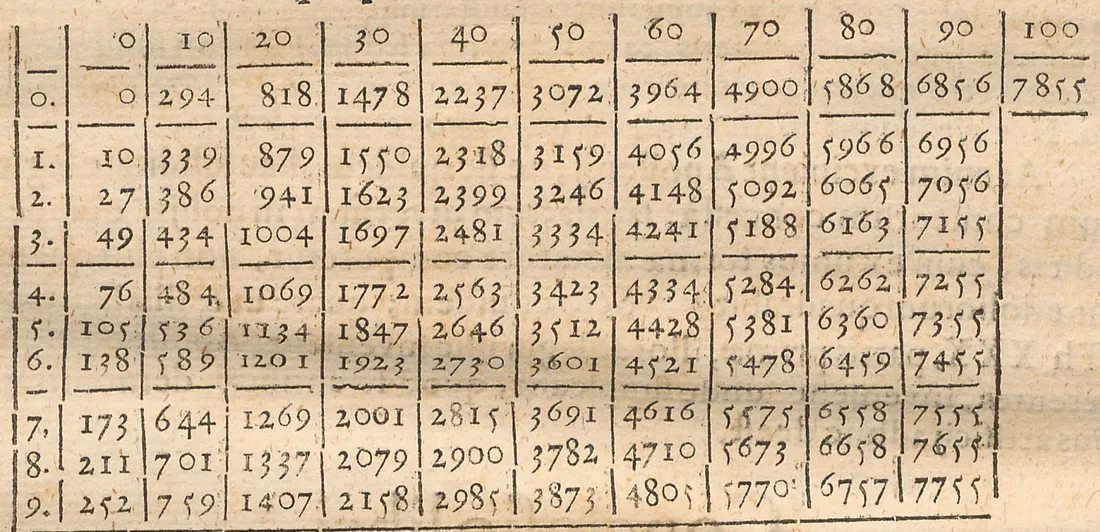
| 0 | 10 | 20 | 30 | 40 | 50 | 60 | 70 | 80 | 90 | 100 | |
|---|---|---|---|---|---|---|---|---|---|---|---|
| 0. | 0 | 294 | 818 | 1478 | 2237 | 3072 | 3964 | 4900 | 5868 | 6856 | 7855 |
| 1. | 10 | 339 | 879 | 1550 | 2318 | 3159 | 4056 | 4996 | 5966 | 6956 | |
| 2. | 27 | 386 | 941 | 1623 | 2399 | 3246 | 4148 | 5092 | 6065 | 7056 | |
| 3. | 49 | 434 | 1004 | 1697 | 2481 | 3334 | 4241 | 5188 | 6163 | 7155 | |
| 4. | 76 | 484 | 1069 | 1772 | 2563 | 3423 | 4334 | 5284 | 6262 | 7255 | |
| 5. | 105 | 536 | 1134 | 1847 | 2646 | 3512 | 4428 | 5381 | 6360 | 7355 | |
| 6. | 138 | 589 | 1201 | 1923 | 2730 | 3601 | 4521 | 5478 | 6459 | 7455 | |
| 7. | 173 | 644 | 1269 | 2001 | 2815 | 3691 | 4616 | 5575 | 6558 | 7555 | |
| 8. | 211 | 701 | 1337 | 2079 | 2900 | 3782 | 4710 | 5673 | 6658 | 7655 | |
| 9. | 252 | 759 | 1407 | 2158 | 2985 | 3873 | 4805 | 5770 | 6757 | 7755 |
Vsus tabellæ: segmenti sagittam seu sinum versum, seu quod est loco eius (ut in Ventre, altitudinem vacui, in orbe ligneo, altitudinem extantis partis supra liquorem) duabus Cyphris auctum, divide per semidiametrum circuli, cuius est segmentum: quod prodit, eius denarios quære in fronte, digitos in margine, & area communis exhibebit aream segmenti, qualium area totius illius circuli valet 15710; quæ si valeret minus aut plus, reductione aliqua opus esset ad communem dimensionem.
Use of the table: increase the sagitta or versed sine of the segment, or what stands in its place (as in the belly the height of the empty part, and in the wooden head the height of the part standing out above the liquid), by two zeros and divide by the radius of the circle whose segment it is: of what results, look for the tens along the top and the units in the margin, and the common cell will show the area of the segment, of parts of which the area of that whole circle is worth 15710; and if it were worth less or more, some reduction to a common measure would be needed.
Exemplum huius processus. Sit venter dolij CA altus 22, diameter orbis lignei GE 19, dimidia ergo differentia CO sesqui; Et OG 13 s. Vt autem CO sesqui ad OG 13 s. vel ut 3 ad 27; 1 ad 9. sic CL 11 ad LB 99, ergo KB est 85 s. Ponemus autem, aream circuli CA valere numerum Tabellæ, sc. 15710. Erit ergo ut quadratum 484 de CA 22, ad quadratum 361 de GE 19, sic area circuli CA 15710, ad aream circuli GE 11718. Duc 15710 in trientem de 99, prodit 518430, pro corpore CBA: duc 11718 in trientem de 85 s. prodit 333963, pro corpore GBE, quod aufer à CBA, restat 184467, pro Trunco CGEA. Iam pro diametro metatoris: ipsius LB 99, quadratum 9801, divide per CL 11, quotiens erit 891; cui adde 11, erit Metatoris diameter 902.
An example of this process. Let the belly of the barrel CA be 22 high, the diameter of the wooden head GE 19, and so half the difference CO 1½, and OG 13½. And as CO, 1½, to OG, 13½, or as 3 to 27, or 1 to 9, so is CL, 11, to LB, 99; so KB is 85½. And we shall suppose the area of the circle CA to be worth the number of the table, namely 15710. Then as the square 484 of CA, 22, is to the square 361 of GE, 19, so will the area of the circle CA, 15710, be to the area of the circle GE, 11718. Multiply 15710 by a third of 99: the result is 518430, for the body CBA; multiply 11718 by a third of 85½: the result is 333963, for the body GBE, which take from CBA: 184467 remains for the frustum CGEA. Now for the diameter of the Measurer: divide the square of LB, 99, which is 9801, by CL, 11: the quotient will be 891; add 11 to it, and the diameter of the Measurer will be 902.
Sit primò altitudo vacui minor quam CO, sc. 1. Vt igitur possis excerpere eius segmentum ex tabella, dic, CL 11 fit 100, quid 1, prodit 9 cum undecimâ: hæc immissa in tabellam, refert segmentum Ventris 256 ferè. Aufer deinde 1 à 902 diametro metatoris, restat 901, quod duc in 1. fit 901. cuius radix 30 +. Duc igitur eius tertiam 10 in 256. prodit soliditas segmenti 2560. Quia ergo altitudo vacui minor est, quàm CO: valet tota hæc soliditas. Et ut 184467 ad numerum mensurarum dolij, sic 2560 ad numerum mensurarum quæ defluxerunt. Sed nota, si operareris per simplicem segmenti altitudinem, quæ esset 11, tunc non multo plus tertia parte huius colligeres, quod est certò minus justo.
First let the height of the empty part be less than CO, namely 1. So that you may take its segment from the table, then, say: if CL, 11, becomes 100, what does 1 become? The result is 9 and one eleventh; and this, put into the table, gives the segment of the belly as about 256. Then take 1 from 902, the diameter of the Measurer: 901 remains, which multiply by 1: it makes 901, whose root is 30 +. Multiply its third, 10, by 256: the solidity of the segment results, 2560. Since, then, the height of the empty part is less than CO, this whole solidity holds. And as 184467 is to the number of measures in the barrel, so is 2560 to the number of measures that have run out. But note that if you worked with the simple height of the segment, which would be 11, you would gather not much more than a third of this, which is certainly less than the true amount.
Sit secundò altitudo vacui, maior quam CO, sc. 6. Vt autem 11. ad 100, sic 6 ad 54, cum 6 undecimis, Ergo in tabella quæsiti, 50 in fronte, & 4 cum appendice in margine, exhibent segmentum 3468. Aufer deinde 6 à 902 restat 896, quod duc in 6. fit 5376, cuius radix 74, minus sexta parte: duc huius tertiam partem in segmentum, prodit soliditas segmenti Conici 85351. sed ultra truncum conicum excurrentis, quia 6 superat CO. Ergo aufer CO sesqui à 6, restant 4 s. cum hoc quærendum segmentum orbis lignei. Si semidiameter eius 9 s. fit 100, tunc 4 s. fit 47 cum triente ferè: cum quo ex tabella eruitur segmentum 2843, qualium area orbis lignei, quæ minor est areâ ventris, habet 15710. Duc igitur 2843 in 361, quadratum de 19; factum divide per 484, quadratum de 22, prodit 2120 s. Et quia segmento toti, cuius erat numerus 6, tribuebatur 74, eius parti, cuius est numerus 4 s. tribuendū erit pro altitudine 55 s. cuius tertiam duc in 2120 s. fiet 3922 s. soliditas apicis, de segmento excurrentis in conum deficientem. Aufer hanc à segmento toto, restat segmentum Trunci conici 81429 s. vacuum. Rursum igitur, ut 184467 ad numerum mensurarum totius dolij, sic 81429, ad numerum exhaustarum mensurarum. Si per simplicem altitudinem segmenti operareris, ea fuisset non 74 sed 66, segmenti soliditas 76312, deficientis verò apicis 3640, soliditas ergò segmenti de Trunco 72672, certò minor justo. Nos igitur quod hic maius invenimus, pro vero amplectimur.
Second, let the height of the empty part be greater than CO, namely 6. And as 11 to 100, so 6 to 54 and six elevenths; so 50 sought along the top of the table, and 4 with the remainder in the margin, show the segment 3468. Then take 6 from 902: 896 remains, which multiply by 6: it makes 5376, whose root is 74 less a sixth: multiply a third of this by the segment: the solidity of the conical segment results, 85351, but of one running out beyond the conical frustum, because 6 exceeds CO. So take CO, 1½, from 6: 4½ remains; with this the segment of the wooden head must be sought. If its radius, 9½, becomes 100, then 4½ becomes about 47⅓; with which the segment 2843 is drawn from the table, of parts of which the area of the wooden head, which is less than the area of the belly, has 15710. So multiply 2843 by 361, the square of 19; divide the product by 484, the square of 22: the result is 2120½. And since to the whole segment, whose number was 6, 74 was assigned, to its part, whose number is 4½, there must be assigned for its height 55½, a third of which multiply by 2120½: it will make 3922½, the solidity of the tip of the segment running out into the missing cone. Take this from the whole segment: there remains the empty segment of the conical frustum, 81429½. Again, then, as 184467 to the number of measures of the whole barrel, so 81429 to the number of measures drawn off. If you worked with the simple height of the segment, it would have been not 74 but 66, the solidity of the segment 76312, and of the missing tip 3640, so the solidity of the segment of the frustum 72672, certainly less than the true amount. So we take what we have found greater here as the truth.
At enim excipient Apollonij; ne sic quidem, hac soliditate segmentorum conicorum concessà, satisfactum diversitati in dolijs; quippe hæc soliditas, cum ex unius formæ metatore computetur, non plus quàm uni figuræ doliorum quadrabit? Scio equidem; quare ut & illis satisfaciam, ad Th. XXX, partis primæ, illos ablego; illic invenient (Apollonij inquam, quærentes, invenient) unde suppleant, quod scientificæ demonstrationi huius artificij adhuc deest.
But the Apolloniuses will object: not even so, with this solidity of conical segments granted, has the variety in barrels been satisfied; since this solidity, being computed from a Measurer of one form, will fit no more than one shape of barrel? I know it; so, to satisfy them too, I send them off to Theorem XXX of the first part; there they will find (the Apolloniuses, I mean, if they seek, will find) the means to supply what is still lacking to a scientific proof of this device.
Conclusio libri.
Conclusion of the book.
Constitueram errores aliorum, cum circa doliorum integrorum, tum etiam circa partis vacuæ dimensiones, detegere, fundamentaque Elenchorum monstrare in Theorematibus huius libri. At cùm una veritas sufficiat vel tacens, contra omnes errorum strepitus; & jam antea liber, vix decem initio Theorematum, præter opinionem excreverit: habeant igitur sibi suos errores, quicunque ijs delectantur; fruamur nos nostris commodis; & ut fruendi materia, salvis corporis animique bonis, affatim suppetat, precabimur:
I had resolved to uncover the errors of others, both about the measurement of whole barrels and about that of the empty part, and to show the grounds of the refutations in the theorems of this book. But since one truth suffices, even silent, against all the din of errors, and the book has already grown beyond expectation, from barely ten theorems at the start: let those who delight in their errors keep them; let us enjoy our own advantages; and we shall pray that the means of enjoying them, with the goods of body and mind kept safe, may be abundantly supplied:
Et cùm pocula mille mensi erimus,
Conturbabimus illa, ne sciamus.
And when we have measured a thousand cups,
We’ll muddle the count, so we shan’t know.
FINIS.
THE END.