Part II: The Solid Geometry of the Austrian Barrel in Particular
Nova stereometria doliorum vinariorum 1615, p. 61–100
Part of Nova stereometria doliorum vinariorum
Johannes Kepler, “Part II: The Solid Geometry of the Austrian Barrel in Particular,” in Nova stereometria doliorum vinariorum, inprimis Austriaci, figurae omnium aptissimae; et usus in eo virgae cubicae compendiosissimus et plane singularis. Accessit stereometriae Archimedeae supplementum (Linz: Johannes Planck, 1615), 61–100, available online https://doi.org/10.3931/e-rara-11051.
Kepler shows that of all cylinders with the same diagonal the largest has its diameter to its height as the side of a tetrahedron to the side of a cube, that the Austrian coopers' rule comes close to it, and that near this maximum small departures in shape barely change the volume, which is why the gauger's single slanting rod can be trusted for Austrian barrels. [This is an automatically generated summary]
Source: The second part of Kepler's Nova stereometria doliorum vinariorum (Linz: Johannes Planck, at the author's expense, 1615).
Transcribed from: the page images of the copy in the ETH-Bibliothek, Zürich (Rar 356: 1 q), on e-rara.
Spelling, accents and italics as printed, including v for u. Long s is given as s, ligatures other than æ and œ are resolved, the abbreviation q; is written out as que, and a tilde for a following m or n is written out. Line-end hyphens are rejoined; running heads, signatures and catchwords are not marked. Words in small capitals, and those following a large initial, are given in ordinary type. Kepler’s marginal notes are given as footnotes. Each diagram is shown as a photograph of the printed woodcut, from the same scan, where it stands on the page. The book has no printed page numbers; the page numbers given here count from the title page.
English translation of the 1615 Linz printing, made for Plain Old Text. Each paragraph translates the corresponding paragraph of the original. Kepler’s letters in the diagrams and his figures are kept as printed, including his slips; his marginal notes are given as footnotes. A ratio Kepler calls “double” (dupla) of another is its square, and a “half” ratio (semidupla, subsemidupla) is a square root: so “diameter to height in the ratio semidupla” is √2 : 1. The “conjugate” cylinders and frustums are defined in this part, before Theorem VI.
Source
-
Go to source
Text
- View as markdown
- View on GitHub
-
Submit a correction
Email your correction to plainoldtext@vjbe.net.
This English translation was machine translated and has not been checked by a Latinist.
Stereom. Dolii Austriaci II. Pars. Stereometria Dolii Austriaci in specie.
Solid Geometry of the Austrian Barrel, Part II. The solid geometry of the Austrian barrel in particular.
Ad quod genus figurarum præmissarum pertineat figura Dolij Austriaci.
To which kind of the foregoing figures the shape of the Austrian barrel belongs.
Præmissis igitur generalibus, quæ de stereometria regularium tam ex Archimede quam ex proprijs inventionibus, ad demonstrationes intelligendas vtilia videbantur, jam propius ad propositum venio, multaque ab Archimede itidem non tacta, de corporibus in eadem Sphæra Parallelepipedis, eorumque Cylindris & Conis, sed quæ dolij Austriaci naturam vnicè attinere videbantur, sub titulo Stereometriæ Dolij Austriaci infero, & præmisso Archimedis supplemento adjungo. Dolij namque figura est Cylinder ventricosus; seu accuratiùs loquendo, dolium intelligitur diremptum in duos veluti Truncos duorum Conorum, quibus vertices in contraria vergentes, intelliguntur præsecti ligneis dolij Orbibus, Basis verò communis, divisionem Conorum faciens, est circulus per dolij ventrem amplissimus.
Having set out, then, the general matters on the solid geometry of regular figures, both from Archimedes and from my own findings, that seemed useful for understanding the proofs, I now come closer to my purpose; and many things likewise untouched by Archimedes, on parallelepipeds in the same sphere and their cylinders and cones, but which seemed to concern the nature of the Austrian barrel alone, I bring in under the title of the Solid Geometry of the Austrian Barrel, and join them to the foregoing supplement to Archimedes. For the shape of a barrel is a cylinder with a belly; or, to speak more exactly, a barrel is understood as divided into two frustums, as it were, of two cones, whose vertices, pointing in opposite directions, are understood to be cut off by the wooden heads of the barrel, while their common base, dividing the cones, is the widest circle through the barrel’s belly.
In Schemate XVIII. hic subjuncto, Cylinder intelligitur HEGF, Conus ABC, & alter huic æqualis ab AC versus ND: vertices præsecti EBG, & æqualis illi alter ab HF, versus ND. Trunci AEGC, AHFC, communis basis AC.
In Schema XVIII, given here, the cylinder is understood as HEGF; the cone as ABC, and another equal to it from AC towards ND; the vertices cut off as EBG, and another equal to it from HF towards ND; the frustums as AEGC, AHFC, with the common base AC.
Quæ igitur de Cylindris & de Conorum truncis vera sunt, eadem etiam ad figuram dolii possunt applicari, quippe quæ parum à Cylindro, minusque à trunco conico abit, dum asserum conniventia, hic per rectam CRF intellecta, extrorsum versus, in buccositatem nonnullam flectitur.
What is true of cylinders and of frustums of cones, then, can also be applied to the shape of a barrel, since it departs little from a cylinder and less from a conical frustum, while the leaning together of the staves, here understood by the straight line CRF, bends outwards into some bulge.
Accuratissimè, omnis dolij figura, est medius truncus, vel Citrii ex circuli segmento, vel Pruni ex verticali parte Ellipsis, vel Fusi Parabolici, plerumque verò Hyperbolici, præsectis utrinque verticibus æqualibus. Ratio cur Fusum Hyperbolicum dicam, est hæc; quia dolia buccositatem plerunque recipiunt in ventrem medium: versus extrema & orbes utrinque ligneos, magis ad rectitudinem conicam accedunt, ut circuli lignei facilius trudi adstringique adigendo possint. Hoc verò facit & Hyperbola, & nata ab illa, Conoides & Fusum, ut brachia eius à medio flexu sensim degenerent in rectitudinem Asymptôton. Facit idem ex parte & Fusum Parabolicum & Prunum Ellipticum, sed evidentissimè Hyperbolicum Fusum: Prunum verò Ellipticum minus minusque; nec omne, sed gracile tantum, & quod à segmento verticali Ellipsis est, cuius axis post truncationem, ad Focum usque non pertingat: quæ cautio etiam in Parabolico Fuso locum habet. Oliva verò, ex Ellipsis segmento inter vertices medio creata, contrarium facit, nam versus extrema magis flectitur, quàm in medio, quod abhorret à dolij figura. Etsi non negaverim propter insensibilem differentiam istarum figurarum, esse dolio quandoque etiam ex Olivæ trunco figuram; at non studio artificis, sed aberratione manus constitutam. Nunquam vero ullum dolium constitutum puto ex ventre Sphæroidis Archimedei; quam, ut veræ proximam (nondum notis aliis, quarum genesin supra docui) Clavius subiecit: paratus tamen interim (verba Clavij) si quis accuratiorem invenerit, eam libenti animo & grato acceptare. Nam Sphæroidis longi, quod in medio justam & dolijs aptam habeat buccositatē, flexura versus truncatos vertices nimia est, nec ulla vincula in ea possent diu hærere. Sin autem sumseris medium ventrem sphæroidis valde gracilis; minues quidem hoc incommodum flexuræ nimiæ in extremitatibus dolij, at vicissim ventrem dolio nullum permittis, ac si ex puro puto Cylindro illud construeres.
Most exactly, the shape of every barrel is the middle frustum either of a lemon from a segment of a circle, or of a plum from a vertical part of an ellipse, or of a parabolic spindle, but mostly of a hyperbolic one, with equal vertices cut off at both ends. The reason why I say a hyperbolic spindle is this: because barrels mostly take their bulge in the middle of the belly, while towards the ends and the wooden heads on both sides they come nearer to conical straightness, so that the hoops can more easily be pushed and tightened by driving. And the hyperbola does this, and the conoid and spindle born from it, so that its arms gradually degenerate from the middle bend into the straightness of the asymptotes. The parabolic spindle and the elliptical plum do the same in part, but the hyperbolic spindle most plainly; the elliptical plum less and less, and not every one, but only a slender one, from a vertical segment of an ellipse whose axis, after cutting, does not reach the focus; and this caution also has place in the parabolic spindle. But the olive, created from the middle segment of an ellipse between its vertices, does the opposite: for it bends more towards the ends than in the middle, which is foreign to the shape of a barrel. Though I would not deny that, because of the imperceptible difference between these figures, a barrel sometimes has the shape of a frustum of an olive too; but made not by the cooper’s design but by a slip of the hand. But I think no barrel has ever been made from the belly of Archimedes’ spheroid, which Clavius put forward as nearest the truth (the others, whose generation I taught above, being not yet known), though ready meanwhile (Clavius’s words) to accept gladly and gratefully a more exact one if anyone should find it. For the long spheroid, which has in the middle a proper bulge suited to barrels, bends too much towards the cut-off vertices, and no hoops could hold on it for long. But if you take the middle belly of a very slender spheroid, you will indeed lessen this trouble of too much bending at the ends of the barrel, but in turn you allow the barrel no belly, as if you built it from a pure and simple cylinder.
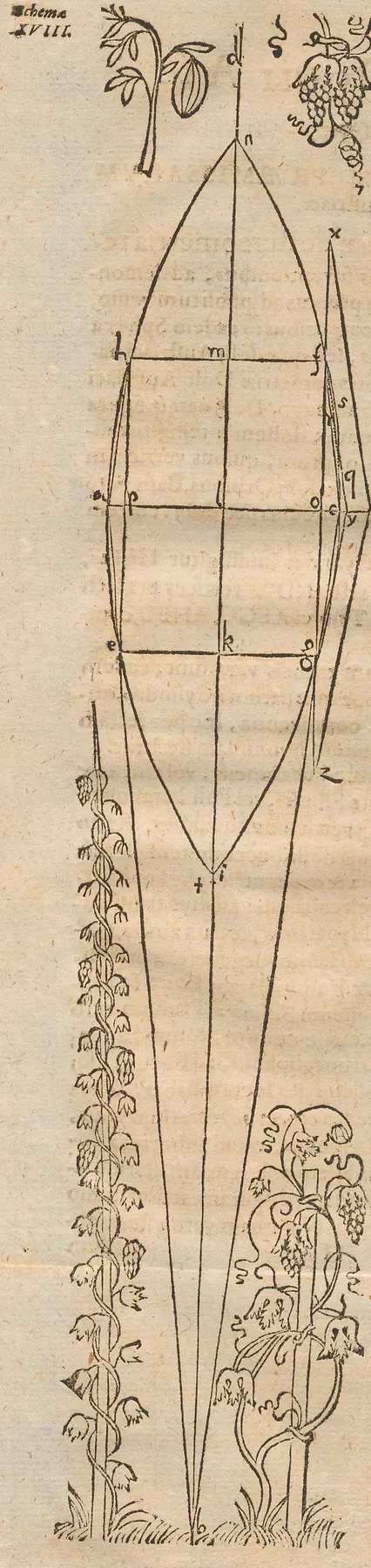
In hac igitur figura, duo arcus HAE, FCG, circuli cuius diameter æqualis ipsi BT, describunt truncatum Citrium, cuius vertices truncati sunt HNF, EIG. Linea verò punctis notata, inter rectam FRC & arcum FSC, Fusum denotat Hyperbolicum, cuius Hyperboles vertex C, centrum V, Asymptoti VX, VZ. quarum rectitudinem Hyperbola CF, versus F magis magisque affectat, & hîc à contingente sua FQY, secante arcum FSC in Q, difficulter distinguitur.
In this figure, then, the two arcs HAE, FCG, of a circle whose diameter equals BT, describe a cut lemon, whose cut-off vertices are HNF, EIG. The dotted line, between the straight line FRC and the arc FSC, marks a hyperbolic spindle, whose hyperbola has its vertex at C, centre V and asymptotes VX, VZ, whose straightness the hyperbola CF approaches more and more towards F, and here it is hard to tell apart from its tangent FQY, which cuts the arc FSC at Q.
Quâ ratione quis Virgam mensoriam falsitatis arguere possit; & quomodo fides ejus asseratur.
How one might convict the gauging rod of falsity, and how its reliability is established.
Igitur ut ad exordium disquisitionis huius revertar, Elenchus meus Virgæ Mensoriæ primum erat hic, quod eadem eius longitudo AF dissimilibus figuris doliorum competeret, quarum tamen non essent æqua spacia.
To return, then, to the beginning of this inquiry: my first objection to the gauging rod was this, that the same length AF of it would fit barrels of unlike shapes, whose spaces would nevertheless not be equal.
Vt hanc rem in plano demonstrarem: visum est, pro Cylindri corpore, assumere Parallelogrammum, quo Cylinder per axem secatur. Nam quæ de Cylindro vera sunt, ea etiam Trunco conico AHFC, eiusque Trapezio, quod illum per axem secat, sc. de plano AHFC, in quod etiam AF virga mensoria incidit, applicari possunt. Nam planum hoc cum cylindri corpore & crescere & minui videbatur. Sit igitur hac de re
To show this in a plane, it seemed best to take, in place of the body of the cylinder, the parallelogram by which the cylinder is cut through its axis. For what is true of the cylinder can also be applied to the conical frustum AHFC and its trapezium that cuts it through the axis, namely to the plane AHFC, in which the gauging rod AF also lies. For this plane seemed to grow and shrink with the body of the cylinder. Let there be, then, on this matter
Theorema I.
Theorem I.
Cylindrorum rectorum sectiones per Axem, quæ diagonios habent æquales, nisi proportio Diametri basis ad altitudinem fuerit eadem aut permutata, inæquales habent areas: estque inter has illius area maxima, quæ secat Cylindrum æquealtum diametro suę basis.
Sections through the axis of right cylinders that have equal diagonals have unequal areas, unless the ratio of the diameter of the base to the height is the same or reversed; and among them the greatest area is that of the section of the cylinder whose height equals the diameter of its base.
Esto Baseos Cylindraceæ diameter CI, altitudo cylindri IA. æqualis Diametro Basis, repræsentans jam dimidium Dolij Vinarij; sectio Cylindri sit AICO Rectangulum, quod hic est quadratum, linea diagonios AC, repræsentans Virgam mensoriam ab infusorio Orificio A, ad orbis lignei IC, calcem C, transversim descendens. Et quia cylinder præsupponitur Rectus, erit CIA angulus rectus. Bisecetur AC in N, & centro N, spacio NA scribatur semicirculus AIC, qui per I transibit, quia AIC rectus. Et quia AI, IC æquales, erunt igitur arcus AI, IC, quadrantes circuli; & connexis punctis N, I, anguli INA, INC erunt recti, & IN perpendicularis in AC.
Let the diameter of the cylinder’s base be CI, and the height of the cylinder IA, equal to the diameter of the base, now representing half a wine barrel; let the section of the cylinder be the rectangle AICO, which here is a square, with the diagonal line AC representing the gauging rod going down slantwise from the filling-hole A to the foot C of the wooden head IC. And since the cylinder is supposed right, CIA will be a right angle. Let AC be bisected at N, and about the centre N with radius NA let the semicircle AIC be described, which will pass through I, because AIC is a right angle. And since AI, IC are equal, the arcs AI, IC will be quadrants of the circle; and when the points N, I are joined, the angles INA, INC will be right angles, and IN perpendicular to AC.
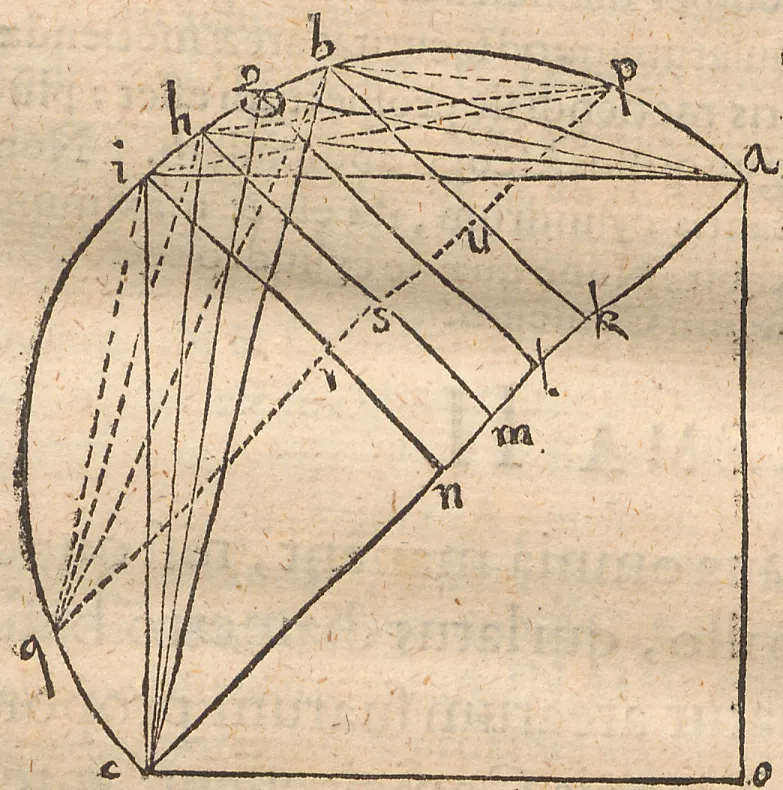
Eligantur jam puncta quæcunque unius quadrantis: & sint verbi gratia H, B, connectanturque cum terminis diametri A. C. lineis HA, HC, BA, BC: sic, ut manente eadem diagonio AC, quadratum AICO, vel eius pars dimidia, sc. triangulum AIC, mutetur in alias figuras AHC, ABC, angulo I manente recto, etiam apud H & B, quippe omnibus in semicirculo eodem constitutis; ut ita AHC, ABC, sint iterum rectorum Cylindrorum sectiones dimidiatæ, sintque jam diametri Basium CH, CB, altitudines Cylindrorum HA, BA.
Now let any points of one quadrant be chosen, say H and B, and let them be joined to the ends A, C of the diameter by the lines HA, HC, BA, BC: so that, the same diagonal AC remaining, the square AICO, or its half, the triangle AIC, is changed into other figures AHC, ABC, the angle staying right at H and B as at I, since all lie in the same semicircle; so that AHC, ABC are again the halves of sections of right cylinders, and the diameters of their bases are now CH, CB and the heights of the cylinders HA, BA.
Dico aream AIC esse maximam, AHC minorem, ABC (puncto B remotiori ab I quadrantis termino) iterum minorem.
I say that the area AIC is the greatest, AHC less, and ABC (the point B being further from I, the end of the quadrant) less again.
Demittantur enim à punctis H. B. perpendiculares in diametrum AC, quæ sint HM, BK. Igitur per demonstrata Euclidis, area cuiusque trianguli æquat Rectangulum sub dimidia basi AC, & altitudine triangulorum, sc. NI, MH, KB. Quare ut IN ad HM & BK, sic AIC area ad AHC, & ABC areas. At in quadrante AI, omnes Rectæ, parallelæ semidiametro IN, vt sunt HM BK, sunt minores ipsa semidiametro IN, & minor BK, remotior ab illa, quam HM propinquior illi. Minor igitur est area AHC, quam AIC, iterumque minor ABC, quam AHC. Rectangula igitur horum triangulorum dupla, sunt eodem ordine maiora.
For let perpendiculars HM, BK be let fall from the points H, B onto the diameter AC. Then, by what is proved in Euclid, the area of each triangle equals the rectangle under half the base AC and the height of the triangle, namely NI, MH, KB. So as IN is to HM and BK, so is the area AIC to the areas AHC and ABC. But in the quadrant AI all straight lines parallel to the radius IN, such as HM, BK, are less than the radius IN itself, and BK, further from it, less than HM, nearer to it. The area AHC, then, is less than AIC, and ABC less again than AHC. And so the rectangles that are twice these triangles are greater in the same order.
Dico etiam Cylindris, qui proportionem altitudinum ad diametros Basium habent permutatam, esse sectiones æquales.
I say also that cylinders that have the ratio of height to base diameter reversed have equal sections.
Esto enim AB diameter Basis, & BC altitudo Cylindri: patet, triangulum ABC, quod est dimidia sectio Cylindri per axem, manere idem quod antea, cum BC esset diameter Basis, & AB altitudo, eoque proportio harum linearum permutata.
For let AB be the diameter of the base and BC the height of the cylinder: it is plain that the triangle ABC, which is half the section of the cylinder through the axis, stays the same as before, when BC was the diameter of the base and AB the height, and so the ratio of these lines reversed.
Porrò non celandus est error in quem me conjecit primo die supina Theorematis huius consideratio. Nam hæc commemoratio admonebit lectorem, ut à similibus sibi caveat etiam alibi. Sic enim sum ratiocinatus perperam: Cùm arearum similium proportio sit dupla proportionis laterum, Corporum verò similium tripla: fore etiam in dissimilibus, eâdem tamen diagonio AC utentibus, corporum proportionem, proportionis arearum linearumque semper analogam. Hoc verò falsum est: et ego si vietoribus id consilij dedissem, ut semper diametrum orbis lignei constituerent subduplam longitudinis Tabularum; quod securitas areæ metiendæ requirit, ac si etiam securitati corporis metiendi sic prospectum esset: plurimum ipsorum arti nocuissem, longiusque illos à scopo abduxissem. Non enim ubi maxima est area plani, secantis cylindrum, ibi est & maximum cylindri corpus. Sed id postea apparebit; Nunc quæ de cylindro recto sunt dicta, accommodabo etiam ad Truncum Conicum.
Further, I must not hide the error into which a careless consideration of this theorem threw me on the first day. For mentioning it will warn the reader to beware of similar things elsewhere too. For I reasoned wrongly thus: since the ratio of similar areas is the square of the ratio of the sides, and that of similar bodies the cube, so also in dissimilar figures using the same diagonal AC the ratio of the bodies would always be analogous to the ratio of the areas and lines. But this is false; and if I had advised the coopers always to make the diameter of the wooden head half the length of the staves, as the safety of measuring the area requires, as if the safety of measuring the body were so provided for too, I should have done their craft great harm and led them further from the mark. For where the area of the plane cutting the cylinder is greatest, there the body of the cylinder is not also greatest. But that will appear later. Now I shall apply what has been said of the right cylinder to the conical frustum too.
Theorema II.
Theorem II.
In Truncis Conicis reliqua omnia manent, nisi quod inter truncos proximos ab illo, qui latus diametro basis habuerit æquale, plus variatur arearum suarum proportio, quàm si Cylindri pro Truncis Conicis essent, inter truncos remotiores minus.
In conical frustums everything else remains, except that among the frustums next to the one whose side equals the diameter of its base the ratio of their areas varies more than if they were cylinders instead of conical frustums, and among those further away less.
Cùm enim angulus comprehensus à latere Trunci, & à diametro basis minoris, sit maior Recto, competet non in semicirculum, sed in arcum semicirculo minorem. Ducatur igitur ipsi AC parallela PQ, secans semicirculum in punctis P, Q, & perpendiculares IN, HM, BK, in punctis R. S. V. & connectantur puncta I. H. B. cùm punctis P. Q. Repræsentat igitur jam PQ Virgam mensoriam, QI, QH, QB diametrum basis detruncati Coni; IP, HP, BP, latus trunci, dimidia longitudo Tabularum in dolijs: & anguli QIP, QHP, QBP obtusi & æquales inter se, quippe in eodem segmento PQI stantes, causam præbent æqualem per has omnes figuras, variationis eius, quam hic explicandam sumpsi.
For since the angle contained by the side of the frustum and the diameter of the lesser base is greater than a right angle, it will fit not in a semicircle but in an arc less than a semicircle. Let PQ be drawn parallel to AC, then, cutting the semicircle at the points P, Q, and the perpendiculars IN, HM, BK at the points R, S, V; and let the points I, H, B be joined with the points P, Q. PQ now represents the gauging rod; QI, QH, QB the diameter of the base of the cut cone; IP, HP, BP the side of the frustum, half the length of the staves in barrels; and the angles QIP, QHP, QBP, obtuse and equal to each other, since they stand in the same segment PQI, give an equal cause through all these figures for the variation I have undertaken to explain here.
Rursum igitur area PIQ, est ad aream PHQ & PBQ, ut IR, ad HS, & BV: cùm igitur ab inæqualibus IN, HM, ablata sint æqualia RN & SM: residua IR & HS erunt in proportione maiori: magis igitur est sensibilis differentia arearum PIQ, PHQ, quam arearū AIC, AGC. Contra decrementa perpendicularium sunt maxima apud A: minora igitur erunt apud P. Et apud P evanescunt perpendiculares Truncorum, apud A verò evanescunt perpendiculares Cylindrorū: minori igitur proportione decrescunt areæ PBQ, propiores fini P: quàm areæ ABC, propiores fini A. At prius propiores initio I, maiori proportione decrescebant PHQ, quam AHC. Hoc theorema præcipuè notabile est propter hallucinationem aliam diuturniorem, circa comparationem Truncorum conicorum inter se, cuius infra fiet mentio.
Again, then, the area PIQ is to the areas PHQ and PBQ as IR to HS and BV; and since equal amounts RN and SM have been taken from the unequal IN, HM, the remainders IR and HS will be in a greater ratio: the difference of the areas PIQ, PHQ is therefore more noticeable than that of the areas AIC, AGC. On the other hand, the decreases of the perpendiculars are greatest at A, so they will be less at P. And at P the perpendiculars of the frustums vanish, but at A those of the cylinders: the areas PBQ near the end P therefore decrease in a smaller ratio than the areas ABC near the end A. But earlier, near the beginning I, PHQ decreased in a greater ratio than AHC. This theorem is especially notable because of another, longer-lasting delusion about comparing conical frustums with one another, which will be mentioned below.
Porrò elenchum hallucinationis dictæ continet sequens
Further, the refutation of the said delusion is contained in the following
Theorema III.
Theorem III.
Cylindrorum Rectorum, quorum sectiones habent eandem Diagonium, Corpora non habent inter se proportiones analogas proportionibus Arearum, quibus secantur per Axem: nec cujus est maxima sectrix area, eiusdem & corpus maximum est.
The bodies of right cylinders whose sections have the same diagonal do not have to each other ratios analogous to the ratios of the areas by which they are cut through the axis; nor is the body greatest of the one whose cutting area is greatest.
In Schemate priori, cum AIC sit dimidium areæ IO, secantis Cylindrum IO per axem, IC Diametrum Basis: ductâ igitur AICO area in IC Diametrum Basis, creatur parallelepipedum Rectangulum, quod Cylindrum stringit. Vt igitur 14 ad 11, sic hoc parallelepipedum ad cylindri sui corpus Per III. præmissæ stereometriæ Regularium. Ergo in qua figura, ex ijs, quæ habent eandem diagonion AC, maximum est hoc parallelepipedum, ibi & Cylinder est maximus. At in figura cuius AIC est dimidia sectio, non est maximum hoc parallelepipedum, quantumvis area sectrix AICO sit maxima: quod sic demonstro.
In the previous schema, since AIC is half the area IO cutting the cylinder IO through the axis, and IC is the diameter of the base: multiplying the area AICO by IC, the diameter of the base, creates the rectangular parallelepiped that encloses the cylinder. As 14 to 11, then, so is this parallelepiped to the body of its cylinder, by III of the foregoing solid geometry of regular figures. So in whichever figure, of those with the same diagonal AC, this parallelepiped is greatest, there the cylinder too is greatest. But in the figure of which AIC is half the section this parallelepiped is not greatest, however much the cutting area AICO is greatest; which I prove thus.
Sit in quadrante IA punctum H, proximum puncto I, quippe ad finem Quadrantis. Cùm ergo AHC sit alia figura, quam AIC, & habeat eandem cum illa diagonion AC, sint vero AIC, AHC areæ ad se in vicem, vt perpendiculares earum IN, HM: erunt in fine quadrantis inter se in minima proportione, & proximè æquales, quia etiam lineæ IN, HM intervallo certo inter se remotæ, in minima ad invicem sunt proportione; quæ proportio inter easdem semper evadit maior, quo propius illæ ad A initium quadrantis, eodem inter ipsas intervallo manente, accesserint.
Let there be in the quadrant IA a point H next to the point I, that is, at the end of the quadrant. Since AHC is a different figure from AIC and has the same diagonal AC, and the areas AIC, AHC are to each other as their perpendiculars IN, HM, they will be in the least ratio to each other at the end of the quadrant, and very nearly equal, because the lines IN, HM, a fixed distance apart, are also in the least ratio to each other; and this ratio between them always becomes greater the nearer they come to A, the beginning of the quadrant, the same distance between them remaining.
Atqui, ut corpus creetur, lineæ CI, CH ducendæ sunt in areas AIC, AHC, & per æquipollentiam, ut Rectangulum sub NI, IC, ad Rectangulum sub MH, HC, sic corpus Parallelepipedi AICI, ad corpus AHCH; atqui maior est proportio HC ad CI, quam IN ad HM. Nam CI subtendit quadrantem CH, paulo plus, & ipsarum dimidia sunt perpendiculares dimidij quadrantis & paulò plus: illæ verò non sunt in minima inter se proportione, quippe quæ in medio quadrantis maior est quàm in fine, eodem utrinque perpendicularium intervallo supposito. Ergò existente eodem perpendicularium intervallo, quod sit dimidium arcus HI, perpendiculares circa finem quadrantis I, sunt in minore proportione, quam dimidiæ CI, CH circa medium quadrantis, distantes etiam dimidio arcus HI. Et cum dimidiarū CI, CH differentia sit maior; quàm perpendicularium ad I, quæ dimidio arcus HI distant, totarum igitur CI CH differentia, prioris duplex, erit maior quàm perpendicularium IN, HM, toto arcu HI distantium. Ita conficitur, maiorem esse differentiam inter IC & CH, quam inter HM & IN. Itaque etsi HM secundæ figuræ est paulo minor quam IN primæ: vicissim tamen CH secundæ figuræ est multo maior quàm CI primæ. Majus est igitur Rectangulum MHC, quàm NIC, & sic maior Cylinder, eiusque parallelepipedum AHCH, quam AICI: cùm è contrario ipsius Cylindri AHCH, area sectrix AHC, minor antea fuerit, quam AIC. Non est igitur proportio Corporum AICI, AHCH analoga proportioni arearum AIC, AHC. Et AIC quidem est maxima arearum super eadem diagonio, corpus verò AICI non est maximum, sed AHCH est eo maius.
But to create the body, the lines CI, CH must be multiplied by the areas AIC, AHC; and equivalently, as the rectangle under NI, IC is to the rectangle under MH, HC, so is the body of the parallelepiped AICI to the body AHCH. But the ratio of HC to CI is greater than that of IN to HM. For CI subtends the quadrant CH, a little more, and their halves are the perpendiculars of half the quadrant, and a little more; and these are not in the least ratio to each other, since that is greater in the middle of the quadrant than at the end, the same distance of the perpendiculars being supposed on both sides. So, the distance of the perpendiculars being the same, namely half the arc HI, the perpendiculars about the end of the quadrant I are in a smaller ratio than the halves of CI, CH about the middle of the quadrant, also half the arc HI apart. And since the difference of the halves of CI, CH is greater than that of the perpendiculars at I, which are half the arc HI apart, the difference of the whole CI, CH, twice the former, will be greater than that of the perpendiculars IN, HM, the whole arc HI apart. So it follows that the difference between IC and CH is greater than between HM and IN. So although HM of the second figure is a little less than IN of the first, CH of the second figure in turn is much greater than CI of the first. The rectangle MHC, then, is greater than NIC, and so the cylinder and its parallelepiped AHCH greater than AICI; whereas, on the contrary, the cutting area AHC of the cylinder AHCH was before less than AIC. The ratio of the bodies AICI, AHCH, therefore, is not analogous to the ratio of the areas AIC, AHC. And AIC is indeed the greatest of the areas on the same diagonal, but the body AICI is not the greatest; AHCH is greater than it.
Praxis & per eam successus.
Practice, and the success it brought.
Cùm corpora ex I adhuc crescant versus H, inquisivi logisticè, ubi esset corpus maximum; non enim crescit corpus continuè usque in A, sed in vicinia ipsius A, rursum attenuatur, & unâ cum area ABC, tandem in A, in nihilum redigitur, quando altitudo Cylindri, analogicè loquendo, punctum est, sc: A, diameter verò Basis AC, cioncidens cum diagonio.
Since the bodies still grow from I towards H, I inquired by calculation where the greatest body would be; for the body does not grow continually all the way to A, but in the neighbourhood of A it thins again, and together with the area ABC is finally reduced to nothing at A, when the height of the cylinder, to speak by analogy, is a point, namely A, and the diameter of the base AC coincides with the diagonal.
Processus hic fuit: sinum arcus AH. AB multiplicavi in sinum dimidij arcus HC, BC, per omnes quadrantis gradus ordine.
The process was this: I multiplied the sine of the arc AH, AB by the sine of half the arc HC, BC, through all the degrees of the quadrant in order.
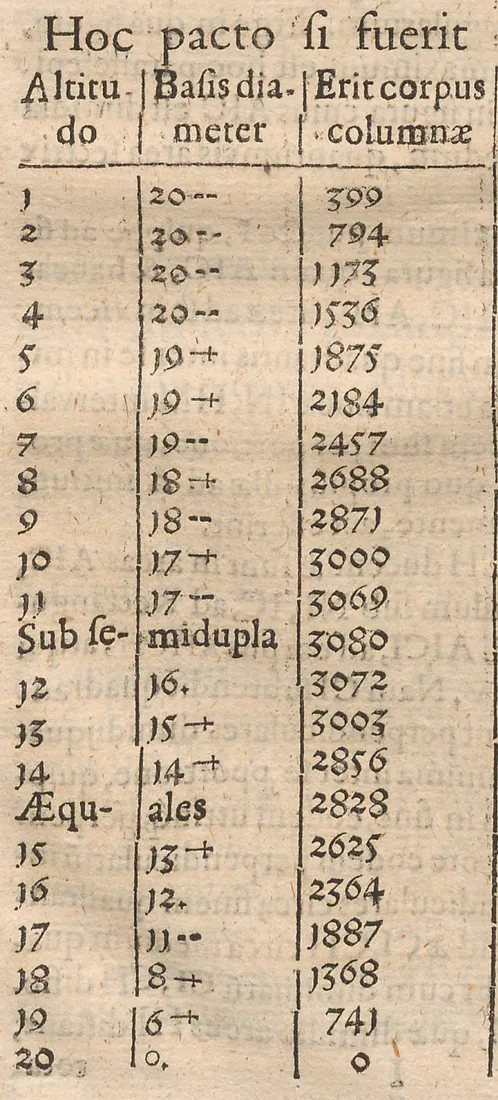
Cùm autem sit tædiosa multiplicatio sinuum, accipe processum breviorem: sit diagonios 20, quadratum 400, sit altitudo AG 1, quadratum 1, hoc ablato à 400, restat quadratum ipsius GC 399: quod duc in altitudinem, venit 399, pro corpore huius columnæ, in comparatione cum cæteris.
But since multiplying sines is tedious, take a shorter process: let the diagonal be 20, its square 400; let the height AG be 1, its square 1; taking this from 400 leaves the square of GC, 399, which multiply by the height: the result, 399, is for the body of this column, in comparison with the others.
Hoc pacto si fuerit
In this way, if there be
| Altitudo | Basis diameter | Erit corpus columnæ |
|---|---|---|
| 1 | 20 − | 399 |
| 2 | 20 − | 794 |
| 3 | 20 − | 1173 |
| 4 | 20 − | 1536 |
| 5 | 19 + | 1875 |
| 6 | 19 + | 2184 |
| 7 | 19 − | 2457 |
| 8 | 18 + | 2688 |
| 9 | 18 − | 2871 |
| 10 | 17 + | 3000 |
| 11 | 17 − | 3069 |
| Sub se- | midupla | 3080 |
| 12 | 16. | 3072 |
| 13 | 15 + | 3003 |
| 14 | 14 + | 2856 |
| Æqu- | ales | 2828 |
| 15 | 13 + | 2625 |
| 16 | 12. | 2364 |
| 17 | 11 − | 1887 |
| 18 | 8 + | 1368 |
| 19 | 6 + | 741 |
| 20 | 0. | 0 |
| Height | Diameter of the base | The body of the column will be |
|---|---|---|
| 1 | 20 − | 399 |
| 2 | 20 − | 794 |
| 3 | 20 − | 1173 |
| 4 | 20 − | 1536 |
| 5 | 19 + | 1875 |
| 6 | 19 + | 2184 |
| 7 | 19 − | 2457 |
| 8 | 18 + | 2688 |
| 9 | 18 − | 2871 |
| 10 | 17 + | 3000 |
| 11 | 17 − | 3069 |
| In the ratio | 1 : √2 | 3080 |
| 12 | 16. | 3072 |
| 13 | 15 + | 3003 |
| 14 | 14 + | 2856 |
| Eq- | ual | 2828 |
| 15 | 13 + | 2625 |
| 16 | 12. | 2364 |
| 17 | 11 − | 1887 |
| 18 | 8 + | 1368 |
| 19 | 6 + | 741 |
| 20 | 0. | 0 |
Sed in priori processu attendi, ubi primùm consisterent quotientum, seu corporum, incrementa; ab eoque termino iterum decrescerent; illos igitur sinus notavi. Quos cùm interpositâ vna nocte repeterem sub aspectum; apparavit, G punctum circumferentiæ, apud quod maximum corpus terminabatur, connexum cum AC, præbere GA, latus cubi in Sphæram AIC inscripti, & GC, diagonium plani cubici, seu latus Tetraedri in eadem. Id igitur sequentibus Theorematibus demonstrabitur. Et nota quod hisce Theorematibus tradatur
But in the first process I noted where the increases of the quotients, that is, of the bodies, first stopped, and from that limit decreased again; and I noted those sines. When I looked at them again after a night between, it appeared that G, the point of the circumference at which the greatest body ended, joined to A and C, gives GA, the side of the cube inscribed in the sphere AIC, and GC, the diagonal of a face of the cube, or the side of the tetrahedron in the same sphere. This, then, will be proved in the following theorems. And note that these theorems give
Ratio proportionis usitatæ in fabrica dolij Austriaci.
The reason for the proportion used in making the Austrian barrel.
Theor. IV.
Theorem IV.
Omnium Parallelepipedorū seu columnarum inscriptarum sphæræ eidem, quæ binis ex opposito quadratis Basibus constant, Cubus est maximo corpore.
Of all the parallelepipeds or columns inscribed in the same sphere which have two opposite square bases, the cube has the greatest body.
Theorema est hactenus desideratum: etsi habet dixin evidentem ex Analogia. Circulus est omnium planorum, æqualibus perimetris contentorum, capacissimum, ut demonstravit Pappus, libro V. Sed & planorum æquali laterum numero contentorum, & æquali perimetro, quæ sunt circuli similiora, capaciora sunt.
The theorem has been wanting until now, though it has an evident showing from analogy. The circle is the most capacious of all plane figures contained by equal perimeters, as Pappus proved in Book V. And of plane figures contained by an equal number of sides and an equal perimeter, those more like the circle are more capacious.
Rursum & segmentorum ex diversis circulis, quorum circumferentiæ sunt æquales, capacissimum est, semicirculus.
Again, of segments from different circles whose circumferences are equal, the semicircle is the most capacious.
Ad eundem modum & Cubus est solidorum omnium, quæ æqualibus cum illo, superficiebus continentur, capacissimus. Et Polyedrorum Isoperimetrorum, quo fuerit quodlibet Sphæræ similius, ordine & numero laterum: hoc capacius est: Icosaedron quidem capacissimum, quia plurimis Basibus contentum, ut circulus infinitis quasi Basibus. Hæc omnia Pappus habet libro V.
In the same way the cube is the most capacious of all solids contained by surfaces equal to its own. And of polyhedra of equal surface, the more like a sphere each is in the order and number of its faces, the more capacious it is: the icosahedron indeed the most capacious, because it is contained by the most bases, as the circle by infinitely many bases, as it were. Pappus has all this in Book V.
Sed & de segmentis diversorum globorum, Isoperimetris demonstravit Archimedes, capacissimum esse Hemisphærium omnium globi segmentorum, quæ æquali superficie contineantur.
And of segments of different globes with equal surfaces Archimedes proved that the hemisphere is the most capacious of all segments of a globe contained by an equal surface.
Hæc quidem præstat figuris cæteris, circuli & globi natura, cùm sunt Isoperimetræ. Quando verò remittitur ijs æqualitas superficiei, vicissimque datur Polyedris eadem sphæra circumscripta; contrarium contingit nonnullis, ut Dodecaedron sit maius Icosaedro, quod demonstrarunt Apollonius & Hypsicles ad Euclidem: at hoc propter eandem globi naturam accidit, & propter similitudinem figuræ cum globo, quæ hic regnat. Prius enim cum æquales essent superficies, similitudo cum globo consistebat in multitudine superficierum: Hic cum angulorum in varijs figuris ponatur orbis æqualis, & dispositio per illum ordinata: similitudo cum globo consistit in multitudine angulorum, quæ maior est in Dodecaedro, quàm in Icosaedro.
So the nature of the circle and the globe excels the other figures when they are of equal perimeter. But when equality of surface is set aside for them, and in its place the same sphere is circumscribed about the polyhedra, the opposite happens to some, so that the dodecahedron is greater than the icosahedron, as Apollonius and Hypsicles proved in their additions to Euclid; but this happens because of the same nature of the globe, and because of the likeness of the figure to the globe that reigns here. For before, when the surfaces were equal, the likeness to the globe lay in the number of faces; here, since an equal sphere is set for the corners in the various figures, and their arrangement ordered by it, the likeness to the globe lies in the number of corners, which is greater in the dodecahedron than in the icosahedron.
Cùm hæc sic habeant, facile apparet, etiam inter corpora, quæ planorum æquali numero continentur, id esset capacius in globo, quod est globi similius: Vbi similitudo consistit in æqualitate & similitudine superficierum, & ordine angulorum. Hæc igitur Cubo adsunt, præ reliquis globi Parallelepipedis. Quare Cubus erit capacior. Hæc quidem dixis est ex Analogia, Nunc plenam subijcio demonstrationem, quæ sanè difficultatem aliquam habet ex eo, quod solidi sectiones minutæ concipiendæ sunt in Schemate plano.
This being so, it is easy to see that among bodies contained by an equal number of faces too, the one more like the globe would be more capacious in the globe, where the likeness lies in the equality and similarity of the faces and the order of the corners. These belong to the cube above the other parallelepipeds of the globe. So the cube will be more capacious. This is the showing from analogy. I now add a full proof, which indeed has some difficulty from the fact that small sections of a solid have to be imagined in a plane schema.
In Schemate proximè subjecto sit Sphæræ circulus maximus AGB, diameter huius, idemque & axis sphæræ AB, & sit Latus Cubi in Sphæra AG, diagonios unius quadrati Cubici GB. Columnæ igitur binis quadratis Basibus, quæ sphæræ eidem inscribuntur, aut sunt altiores Cubo, Basesque quadratas Cubicis minores habent, aut sunt humiliores Cubo, Basibus quadratis laxioribus.
In the schema just below let AGB be the great circle of the sphere, its diameter, and also the axis of the sphere, AB; and let AG be the side of the cube in the sphere and GB the diagonal of one square face of the cube. Columns with two square bases inscribed in the same sphere, then, are either taller than the cube, with square bases smaller than the cube’s, or lower than the cube, with wider square bases.
Sit primò Columna altior Cubo. Ducatur igitur ipsi GA altitudini Cubi, parallela longior in circulo quæ sit DF, secans GB in K: Similiter & ipsi GB, diagonio quadrati Cubici, ducatur parallela ex puncto D, fine altitudinis columnæ, quæ sit DE, diagonios quadrati Columnaris, dico columnæ FDE corpus, esse minus corpore cubi AGB. Est enim DK ad BK, ut GK ad KF; & vicissim ut FK ad KB, sic GK ad KD: sed AG est minor quam FK, & GB est maior quam KB. Maior est igitur proportio AG ad GB, quam FK ad KB. Maior igitur est earundem AG ad GB, proportio, quam GK ad KD: sed AG ad GB est proportio sub-semidupla. Minor igitur est proportio GK ad KD, quam sub-semidupla, & GK vel plus potest dimidio ipsius KD, vel æquat KD, vel ea etiam longior est.
First let the column be taller than the cube. Let a longer line DF be drawn in the circle parallel to GA, the height of the cube, cutting GB at K; and likewise from the point D, the end of the height of the column, let DE be drawn parallel to GB, the diagonal of the cube’s square, DE being the diagonal of the column’s square. I say that the body of the column FDE is less than the body of the cube AGB. For DK is to BK as GK to KF; and alternately, as FK to KB, so GK to KD. But AG is less than FK, and GB greater than KB. So the ratio of AG to GB is greater than that of FK to KB; and so the ratio of the same AG to GB is greater than that of GK to KD. But AG to GB is the ratio 1 : √2. So the ratio of GK to KD is less than 1 : √2, and GK is either more in square than half of KD, or equals KD, or is even longer than it.
Facta verò est appositio ad corporis cubici altitudinem per ductum duorum quadratorum columnarium utrinque, in particulam altitudinis KD. E contrario facta est diminutio à corporis cubici crassitie, per ductum quatuor Quadratorum, columnaris æqualium, circa corpus columnæ, in particulam decrementi, qua semilatus quadrati cubici differt à semilatere quadrati columnaris: quod decrementum est ad GK decrementum semidiagonij, ut AG ad GB, nimirum eius sub-semiduplum. Neque tamen hic expressa est omnis diminutio, quia quatuor hosce laterculos speciei quadratæ, minoris, quam est quadratum cubicum, circumjacent adhuc duodecim columellæ, quæ itidem de crassitie cubi sunt diminutæ. Quod si laterculi quatuor circa columnam, diminuti de corpore cubi, maiores sunt laterculis duobus supra & infra adjectis ad corpus cubi; multò magis tota diminutio de corpore cubi, superabit adjectionem altitudini factam. Atqui maiores sunt quatuor laterculi laterales, duobus laterculis altitudinis, quod sic probo. Est enim unusquilibet laterculorum lateralium ad laterculum altitudinis, ut decrementum lateris cubici, ad incrementum altitudinis, sc. cuius dimidium est KD. Sed decrementum lateris cubici, ad incrementum altitudinis, habet proportionem compositam ex proportione AG ad GB, & GK ad KD. Nam ut decrementum semilateris, ad decrementum semidiagonij GK, sic AG ad GB, quæ est pars proportionis una: altera est ipsa proportio GK ad KD: Atqui proportiones hæ duæ junctæ constituunt aliquid minus subdupla. Est enim AG ad GB sub-semidupla, & GK ad KD minor quam sub-semidupla. Semis autem & minus quàm semis composita, faciunt minus quam totum. Si ergo vnus laterculus lateralis ad vnum altitudinis, habet proportionem minorem subduplâ: vnus ergo altitudinis, non est planè duplum vnius lateralis, & vnus altitudinis, non planè æquat duos laterales, sed minor est: & per consequens duo altitudinis, sunt minores quatuor lateralibus: Et igitur adjectio facta altitudini, minor est diminutione factà de lateribus cubi. Columna igitur Sphæræ, altior cubo, est minor corpore cubi.
Now an addition has been made to the height of the cube’s body by multiplying two of the column’s squares, one at each end, by the little piece of height KD. Conversely a reduction has been made from the thickness of the cube’s body by multiplying four squares, equal to the column’s, round the body of the column, by the little decrease by which half the side of the cube’s square differs from half the side of the column’s square; and this decrease is to GK, the decrease of the half diagonal, as AG to GB, namely 1 : √2 of it. Yet not all the reduction is expressed here, because round these four slabs of square kind, smaller than the cube’s square, there lie twelve more little columns, which likewise have been taken from the thickness of the cube. So if the four slabs round the column, taken from the body of the cube, are greater than the two slabs added to the body of the cube above and below, much more will the whole reduction from the body of the cube exceed the addition made to the height. And the four side slabs are greater than the two height slabs, which I prove thus. Any one of the side slabs is to a height slab as the decrease of the cube’s side to the increase of the height, namely the increase whose half is KD. But the decrease of the cube’s side has to the increase of the height a ratio compounded of the ratio of AG to GB and of GK to KD. For as the decrease of the half side is to the decrease GK of the half diagonal, so is AG to GB, which is one part of the ratio; the other is the ratio GK to KD itself. And these two ratios joined make something less than 1 : 2. For AG to GB is 1 : √2, and GK to KD less than 1 : √2. And a half and less than a half, put together, make less than a whole. If, then, one side slab has to one height slab a ratio less than 1 : 2, one height slab is not fully twice one side slab, and one height slab does not fully equal two side slabs, but is less; and consequently two height slabs are less than four side slabs. And so the addition made to the height is less than the reduction made from the sides of the cube. A column in the sphere taller than the cube, therefore, is less than the body of the cube.
Sit secundò columna Cubo humilior, & ducatur ipsi GA altitudini Cubi, parallela in circulo minor LN, pro altitudine columnæ, & ipsi GB diagonio plani cubici, ducatur ex L parallela LM, pro diagonio quadrati columnaris cubico maioris, secans GA in O.
Second, let the column be lower than the cube, and let LN, shorter, be drawn in the circle parallel to GA, the height of the cube, for the height of the column; and from L let LM be drawn parallel to GB, the diagonal of the cube’s face, for the diagonal of the column’s square, greater than the cube’s, cutting GA at O.
Rursum igitur, ut prius, est, ut MO ad OA, sic GO decrementum altitudinis ex vna parte ad OL incrementum semidiagonij Sed BG est minor quam MO, & GA est maior quam OA. Ergo proportio BG ad GA, quæ est in Cubo semidupla, minor est quàm GO ad OL. Maior est igitur proportio GO ad OL, quàm semidupla.
Again, then, as before, as MO is to OA, so is GO, the decrease of the height on one side, to OL, the increase of the half diagonal. But BG is less than MO, and GA greater than OA. So the ratio of BG to GA, which in the cube is √2 : 1, is less than GO to OL. The ratio of GO to OL is therefore greater than √2 : 1.
Sed proportio inter incrementum semidiagonij OL, & incrementum semilateris quadrati, est semidupla. Ergo compositis semiduplà & plusquàm semiduplà in vnam, erit proportio GO decrementi dimidiæ altitudinis ad incrementum semilateris, maior duplà. Sed per ductum duorum quadratorum cubicorum in GO, creantur laterculi duo diminuti de altitudine corporis cubici. Contrà per ductum quatuor quadratorum cubicorum, in incrementū semilateris, creantur laterculi quatuor, qui sunt maiores ea adjectione & circumpositione, quæ facta est circa corpus Cubi. Nam etsi appositis his quatuor laterculis, adhuc hiat columna, deficientibus quatuor columellis, apud quatuor erecta columnæ latera; tamen vicissim excedunt hi laterculi altitudinem columnæ, octo alijs columellis æquealtis cum illis deficientibus, crassioribus tamen, quàm illæ. Harum enim crassities est GO, illarum crassities est ad OL, ut AG ad GB, minor sc. quàm OL, multo igitur minor quam GO. Tribus igitur nominibus octo crassæ columellæ excedentes, sunt maiores quatuor exilibus deficientibus. Quatuor igitur laterculi dicti, sunt maiores appositione, factà ad corpus cubi. Quod si igitur incrementum semilateris esset præcisè dimidium ipsius GO: quod creatur à GO, ductà in duo quadrata, æquale esset ei, quod creatur ab incremento semilateris, ducto in quadrata quatuor. At minus est incrementū semilateris, dimidio ipsius GO, ut demonstratū. Quare & quatuor laterculi quadrati, minores sunt duobus laterculis altitudinis. Multo igitur minor est adjectio, facta ad latera cubi, quàm diminutio, facta de altitudine. Columna igitur Sphæræ, humilior cubo Sphæræ, minor est corpore Cubi in eadem Sphæra. At prius etiam altior Cubo, minor erat illo: nulla igitur Columna sphæræ, quadratarum basium & rectangulorum laterum, assequitur corpus Cubi in eadem Sphærà: quod erat demonstrandum.
But the ratio between OL, the increase of the half diagonal, and the increase of the half side of the square is √2 : 1. So, √2 and more than √2 being compounded into one, the ratio of GO, the decrease of half the height, to the increase of the half side will be greater than 2 : 1. But by multiplying two of the cube’s squares by GO, the two slabs taken from the height of the cube’s body are created. Conversely, by multiplying four of the cube’s squares by the increase of the half side, four slabs are created which are greater than the addition and surrounding made round the body of the cube. For although when these four slabs have been added the column still gapes, four little columns being wanting at the four upright edges of the column, yet in turn these slabs exceed the height of the column by eight other little columns of the same height as the wanting ones, but thicker than they. For the thickness of these is GO, while the thickness of those is to OL as AG to GB, that is, less than OL, and so much less than GO. On three counts, then, the eight thick exceeding little columns are greater than the four thin wanting ones. The four said slabs, therefore, are greater than the addition made to the body of the cube. So if the increase of the half side were exactly half of GO, what is created by GO multiplied by two squares would be equal to what is created by the increase of the half side multiplied by four squares. But the increase of the half side is less than half of GO, as was proved. So the four square slabs are less than the two height slabs. Much less, then, is the addition made to the sides of the cube than the reduction made from the height. A column in the sphere lower than the cube of the sphere, therefore, is less than the body of the cube in the same sphere. And before, the column taller than the cube was also less than it: so no column in the sphere, with square bases and rectangular sides, reaches the body of the cube in the same sphere: which was to be proved.
Theorema V.
Theorem V.
Omnium Cylindrorum, diagonium eandem habentium, maximus & capacissimus est is, cujus diameter Basis, est ad altitudinem in proportione semidupla, seu vt latus Tetraedri aut diagonios quadrati cubici ad latus cubi in eadem sphæra.
Of all cylinders having the same diagonal, the greatest and most capacious is the one whose base diameter is to its height in the ratio √2 : 1, or as the side of the tetrahedron, or the diagonal of the cube’s face, to the side of the cube in the same sphere.
Repetatur Schema Theorematis primi, & sit AC linea diagonios Rectanguli, quo conus secatur per axem, repræsentans virgam mensoriam, & super AC constituatur semicirculus AGC, dividatur verò AC in partes tres æquales, & sit AL pars vna, LO duæ, & ex L erigatur perpendicularis LG, secans circulum in G, & connectatur G cùm A & C. Quia igitur GL ipsius LA est dupla, erit CA ipsius LA tripla. Vt verò CA ad AG, sic AG ad LA. Tribus autē existentibus proportionalibus continuè, vt prima est ad tertiam, sic quadratum primæ est ad secundæ quadratum, quia ergo CA prima, est triplum tertiæ LA, quadratum etiam ipsius CA diametri erit triplum quadrati AG, secundæ. Et quia quadratum AC æquat quadrata AG, GC, juncta, quorum AG est tertia pars, erit GC duæ tertiæ ipsius AC, & sic quadratum GC duplum erit quadrati AG. Igitur AG est latus Cubi inscripti sphæræ AGC, & AC est diagonios quadrati Cubici, vel latus Tedraedri inscripti eidem sphæræ. Dico Cylindrum, cuius diameter baseos, est GC, altitudo GA, esse omnium Cylindrorum, quibus est hæc diagonios AC, capacissimum, seu maximo corpore. Nam quia, GC, puncta sunt in superficie sphæræ, & linea GC est diameter basis unius: tota igitur circumferentia illius basis stabit in circumferentia sphæræ; sic & basis opposita, cuius unum punctum A. At si AG latus est Cubi, & GC diagonios lateris Cubici, necessario in circulo GC, & sic in Sphæra, inscriptum erit quadratum cubicum, cuius oppositi duo anguli G, C, sic & in circulo basis oppositæ per A traductæ. Itaque Cylindrus jam definitus, habebit inscriptum Cubum eiusdem secum altitudinis, cuius omnes anguli stant in superficie sphæræ.
Let the schema of the first theorem be repeated, and let AC be the diagonal line of the rectangle by which the cone is cut through the axis, representing the gauging rod; and on AC let the semicircle AGC be set up, and let AC be divided into three equal parts, AL being one part and LO two; and from L let the perpendicular LG be raised, cutting the circle at G, and let G be joined to A and C. Since, then, GL is twice LA, CA will be three times LA. And as CA is to AG, so is AG to LA. And when three quantities are in continued proportion, as the first is to the third, so is the square of the first to the square of the second; so since CA, the first, is three times LA, the third, the square of the diameter CA will also be three times the square of AG, the second. And since the square of AC equals the squares of AG and GC together, of which AG is a third part, GC will be two thirds of AC, and so the square of GC will be twice the square of AG. AG, then, is the side of the cube inscribed in the sphere AGC, and AC is the diagonal of the cube’s square, or the side of the tetrahedron inscribed in the same sphere. I say that the cylinder whose base diameter is GC and height GA is the most capacious, or of greatest body, of all cylinders that have this diagonal AC. For since G and C are points on the surface of the sphere, and the line GC is the diameter of one base, the whole circumference of that base will stand on the surface of the sphere; and so too the opposite base, of which A is one point. But if AG is the side of the cube and GC the diagonal of a face of the cube, a face of the cube will necessarily be inscribed in the circle GC, and so in the sphere, with its two opposite corners G and C; and so too in the circle of the opposite base drawn through A. So the cylinder now defined will have inscribed in it a cube of the same height as itself, all of whose corners stand on the surface of the sphere.
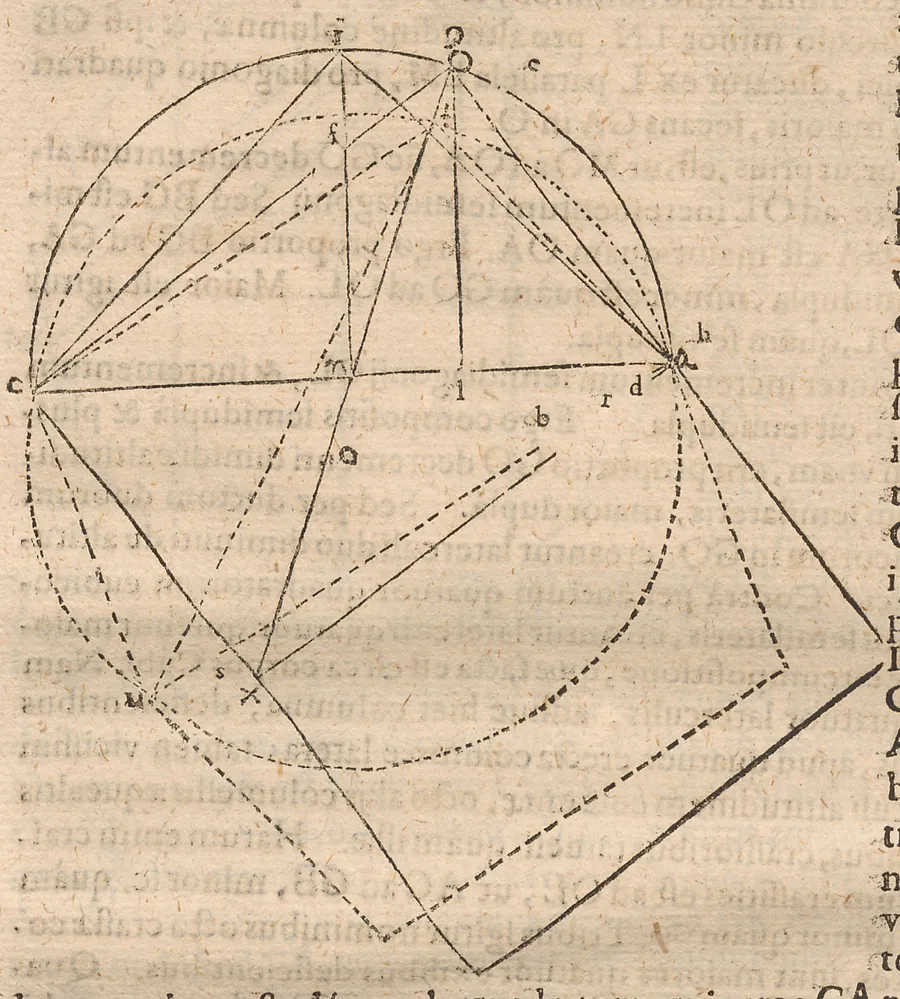
Eodem modo etiam in alio quocunque sphæræ circulo, cuius verbi gratia IC diameter, intelligitur inscriptum quadratum columnæ, cuius altitudo IA, & quadrati unius, anguli duo I. C. oppositi, quadrati alterius anguli A, X: itaque Cylindro AIC columna æquealta inscripta est.
In the same way, in any other circle of the sphere, whose diameter is, say, IC, the square of a column is understood as inscribed, whose height is IA, and two opposite corners of one square are I and C, and of the other square A and X: so a column of the same height is inscribed in the cylinder AIC.
Atqui omnium Columnarum ad Cylindros æquealtos, quibus inscribuntur, eadem est proportio; Cubus verò omnium in sphæra Columnarum est maximus, Cylinder igitur AGC, cubo sphæræ circumscriptus, omnium aliorum Cylindrorum in sphæra, ut AIC, maximus est.
But the ratio of all columns to the cylinders of equal height in which they are inscribed is the same; and the cube is the greatest of all columns in the sphere; so the cylinder AGC, circumscribed about the cube of the sphere, is the greatest of all the other cylinders in the sphere, such as AIC.
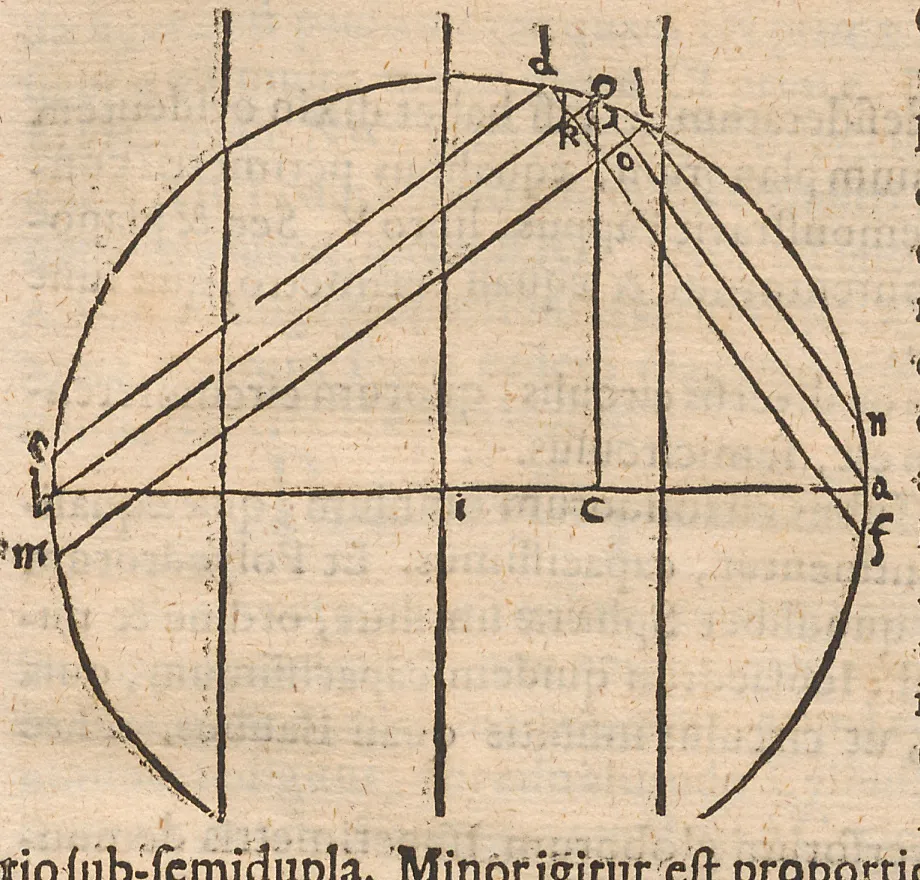
Eadem demonstratio potest etiam per Schema XIX.1 in hunc modum institui. Cylindri tres terminentur in H, G, A, punctis, eandem habentes diagonion CA, bases CH, CG, CB, altitudines HA, GA, BA. Sit autem quadratum CG duplum quadrati GA, & CH brevior, CB longior ipsâ CG. Descendant perpendiculares in CA, quæ sint HM, GL, BK. Cùm igitur sit CGA rectus, erit ut quadratum CG ad quadratum GA, sic recta CL ad rectam LA, dupla scilicet eius; & ut quadratum CH ad quadratum HA, sic CM ad MA, & ut quadratum CB, ad quadratum BA, sic CK ad KA. Vt verò quadrata CH, CG, CB inter se, sic sunt etiam bases Cylindrorum circulares inter se. Quare ut CM, CL, CK inter se, sic etiam sunt bases cylindrorum inter se. Componitur autem proportio Cylindrorum ex proportione basium & proportione altitudinum. Ergo rectangula tria, sub CM, CL, CK, quæ habent proportionem basium, & sub HA, GA, BA altitudinibus, habent inter se proportionem Cylindrorum.
The same proof can also be set up by Schema XIX1 in this way. Let three cylinders end at the points H, G, A, having the same diagonal CA, bases CH, CG, CB and heights HA, GA, BA. Let the square of CG be twice the square of GA, and CH shorter and CB longer than CG. Let perpendiculars HM, GL, BK come down onto CA. Since, then, CGA is a right angle, as the square of CG is to the square of GA, so is the straight line CL to the straight line LA, namely twice it; and as the square of CH to the square of HA, so CM to MA; and as the square of CB to the square of BA, so CK to KA. And as the squares CH, CG, CB are to each other, so are the circular bases of the cylinders to each other. So as CM, CL, CK are to each other, so too are the bases of the cylinders to each other. And the ratio of cylinders is compounded of the ratio of the bases and the ratio of the heights. So the three rectangles under CM, CL, CK, which have the ratio of the bases, and under the heights HA, GA, BA, have among themselves the ratio of the cylinders.
Permutatim autem ut AM, AL, AK inter se, sic sunt inter se etiam quadrata altitudinum AH, AG, AB. Est igitur quantitas eadem LM, quæ adjicitur ad LA, & aufertur ab LC; & vicissim quantitas est eadem LK, quæ aufertur ab LA, & adjicitur ad LC. Cùm aum autem CL sit dupla ipsius LB, proportio igitur CM brevioris, ad CL longiorem, est maior dimidia proportione eversa ipsius MA tanto longioris, ad LA breviorem. Vt si CL sit 20, LA 10, deinde CM 19, MA 11, proportio 20 ad 19, maior est dimidia proportione ipsius 11 ad 10, hoc est 22 ad 20. Nam proportio 22 ad 20 habet duo elementa, 22 ad 21, & 21, ad 20, quorum utrumque minus est proportione 20 ad 19. Est igitur proportio MA ad LA, & sic quadrati HA ad quadratum GA, minor quàm dupla proportionis CL ad CM. Sed rectarum ipsarum HA ad GA proportio est dimidia quadratorum, & duplæ proportionis dimidia, est simpla. Ergo altitudinis HA ad altitudinem BA proportio minor est, quàm LC ad MC, proportio basium. Rectangulum igitur sub HA, CM, repræsentans cylindrum CHA, minus est rectangulo sub GA, CL, repræsentante cylindrum CGA, quia CM est brevior in sua proportione, HA longior in suà.
Alternately, as AM, AL, AK are to each other, so too are the squares of the heights AH, AG, AB. The same quantity LM, then, is added to LA and taken from LC; and in turn the same quantity LK is taken from LA and added to LC. And since CL is twice LB, the ratio of the shorter CM to the longer CL is greater than half the reversed ratio of MA, longer by as much, to the shorter LA. As if CL is 20 and LA 10, then CM 19 and MA 11, the ratio 20 to 19 is greater than half the ratio 11 to 10, that is, 22 to 20. For the ratio 22 to 20 has two elements, 22 to 21 and 21 to 20, each of which is less than the ratio 20 to 19. The ratio of MA to LA, then, and so of the square of HA to the square of GA, is less than the square of the ratio CL to CM. But the ratio of the straight lines HA to GA themselves is half that of the squares, and half of a squared ratio is the simple ratio. So the ratio of the height HA to the height BA is less than LC to MC, the ratio of the bases. The rectangle under HA, CM, then, representing the cylinder CHA, is less than the rectangle under GA, CL, representing the cylinder CGA, because CM is shorter in its ratio than HA is longer in its.
Idem demonstratur versis argumentis etiam de cylindro CBA. Nam proportio CK longioris ad CL breviorem, est minor quàm dimidia proportionis eversæ AK brevioris ad AL longiorem. Vt si CL sit 20, LA 10, deinde CK 21. KA 9. Proportio 20 ad 21 minor est quam dimidia ipsius 9 ad 10, vel 18 ad 20. Nam proportionis 18 ad 20 elementa duo, 18 ad 19, & 19 ad 20, sunt singula maiora proportione 20 ad 21. Proportio igitur LA ad AK, hoc est quadrati GA ad quadratum AB, maior est quam dupla KC ad CL: & sic linearum GA ad AB proportio maior est, quàm KC ad CL; nec quanto BA brevior est ipsa GA in proportione sua, tanto vicissim longior est CK quàm CL in sua; & rectangulum sub BA, CK minus est rectangulo sub GA, CL, cylinder igitur CBA minor cylindro CGA: solus igitur CGA omnium maximus.
The same is proved by reversed arguments of the cylinder CBA too. For the ratio of the longer CK to the shorter CL is less than half the reversed ratio of the shorter AK to the longer AL. As if CL is 20 and LA 10, then CK 21 and KA 9. The ratio 20 to 21 is less than half that of 9 to 10, or 18 to 20. For the two elements of the ratio 18 to 20, 18 to 19 and 19 to 20, are each greater than the ratio 20 to 21. The ratio of LA to AK, then, that is, of the square of GA to the square of AB, is greater than the square of KC to CL; and so the ratio of the lines GA to AB is greater than KC to CL; and CK is not as much longer than CL in its ratio as BA is shorter than GA in its; and the rectangle under BA, CK is less than the rectangle under GA, CL; the cylinder CBA, then, is less than the cylinder CGA: so CGA alone is the greatest of all.
Corollarium I.
Corollary I.
Dolia Cylindracea sine Ventre, sive longioris fuerint figuræ quàm Austriaca sive curtioris, minus sunt capacia Austriacis.
Cylindrical barrels without a belly, whether of a longer shape than the Austrian or a shorter, are less capacious than Austrian ones.
Corollarium II.
Corollary II.
Patet hinc bono quodam & Geometrico genio esse factum, quod Austriaci Vietores Regulam hanc observent construendi dolij; ut tertia parte de longitudine Tabulæ utantur pro semidiametro Orbis lignei. Nam hac ratione fit, ut Cylinder inter duos orbes ligneos mente adumbratus, quam proximè habeat duas medietates, ad Regulam Theorematis V. quadrantes, & figuræ capacissimæ participes, etsi à perfectione Regulæ nonnihil recedant. Nam figuræ aliæ, terminatæ ad puncta ipsi G proxima cis & ultra, minimum variant capacitatem; quia capacitas figuræ AGC maxima est: circa maximam verò utrinque circumstantes decrementa habent initio insensilia.
It is plain from this that it was by some good and geometrical genius that the Austrian coopers keep this rule for building a barrel: that they use a third of the length of a stave for the radius of the wooden head. For in this way it comes about that the cylinder sketched in the mind between the two wooden heads has its two halves as near as possible to the rule of Theorem V, and sharing in the most capacious figure, even if they depart somewhat from the perfection of the rule. For other figures, ending at points next to G on this side and that, vary the capacity very little, because the capacity of the figure AGC is the greatest; and those standing about the greatest on either side have at first imperceptible decreases.
In Schemate sequenti CG ad GA habeat rationem semiduplam, eam nempe quam 100000. ad 70711: duplicata AG ex hac regula debebat habere 141421; at vietores pro hoc sumunt longitudinem 150000. sesquialteram basis, pro longitudine tabulæ GX, quod paulò plus est, quam 141421. Et hoc ipsum facit ad figuræ capacissimæ imitationem accuratiorem. Nam tabulæ & curvantur & marginibus utrinque extant & procurrunt super crenas, quibus capiunt & stringunt orbes ligneos. Quod igitur nimium est in hac tabularum longitudine, quæ est ad diametrum basis in proportione sesquialterà, id his marginibus imputatur, qui in examinatione figuræ ad regulam Theorematis V, non censebantur.
In the following schema let CG have to GA the ratio √2 : 1, namely that of 100000 to 70711: AG doubled ought by this rule to have 141421; but the coopers take for this a length of 150000, one and a half times the base, for the length of the stave GX, which is a little more than 141421. And this very thing makes for a more exact imitation of the most capacious figure. For the staves both curve and stand out at both ends with their margins, running out beyond the grooves with which they take hold of and grip the wooden heads. What is too much in this length of the staves, which is to the diameter of the base as 3 to 2, is set down to these margins, which were not counted in examining the figure by the rule of Theorem V.
Quis neget Naturam instinctu solo, sine etiam ratiocinatione docere Geometriam? cùm Vietores nostri, solis oculis & speciei pulchritudine ducti, capacissimam in dimidiato dolio figuram exprimere didicerint? Prodeat Geometra, doceatque faciliorem Methodum construendi dolij, quod dimidiâ sui parte ad capacissimum Cylindrum propius accedat, quàm est hæc ipsa, quam Vietores Austriaci ex antiquo tenent, proportionis sesquialteræ: doceat idem Geometra figuram ad compendiosè mensurandum aptiorem, quàm est illa quam struit Austria.
Who would deny that nature teaches geometry by instinct alone, even without reasoning, when our coopers, led only by their eyes and a sense of beauty, have learned to give half a barrel the most capacious shape? Let a geometer come forward and teach an easier method of building a barrel whose half comes closer to the most capacious cylinder than this one, in the ratio 3 : 2, which the Austrian coopers have held from of old; let the same geometer teach a shape better suited to quick measurement than the one Austria builds.
Credere poteram, extitisse olim præstantissimum aliquem in Austria Geometram, qui Vietores ista docuerit; nisi me hoc retinuisset, quod pulcherrimæ demonstrationis vestigia nuspiam extant in libris Geometrarum: quodque ratio hæc construendi dolij, quod equidem sciam, ad Rhenum, cæteraque loca vitifera, usitata non est; ferè enim longiora dolia factitant. Quod igitur publicè receptum non est, quî possit esse verisimile, ex libris aut institutione Geometrarum, ab vnà sola natione petitum esse?
I could have believed that there was once some most excellent geometer in Austria who taught the coopers these things, had I not been held back by this: that no trace of so beautiful a proof is to be found anywhere in the books of the geometers; and that this way of building a barrel, as far as I know, is not used on the Rhine and in the other wine-growing places, for they mostly make longer barrels. How could it be likely that what is not publicly received was taken by one nation alone from the books or teaching of geometers?
Admonitio.
A warning.
Quis tam est ingenio perspicaci & circumspecto, qui eluctatus ex hallucinatione ista, qua Cylindrorum eandem diagonion habentium illis maximum corpus tribuerat, quibus est area maxima sectionis per axem; postquam didicit, ijs Cylindris esse maximum corpus, in quibus diameter basis est semidupla altitudinis, per Th. hoc V, ijs verò, qui lineas has habeant æquales, aream sectionis esse maximam, per Th. I. huius partis: & verò eandem esse circa areas & Truncorum Conicorum rationem, per Th. II. huius: qui inquam his perspectis, non statim etiam de corpore Trunci conici præsumat idem, quod de corpore Cylindri: quòd scilicet etiam Trunci conici illius corpus sit maximum, in quo diameter basis minoris, sit dupla lateris acclivis? Atque id ego & credidi per hunc sesquiannum, & secutus sum: iamque in hoc eram, ut hoc nixus fundamento, dolia Rhenensia promiscuè omnia, sine discrimine ventrium, Austriacis postponerem in capacitatis censura: quod nullâ quidem illorum cum iniuria fecissem sed tamen iure non æquali. Itaque commoditati Typographiæ præsentis acceptum fero, quod aurem hic vulsit Geometria, editionem curanti, sequentiaque Theoremata, velut augendo supplemento ad Archimedem, mihi suppeditavit; quibus simul altera, multoque priore mirabilior proprietas dolii Austriaci traditur.
Who is so sharp and circumspect in mind that, having struggled free of that delusion by which he had given the greatest body, among cylinders with the same diagonal, to those whose section through the axis has the greatest area; and having learned that the greatest body belongs to those cylinders in which the base diameter is √2 times the height, by this Theorem V, but the greatest area of section to those in which these lines are equal, by Theorem I of this part; and indeed that the case is the same as regards the areas of conical frustums too, by Theorem II of this part: who, I say, having seen these things, would not at once presume of the body of a conical frustum the same as of the body of a cylinder, namely that the body of that conical frustum too is greatest in which the diameter of the lesser base is √2 times the sloping side? And I both believed this for the last year and a half and followed it; and I was on the point, relying on this foundation, of ranking all Rhenish barrels without distinction, regardless of their bellies, below the Austrian in judging their capacity; which I should have done with no injury to them, but yet not with equal right. So I credit it to the convenience of having the press here that geometry plucked my ear here as I saw to the printing, and supplied me with the following theorems, as an enlarging supplement to Archimedes; by which at the same time a second property of the Austrian barrel is taught, much more wonderful than the first.
Definitio.
Definition.
Cylinder & Trunci Conici coniugati dicantur, quando sectionibus utrorumque per axem fuerit eadem, vel æquales diagonij, & ut diameter basis cylindri ad eius altitudinem; sic diametri minoris basis Truncorum, ad eorum latera acclivia.
A cylinder and conical frustums are called conjugate when the sections of both through the axis have the same or equal diagonals, and as the diameter of the cylinder’s base is to its height, so are the diameters of the frustums’ lesser bases to their sloping sides.
Theorema VI. Problema.
Theorem VI. Problem.
Dato Cylindro & Trunci conjugati latere, vel basis minoris diametro, invenire trunci conjugati lineas reliquas. Oportet autem proportionem lateris vel basis in Cylindro ad datum latus vel basin Trunci, esse minorem proportione diametri et altitudinis Cylindri junctarum, ad diagonium.
Given a cylinder and the side, or the diameter of the lesser base, of a conjugate frustum, to find the remaining lines of the conjugate frustum. But the ratio of the side or base in the cylinder to the given side or base of the frustum must be less than the ratio of the diameter and height of the cylinder together to the diagonal.
Datus esto Cylinder AGCX, basis diametro CG, altitudine GA, diagonio AC: & Trunci data esto diameter basis CT; & proportio CG ad CT sit minor proportione CG, GA junctarum ad CA. Oportet invenire latus trunci & diametrum basis maioris. Fiat ut CG ad GA, sic CT, ad aliquam, puta AT: & super CA, struatur triangulum ex CT, AT. Nam quia proportio CG, GA ad CA est maior, quàm proportio CG ad CT, erit etiam maior quàm GA ad AT, & junctis terminis, maior erit proportio CG, GA ad CA, quàm earundem CG, GA ad CT, TA. Ac proinde CT, TA junctæ maiores erunt, quàm CA, poterit igitur fieri triangulū ex CT, TA super CA. Scribatur autem circulus circa C, T, A, puncta; & ex C, ipsi TA æqualis extensa, applicetur circulo in V, & connectantur AV, dico TA, CV esse Trunci coniugati latera acclivia, AV diametrū basis maioris.
Let there be given the cylinder AGCX, with base diameter CG, height GA and diagonal AC; and let the base diameter CT of the frustum be given; and let the ratio of CG to CT be less than the ratio of CG and GA together to CA. The side of the frustum and the diameter of the greater base must be found. Let it be made, as CG to GA, so CT to some line, say AT; and on CA let a triangle be built from CT and AT. For since the ratio of CG, GA to CA is greater than the ratio of CG to CT, it will also be greater than GA to AT; and joining the terms, the ratio of CG, GA to CA will be greater than that of the same CG, GA to CT, TA. And so CT, TA together will be greater than CA, and a triangle can therefore be made from CT, TA on CA. Let a circle be described about the points C, T, A; and from C let a line equal to TA be stretched to meet the circle at V, and let AV be joined. I say that TA, CV are the sloping sides of the conjugate frustum and AV the diameter of the greater base.
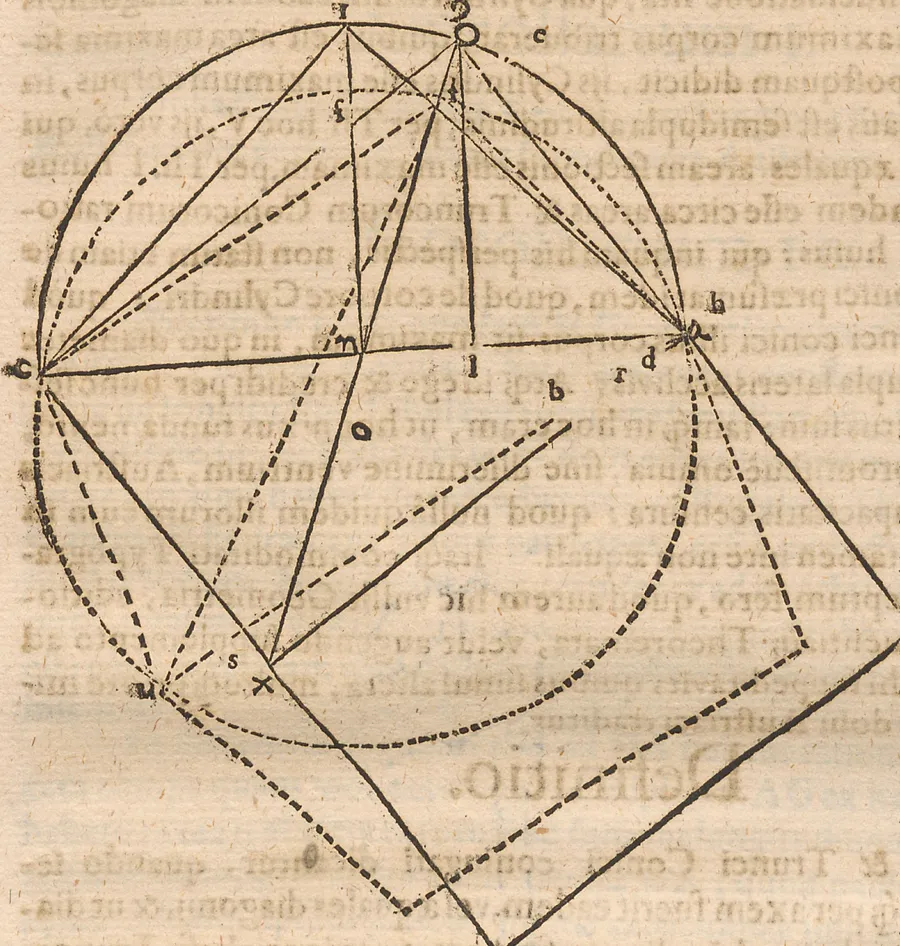
Connexis enim TV punctis: cùm TA sit ipsi CV æqualis, communi arcu TC apposito ad arcus TA & CV, erunt arcus AC, TV, æquales, proinde & subtensæ AC, TV æquales, & angulus ATC, angulo VCT, æqualis; quadrilaterū igitur ATCV, erit ordinatum & circulo inscriptū, eadem diagonio AC vel TV, cum parallelogrammo AGCX, & eadem proportione CT ad TA, qua est LG ad GA; Truncus igitur, cuius sectio per axem ATCV, & cylinder, cuius sectio AGCX, conjugati erunt.
For when the points T, V are joined, since TA is equal to CV, and the common arc TC is added to the arcs TA and CV, the arcs AC, TV will be equal, and so too the chords AC, TV, and the angle ATC equal to the angle VCT; the quadrilateral ATCV, then, will be regular and inscribed in the circle, with the same diagonal AC or TV as the parallelogram AGCX, and with the same ratio of CT to TA as LG to GA. The frustum whose section through the axis is ATCV and the cylinder whose section is AGCX will therefore be conjugate.
Theorema VII.
Theorem VII.
Si fuerint Cylinder & Truncus Conicus coniugati, & differentia diametrorum in basibus trunci secetur in proportione, quam habent inter se quadrata, diametri Basis, & altitudinis Cylindri; erit hoc diametri quadratum, æquale rectangulo, sub minore diametro Trunci, & sub composita ex hac & segmento, quod diametro Cylindri respondet.
If a cylinder and a conical frustum are conjugate, and the difference of the diameters of the frustum’s bases is cut in the ratio of the squares of the cylinder’s base diameter and height, the square of that diameter will be equal to the rectangle under the frustum’s lesser diameter and the sum of this and the segment corresponding to the cylinder’s diameter.
Sit AGCX cylindri sectio, diagonios AC; dividat autem hanc perpendicularis à G in partes CL, LA, sic ut CL respondeat ipsi CG. Formetur etiam sectio Trunci ATCV, super eadem AC diagonio, per VI præmissam, cuius diametri, minor CT, maior AV, & ablatâ ab AV, ipsi CT æquali VB, residuum esto BA.
Let AGCX be the section of the cylinder, with diagonal AC; and let the perpendicular from G divide this into the parts CL, LA, so that CL corresponds to CG. Let the section of the frustum ATCV also be formed on the same diagonal AC, by VI above, whose diameters are the lesser CT and the greater AV; and VB, equal to CT, being taken from AV, let the remainder be BA.
Cùm igitur ATCV quadrilaterum stet in circulo, quadratum ab AC, erit æquale rectangulis duobus, & sub TC, AC, & sub TA, CV, id est quadrato de TA vel CV, junctis, Ablato igitur quadrato ipsius AT, à quadrato ipsius AC, restabit rectangulum sub TC, AV, hoc est sub BV, VA. Atqui etiam quadrato ipsius AG, maioris, quàm est AT, ablato ab eodem quadrato AC, relinquitur rectangulum GC, AX, hoc est quadratum GC, quod ideò minus est rectangulo BVA.
Since, then, the quadrilateral ATCV stands in a circle, the square of AC will be equal to the two rectangles under TC, AC and under TA, CV, that is, to the square of TA or CV, together. Taking the square of AT, then, from the square of AC, there will remain the rectangle under TC, AV, that is, under BV, VA. But also when the square of AG, which is greater than AT, is taken from the same square of AC, there remains the rectangle GC, AX, that is, the square of GC, which is therefore less than the rectangle BVA.
Erit igitur rectangulum aliquod minus quam BVA, æquale quadrato GC; sit BVD, residuum igitur sub DA BV, erit excessus rectanguli BVA, super quadratum GC. Sed excessus hic, est æqualis excessui quadrati GA, super quadratum AT. Et quia rectangulum BVD, positum fuit æquale quadrato GC, & rectangulum DBV, est excessus rectanguli BVD, super quadratum BV vel TC; est igitur DBV etiam excessus quadrati GC super quadratum TC. Componendo igitur, cum sit quadratum AG ad quadratum GC, ut quadratum AT ad quadratum TC; erit etiam, ut quadratum AG ad quadratum CG, hoc est, ut AL ad LC, sic excessus quadrati AG super quadratum AT, hoc est, rectangulum sub DA, BV, ad excessum quadrati GC super quadratum TC hoc est ad rectangulum DBV. Vt igitur AL ad LC, sic rectangulum sub AD, BV, ad rectangulum DBV; quare cùm rectangula habeant eandem longitudinem BV, erunt etiam ut AL ad LC, sic latitudines AD ad DB. Quare reflectendo si fuerit divisa AB in D sic, ut sit BD ad DA, sicut est CL ad LA, hoc est, ut quadratum CG ad quadratum GA; rectangulum DBV, æquabit quadratum GC, quod erat demonstandum.
Some rectangle less than BVA, then, will be equal to the square of GC; let it be BVD; the remainder under DA, BV will then be the excess of the rectangle BVA over the square of GC. But this excess is equal to the excess of the square of GA over the square of AT. And since the rectangle BVD was put equal to the square of GC, and the rectangle DBV is the excess of the rectangle BVD over the square of BV or TC, DBV is also the excess of the square of GC over the square of TC. Componendo, then, since the square of AG is to the square of GC as the square of AT to the square of TC, it will also be that as the square of AG to the square of CG, that is, as AL to LC, so is the excess of the square of AG over the square of AT, that is, the rectangle under DA, BV, to the excess of the square of GC over the square of TC, that is, to the rectangle DBV. As AL to LC, then, so is the rectangle under AD, BV to the rectangle DBV; so since the rectangles have the same length BV, as AL to LC, so will their breadths AD to DB be. Turning it back, then: if AB is divided at D so that BD is to DA as CL to LA, that is, as the square of CG to the square of GA, the rectangle DBV will equal the square of GC; which was to be proved.
Corollarium I. & Praxis.
Corollary I and Practice.
Si dantur quadrata altitudinis & basis Cylindri, cum diametro basis minoris in Trunco, divide quadratum basis per diametrum basis trunci datam, à quotiente aufer divisorem, quod restat, multiplica in summam quadratorum, factum divide per quadratum altitudinis cylindri, provenit differentia diametrorum, adjicienda ad minorem datam, ut componatur diameter Trunci maior.
If the squares of the cylinder’s height and base are given, with the diameter of the frustum’s lesser base, divide the square of the base by the given diameter of the frustum’s base, take the divisor from the quotient, multiply what remains by the sum of the squares, and divide the product by the square of the cylinder’s height: the difference of the diameters results, to be added to the given lesser one to make up the frustum’s greater diameter.
Exemplum.
Example.
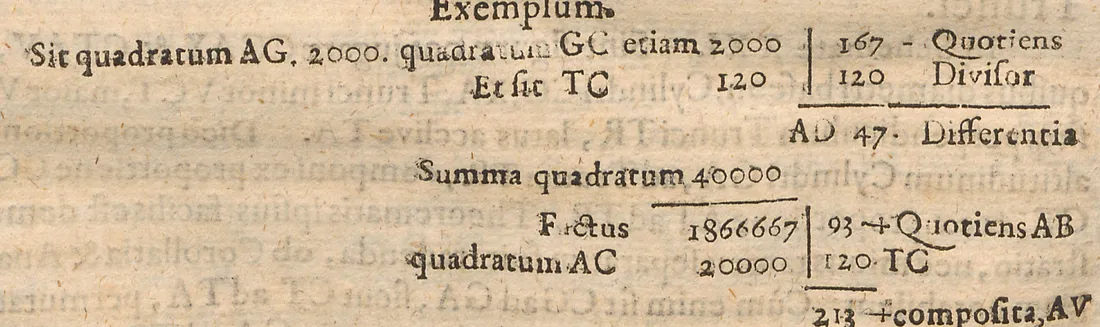
| Sit quadratum AG. 2000. quadratum GC etiam | 2000 | 167 — Quotiens |
| Et sit TC | 120 | 120 Divisor |
| AD 47. Differentia | ||
| Summa quadratum | 40000 | |
| Factus | 1866667 | 93 + Quotiens AB |
| quadratum AC | 20000 | 120. TC |
| 213 + composita, AV |
| Let the square of AG be 2000, and the square of GC also | 2000 | 167 — quotient |
| And let TC be | 120 | 120 divisor |
| AD 47. difference | ||
| Sum of the squares | 40000 | |
| Product | 1866667 | 93 + quotient AB |
| Square of AC | 20000 | 120. TC |
| 213 + sum, AV |
Corollarium II.
Corollary II.
Si verò econtrà datur solùm proportio quadrati altitudinis ad quadratum basis diametri, & diameter utraque basium Trunci; Diameter Basis Cylindri sic invenitur. Adde numeros, quibus expressa est quadratorum proportio, & multiplicatâ differentiâ diametrorum trunci, in numerum quadrati maioris, factum divide per summam utriusque Numeri, quotientem multiplica in minorem Trunci diametrum, proveniet quadratum diametri in base Cylindri.
But if, conversely, only the ratio of the square of the height to the square of the base diameter is given, and both diameters of the frustum’s bases, the diameter of the cylinder’s base is found thus. Add the numbers by which the ratio of the squares is expressed, and multiplying the difference of the frustum’s diameters by the number of the greater square, divide the product by the sum of both numbers, and multiply the quotient by the frustum’s lesser diameter: the square of the diameter of the cylinder’s base will result.

| Sit CG ad GA ut 3. ad 2. quadrata ut 9. ad 4. Sit CT. 130, TA 156 differentia 26. |
Factus 234. Summa 13. |
18 Quotiens 130 CT. |
| Factus 234 | Factus 2340. qdm CG. |
| Let CG be to GA as 3 to 2, the squares as 9 to 4. Let CT be 130, TA 156, difference 26. |
Product 234. Sum 13. |
18 quotient 130 CT. |
| Product 234 | Product 2340, square of CG. |
Vel quod idem est, numerum quadrati maioris multiplica in diametrum minorem, & fac, ut summam quadratorum ad differentiam diametrorum trunci, sic factum ad quartum, qui erit quadratum CG.
Or, what is the same, multiply the number of the greater square by the lesser diameter, and make as the sum of the squares to the difference of the frustum’s diameters, so the product to a fourth, which will be the square of CG.
Corollarium III.
Corollary III.
Si quadratum AG, ad quadratum AC, est ut 1. ad 2. DV est duarum medietatum arithmeticarum inter TC, AV maior; Hinc Praxis brevior.
If the square of AG is to the square of AC as 1 to 2, DV is the greater of the two arithmetic means between TC and AV. Hence a shorter practice.

| Dia- | metri. | ||
|---|---|---|---|
| 19. | 20. | 21. | 22. |
| 19. | |||
| 399. quadratum GC. |
| Dia- | meters. | ||
|---|---|---|---|
| 19. | 20. | 21. | 22. |
| 19. | |||
| 399. square of GC. |
Corollarium IV.
Corollary IV.
Sicut se habet basis minor Trunci, ad basin Cylindri, aut quadratum lateris acclivis Trunci, ad quadratum altitudinis Cylindri, sic se habet diameter minoris basis, ad compositam DV.
As the frustum’s lesser base is to the cylinder’s base, or the square of the frustum’s sloping side to the square of the cylinder’s height, so is the diameter of the lesser base to the sum DV.
Theorema VIII
Theorem VIII.
In Cylindro & Trunco conico coniugatis, altitudinum proportio componitur ex proportione Diametrorum in Basibus, minori Conici trunci, & utraque Cylindri, & ex proportione perpendiculi, ad latus acclive Trunci.
In a conjugate cylinder and conical frustum, the ratio of the heights is compounded of the ratio of the diameters of the bases, the lesser of the conical frustum and that of the cylinder, and of the ratio of the perpendicular to the sloping side of the frustum.
In Schemate XXI. Sint figuræ conjugatæ CGAX & CTAV, in quibus diametri baseon, Cylindri CG, XA, Trunci minor VCT, maior VA, sitque perpendiculum Trunci TR, latus acclive TA. Dico proportionem altitudinum Cylindri GA, ad Trunci TR, componi ex proportione GC ad CT, & ex proportione AT ad TR. Theorematis ipsius facilis est demonstratio, nec minus tamen separatim fuit tradenda, ob Corollaria & Analogiam notabilem. Cùm enim sit CG ad GA, sicut CT ad TA, permutatim igitur, erit GC ad CT, ut GA ad AT: Sed proportio GA ad TR, composita est ex proportione GA ad AT, & ex proportione AT, ad TR: ergo etiam ex GC, ad CT, & ex AT ad TR.
In Schema XXI let the conjugate figures be CGAX and CTAV, in which the diameters of the bases are, of the cylinder, CG, XA, of the frustum, the lesser VCT and the greater VA; and let TR be the perpendicular of the frustum and TA its sloping side. I say that the ratio of the heights, GA of the cylinder to TR of the frustum, is compounded of the ratio of GC to CT and of the ratio of AT to TR. The proof of the theorem itself is easy, yet it had to be given separately, because of its corollaries and a notable analogy. For since CG is to GA as CT to TA, alternately GC will be to CT as GA to AT. But the ratio of GA to TR is compounded of the ratio of GA to AT and of the ratio of AT to TR; so also of GC to CT and of AT to TR.
Corollarium & Praxis quærendæ altitudinis.
Corollary and Practice for finding the height.
Datis CT, & VA, per præmissam, datur etiam quadratum ipsius CG; data verò proportione huius quadrati CG, ad quadratum GA, datur etiam quadratum GA, & quadratum TA. Sed & differentia ipsarum CT, VA, nota est, sc. BA: & quadratum TA, minus est quadrato TR, parte quarta quadrati BA, in omni conjugatione. Anguli enim ad C & T, æquales sunt, & CT, VB æquales, ex Hypothesi, atque etiam parallelæ: connexis igitur B, T, erit BT æqualis ipsi CV: sed hæc est æqualis ipsi TA, ex hypothesi: Ergo BTA isosceles est cuius TR perpendiculum: itaque BR est æqualis ipsi RA, eòque quadratum BA, quadruplum ipsius RA. Ablata igitur parte quarta quadrati BA à quadrato TA, restat quadratum TR, altitudinis Trunci, quod comparatum cum quadrato GA, constituit quælitam proportionem.
Given CT and VA, by the previous theorem the square of CG is also given; and given the ratio of this square of CG to the square of GA, there are also given the square of GA and the square of TA. And the difference of CT and VA is known too, namely BA; and the square of TA is less than the square of TR by a quarter of the square of BA, in every conjugation. For the angles at C and T are equal, and CT, VB equal by hypothesis, and also parallel; so when B and T are joined, BT will be equal to CV; but this is equal to TA by hypothesis; so BTA is isosceles, with TR its perpendicular; so BR is equal to RA, and so the square of BA four times that of RA. Taking a quarter of the square of BA from the square of TA, then, the square of TR, the height of the frustum, remains, which compared with the square of GA makes the ratio sought.
Exempla.
Examples.
Sit TC 19 AV. 22. Quod si quadratum GC fuerit ad GA duplum: erit quadratum GC ut prius, 399. Erit igitur quadratum GA 399 semisses, vel 798 quadrantes: proinde cùm quadratum de 19 sit 361, erit etiam TA 361 semisses vel 722 quadrantes. Denique cum differentia CT & VA, sc. 19 & 22, sit 3, quadratum 9, pars quarta, 9 quadrantes: aufer hos à 722, restant 713 quadrantes pro quadrato TR. Ita constituitur proportio quadrati GA ad quadratum TR, quæ 798 ad 713.
Let TC be 19 and AV 22. If the square of GC is twice GA, the square of GC will be, as before, 399. The square of GA will then be 399 halves, or 798 quarters; and so, since the square of 19 is 361, TA will also be 361 halves or 722 quarters. Finally, since the difference of CT and VA, namely 19 and 22, is 3, its square 9, a quarter, is 9 quarters: take these from 722, and 713 quarters remain for the square of TR. So the ratio of the square of GA to the square of TR is set up as 798 to 713.
Sit verò alia conjugatio, quadrata sc. AG, GC æqualia, & sic etiam quadrata AT, TC: & maneat CT, 19. VA 22. Erit quadratum TA 1444 quadrantes, eoque quadratum TR 1435 quadrantes: Et proportio quadrati GA ad quadratum TR quæ 1596 ad 1435, vel in minimis, quæ 228 ad 205.
But let there be another conjugation, namely with the squares of AG, GC equal, and so too the squares of AT, TC; and let CT remain 19 and VA 22. The square of TA will be 1444 quarters, and so the square of TR 1435 quarters; and the ratio of the square of GA to the square of TR that of 1596 to 1435, or in least terms that of 228 to 205.
Aliud Exemplum. Sit TC 19. AV 20. seu quod idem est 57, & 60. ut communicent cum ternario, propter usus secuturos. Deinde sit quadratum GC ad quadratum GA, non duplum, ut 2. ad 1. vel ut 8. ad 4. sed minor, ut 7. ad 4. Cùm ergò per præmissam, differentia, quæ hîc est 3, sit dividenda in proportione 7 & 4, tota igitur est ut 11. eòque alij termini sunt assumendi, communicantes cum 11, scilicet 627. & 660. ut sit differentia 33. de qua pars respondens quadrato GC, est 21. Composita igitur VD est 648. quam duc in minorem diametrum 627, provenit 406 296, quadratum GC, quod est ad quadratum GA, ex hypothesi, ut 7. ad 4. Ergo quadratum GA 232 169 cum septima, seu 928 677 quadrantes. Est autem quadratum minoris TC 393 129, Et ut 7 ad 4, sic quadratum TC ad quadratum TA, quod erit ideò 224 645 & 1 septima, seu 898 581 quadrantes. Differentia diemetrorum est 33, cuius quadratum 1089, & eius quarta pars, totidem quadrantes Aufer hoc à quadrato TA, reliquuntur 897 492. Hic ergò est proportio q. GA ad q. TR, quæ 928 676 ad 897 491, vel 3 714 708 ad 3 589 968, in minimis, ut 464 377 ad 448 746.
Another example. Let TC be 19 and AV 20, or, what is the same, 57 and 60, so that they share a factor with 3, for the uses to follow. Then let the square of GC be to the square of GA not double, as 2 to 1 or 8 to 4, but less, as 7 to 4. Since, then, by the previous theorem, the difference, which is here 3, must be divided in the ratio 7 to 4, the whole is as 11, and so other terms must be taken with a factor of 11, namely 627 and 660, so that the difference is 33, of which the part corresponding to the square of GC is 21. The sum VD, then, is 648, which multiply by the lesser diameter 627: the result is 406 296, the square of GC, which is to the square of GA, by hypothesis, as 7 to 4. So the square of GA is 232 169 and a seventh, or 928 677 quarters. And the square of the lesser TC is 393 129; and as 7 to 4, so is the square of TC to the square of TA, which will therefore be 224 645 and one seventh, or 898 581 quarters. The difference of the diameters is 33, whose square is 1089, and its quarter part as many quarters. Take this from the square of TA: 897 492 remain. Here, then, is the ratio of the square of GA to the square of TR, that of 928 676 to 897 491, or 3 714 708 to 3 589 968, in least terms as 464 377 to 448 746.
Sit autem proportio quadratorum, non ut 7. ad 4., sed ut 9 ad 4. ipsarum sc. linearum GC ad CT, quæ 3 ad 2. & sit VC 19. AV 20. Oportet ergò differentiam 1, dividere in proportione 9. ad 4. Tota ergo secanda est in particulas 13, & propter communionem cum ternario, in 39. Fient autem termini, VA 780, TC 741, quadratum 549 081. Vt autem 9 ad 4, sic quadratum hoc ad quadratum TA 244 036, de quo aufer quartam de quadrato 39, sc. 1521 quadrantes, restant 974 623 quadrantes, pro TR. Iam pars diametri, respondens quadrato GC, est 27: composita igitur, est 768, qua ducta in diametrum 741, provenit quadratum GC 569 088, ut verò 9 ad 4, sic hoc ad 252 928 seu 1011 712 quartas. Ergo proportio quadrati GA, ad quadratum TR, est illa, quæ 1011 712 ad 974 623.
But let the ratio of the squares be not as 7 to 4 but as 9 to 4, that is, of the lines GC to CT themselves as 3 to 2; and let VC be 19 and AV 20. The difference 1, then, must be divided in the ratio 9 to 4. The whole must therefore be cut into 13 particles, and, to share a factor with 3, into 39. The terms will be VA 780, TC 741, its square 549 081. And as 9 to 4, so is this square to the square of TA, 244 036, from which take a quarter of the square of 39, namely 1521 quarters: 974 623 quarters remain for TR. Now the part of the diameter corresponding to the square of GC is 27; the sum, then, is 768, which multiplied by the diameter 741 gives the square of GC, 569 088; and as 9 to 4, so is this to 252 928, or 1011 712 quarters. So the ratio of the square of GA to the square of TR is that of 1011 712 to 974 623.
Corollarium II. & Analogia.
Corollary II and Analogy.
In conjugatione æqualitatis pulchra existit series proportionum inter quadrata altitudinum; talis nempe.
In the conjugation of equality there arises a beautiful series of ratios between the squares of the heights, namely this.
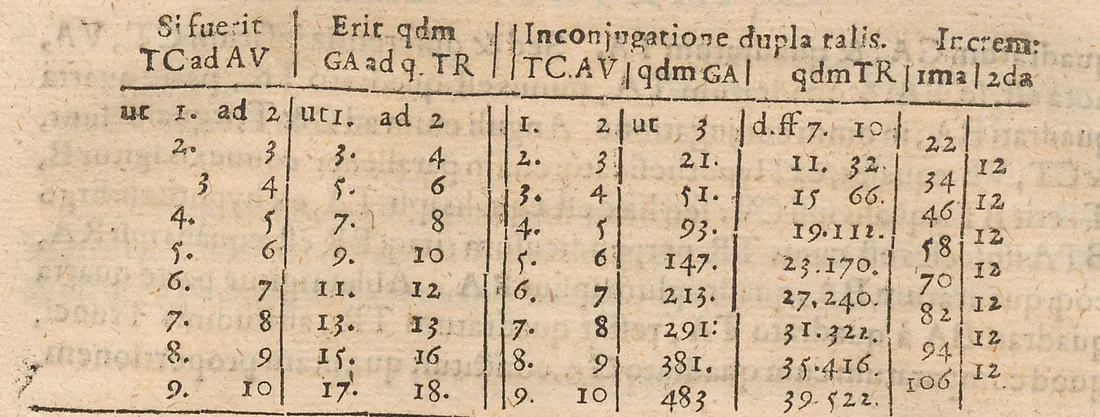
| Si fuerit TC ad AV | Erit qdm GA ad q. TR | In conjugatione dupla talis. TC. AV | qdm GA | qdm TR | Increm: 1ma | 2da |
|---|---|---|---|---|---|---|
| ut 1. ad 2 | ut 1. ad 2 | 1. 2. | ut 3 | d. ff 7. 10 | ||
| 2. 3 | 3. 4 | 2. 3 | 21. | 11. 32. | 22 | |
| 3 4 | 5. 6 | 3. 4 | 51. | 15 66. | 34 | 12 |
| 4. 5 | 7. 8 | 4. 5 | 93. | 19. 111. | 46 | 12 |
| 5. 6 | 9. 10 | 5. 6 | 147. | 23. 170. | 58 | 12 |
| 6. 7 | 11. 12 | 6. 7 | 213. | 27. 240. | 70 | 12 |
| 7. 8 | 13. 13 | 7. 8 | 291. | 31. 322. | 82 | 12 |
| 8. 9 | 15. 16 | 8. 9 | 381. | 35. 416. | 94 | 12 |
| 9. 10 | 17. 18. | 9. 10 | 483 | 39. 522. | 106 | 12 |
| If TC is to AV | The square of GA will be to the square of TR | In the double conjugation, such: TC. AV | sq. GA | sq. TR | First increase | Second |
|---|---|---|---|---|---|---|
| as 1 to 2 | as 1 to 2 | 1. 2. | as 3 | diff. 7. 10 | ||
| 2. 3 | 3. 4 | 2. 3 | 21. | 11. 32. | 22 | |
| 3 4 | 5. 6 | 3. 4 | 51. | 15 66. | 34 | 12 |
| 4. 5 | 7. 8 | 4. 5 | 93. | 19. 111. | 46 | 12 |
| 5. 6 | 9. 10 | 5. 6 | 147. | 23. 170. | 58 | 12 |
| 6. 7 | 11. 12 | 6. 7 | 213. | 27. 240. | 70 | 12 |
| 7. 8 | 13. 13 | 7. 8 | 291. | 31. 322. | 82 | 12 |
| 8. 9 | 15. 16 | 8. 9 | 381. | 35. 416. | 94 | 12 |
| 9. 10 | 17. 18. | 9. 10 | 483 | 39. 522. | 106 | 12 |
Quia puncta D, R hîc coëunt. Tale quid occurrit in unaqualibet Conjugatione
Because the points D and R here coincide. Something of the kind occurs in every conjugation.
Theorema IX.
Theorem IX.
Si differentia diametrorum Trunci secetur in proportione laterum Cylindri conjugati, & addatur pars respondens diametro Basis Cylindri ad minorem, fiantque rectangula, I. sub minore & maiore, II. sub minore & modo composita: Proportio rectanguli primi, aucti tertia parte quadrati à differentia diametrorum, ad rectangulum secundum, & proportio altitudinis Cylindri ad altitudinem Trunci, in vnum compositæ, constituunt proportionem corporis Trunci ad corpus Cylindri conjugati.
If the difference of the frustum’s diameters is cut in the ratio of the sides of the conjugate cylinder, and the part corresponding to the diameter of the cylinder’s base is added to the lesser, and rectangles are made, I. under the lesser and the greater, II. under the lesser and the sum just made: the ratio of the first rectangle, increased by a third of the square of the difference of the diameters, to the second rectangle, and the ratio of the cylinder’s height to the frustum’s height, compounded into one, make the ratio of the body of the frustum to the body of the conjugate cylinder.
In Schemate XXI. manentibus cæteris, ut præcedenti Theoremate, sit BA differentia divisa in D sic, ut sicut quadratum AG ad quadratum GC, sic sit AD, ad DB. Dico proportionem rectanguli sub CT, AV, vnà cum tertia parte quadrati à BA, ad rectangulum CT, VD, & proportionem GA ad TR, in unum compositas, constituere proportionem corporis Trunci ad Cylindri coniugati corpus. Nam per XVII. primæ partis, est ut rectangulum CT, VA, junctâ tertiâ parte quadrati de BA, ad quadratum, CT, sic corpus Trunci CTAV, ad corpus Cylindri æqualis & inscripti, super basi eàdem CT. Vt verò quadratum CT ad quadratum CG, ita corpus Cylindri super CT basi, ad corpus Cylindri æquealti, super basi CG, per dicta ad III & XVI. p. primæ. Vt ergo rectangulū CT, VA, junctâ tertiâ parte quadrati de BA, ad quadratum CG, hoc est, per VI. præmissam, ad rectangulum CT, VD, æquale quadrato GC: ita corpus Trunci, basibus CT, AC, ad corpus Cylindri æquealti. Si ergo Truncus haberet altitudinem Cylindri coniugati, sc. GA; valeret hæc jam dicta proportio sola. Iam verò ut GA, altitudo Cylindri conjugati, ad TR, altitudinem minorem, sic Cylinder coniugatus, ad Cylindrum altitudine Trunci, basibus ijsdem, per Th. XVII p. primæ; & sic etiam Truncus altitudine GA, ad truncum coniugatum; altitudine TR. Hæc igitur est proportionis pars altera.
In Schema XXI, the rest remaining as in the previous theorem, let the difference BA be divided at D so that as the square of AG to the square of GC, so is AD to DB. I say that the ratio of the rectangle under CT, AV, together with a third of the square of BA, to the rectangle CT, VD, and the ratio of GA to TR, compounded into one, make the ratio of the body of the frustum to the body of the conjugate cylinder. For by XVII of the first part, as the rectangle CT, VA, with a third of the square of BA added, is to the square of CT, so is the body of the frustum CTAV to the body of the equal-height cylinder inscribed in it on the same base CT. And as the square of CT to the square of CG, so is the body of the cylinder on the base CT to the body of the cylinder of equal height on the base CG, by what was said at III and XVI of the first part. As the rectangle CT, VA, with a third of the square of BA added, is to the square of CG, then, that is, by VI above, to the rectangle CT, VD, equal to the square of GC, so is the body of the frustum with bases CT, AC to the body of the cylinder of equal height. If, then, the frustum had the height of the conjugate cylinder, namely GA, the ratio just stated would hold alone. But as GA, the height of the conjugate cylinder, is to TR, the lesser height, so is the conjugate cylinder to the cylinder with the height of the frustum and the same bases, by Theorem XVII of the first part; and so too the frustum with height GA to the conjugate frustum with height TR. This, then, is the other part of the ratio.
Corollarium I. & Praxis.
Corollary I and Practice.
Data proportione Trunci ad Cylindrum æquealtum, basi CG, per præmissas: datâ etiam proportione quadrati GA, altitudinis Cylindri, ad quadratum TR, altitudinis trunci coniugati, quia quadratorum proportionalium radices etiam proportionales sunt, sed proportionis dimidiæ: quadrabimus igitur numerum, quo effertur corpus Trunci, & faciemus, ut quadratum GA, ad quadratum TR, sic quadratum numeri Trunci, altitudine GA, ad quadratum numeri justi trunci, hoc est conjugati, altitudine TR: Radix ex hoc quadrato numero, prodit numerum corporis trunci, in proportione, ut quadratum GC, valet Cylindri conjugati corpus.
The ratio of the frustum to the cylinder of equal height on the base CG being given by the foregoing, and the ratio of the square of GA, the cylinder’s height, to the square of TR, the height of the conjugate frustum, being given too: since the roots of proportional squares are also proportional, but in half the ratio, we shall square the number expressing the body of the frustum, and make as the square of GA to the square of TR, so the square of the number of the frustum with height GA to the square of the number of the true frustum, that is, the conjugate one, with height TR. The root of this square number gives the number of the body of the frustum, in the proportion in which the square of GC is worth the body of the conjugate cylinder.
Sit CA quadratum ad quadratum GA ut 7. ad 4. & sint CT. 19. AV. 20, vel ut in exemplo Th. VII, 627. 660. Differentia 33. Minore ergò medietate Arithmetica 638 in 627 ductâ, addito quadrato de 627, vel totâ 660 in eandem 627 ductâ, addito rectangulo ex 11 in 33, conflabitur 414183, pro corpore Trunci. Supra verò quadrati altitudinis cylindri conjugati, ad qdm altitudinis Trunci proportio erat quæ 464377 ad 448746. Si feceris ergò, ut illum ad hunc, sic quadratum numeri trunci hic inventi ad quartum, proveniet 165773240994, cuius radix 407153 pro Trunco: cùm quadratum cylindri, repræsentans eius corpus, esset 406296. En Truncum maiorem cylindro, plus quàm parte quingentesima, cum in eadem proportione diametrorum, sed conjugatione proportionis duplæ, in hoc Theoremate proposita, Truncus esset minor cylindro, minus quam parte termillesima.
Let the square of CA be to the square of GA as 7 to 4, and let CT be 19 and AV 20, or, as in the example of Theorem VII, 627 and 660. The difference is 33. Multiplying the lesser arithmetic mean, 638, by 627, and adding the square of 627, or multiplying the whole 660 by the same 627 and adding the rectangle of 11 by 33, 414183 is made up for the body of the frustum. And above, the ratio of the square of the conjugate cylinder’s height to the square of the frustum’s height was that of 464377 to 448746. If, then, you make as the former to the latter, so the square of the number of the frustum found here to a fourth, 165773240994 will result, whose root, 407153, is for the frustum: whereas the square of the cylinder, representing its body, was 406296. See the frustum greater than the cylinder by more than a five-hundredth part; while in the same ratio of diameters, but in the conjugation of double ratio proposed in this theorem, the frustum was less than the cylinder by less than a three-thousandth part.
Age verò etiam conjugationem tentemus proportionis dupla maioris. Sit TC 19. AV. 20. & q. GC ad quadratum GA, ut 9 ad 4, Erant supra, Th. VIII, termini TC 641. AV 780. Et quadratum GC 869088. Et quadratum GA ad quadratum TR, ut 1011712 ad 974623.
Come, let us also try a conjugation of more than double ratio. Let TC be 19 and AV 20, and the square of GC to the square of GA as 9 to 4. The terms above, at Theorem VIII, were TC 641, AV 780, and the square of GC 869088; and the square of GA to the square of TR as 1011712 to 974623.
Ducto autem 741 in 780, & differentiâ 39 in partem tertiam 13, factisque additis, conflatur numerus Trunci 578487. Denique huius quadrato multiplicato in 974623, & facto diviso per 1011712, prodit 3223 9900 7006. Et hinc radix 567802 est argumentum Trunci coniugati, cùm 569088 sit argumentum cylindri. Truncus igitur hîc, minor est plus quam parte sexcentesima. Minor autem erat in coniugatione proportionis duplæ, minus quam parte termillesimâ.
Multiplying 741 by 780, and the difference 39 by its third part 13, and adding the products, the number of the frustum is made up, 578487. Finally, its square multiplied by 974623, and the product divided by 1011712, gives 3223 9900 7006. And from this the root 567802 is the measure of the conjugate frustum, while 569088 is the measure of the cylinder. Here, then, the frustum is less by more than a six-hundredth part. But in the conjugation of double ratio it was less by less than a three-thousandth part.
Corollarium II.
Corollary II.
In coniugatione duplæ proportionis, duarum medietatum arithmeticarum utraque servit calculo, minor pro Tunicæ corpore, maior pro quadrato GC, & corpore cylindri coniugati.
In the conjugation of double ratio, both of the two arithmetic means serve the calculation: the lesser for the body of the coat, the greater for the square of GC and the body of the conjugate cylinder.
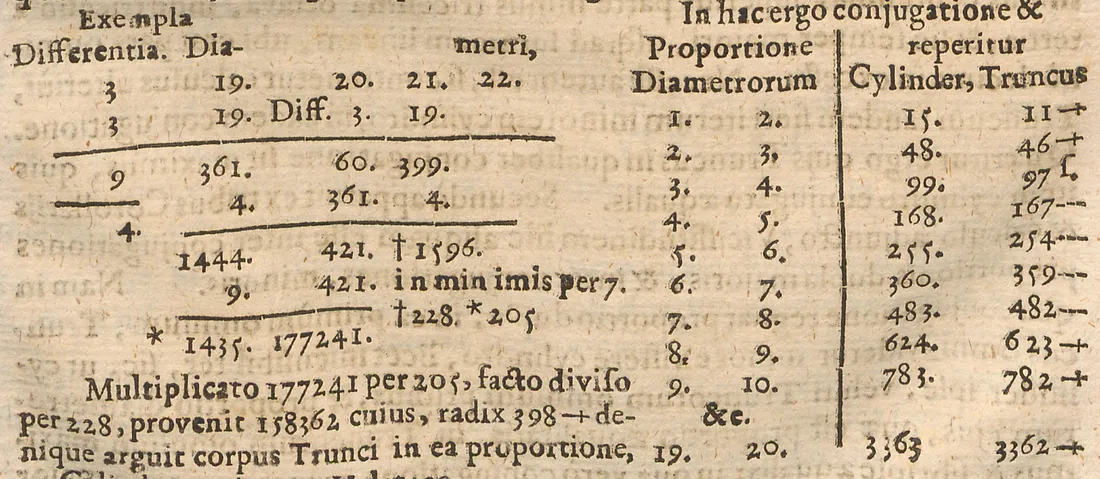
| Exempla Differentia. | Dia- | metri, | ||
|---|---|---|---|---|
| 3 | 19. | 20. | 21. | 22. |
| 3 | 19. | Diff. 3. | 19. | |
| 9 | 361. | 60. | 399. | |
| 4. | 4. | 361. | 4. | |
| 1444. | 421. | † 1596. | ||
| 9. | 421. | in minimis per 7. | ||
| * 1435. | 177241. | † 228. * 205 |
| In hac ergo conjugatione & Proportione Diametrorum | reperitur Cylinder, | Truncus | |
|---|---|---|---|
| 1. | 2. | 15. | 11 + |
| 2. | 3. | 48. | 46 + |
| 3. | 4. | 99. | 97 f. |
| 4. | 5. | 168. | 167 − |
| 5. | 6. | 255. | 254 − |
| 6. | 7. | 360. | 359 − |
| 7. | 8. | 483. | 482 − |
| 8. | 9. | 624. | 623 + |
| 9. | 10. | 783. | 782 + |
| &c. | |||
| 19. | 20. | 3363 | 3362 + |
| Examples. Difference. | Dia- | meters, | ||
|---|---|---|---|---|
| 3 | 19. | 20. | 21. | 22. |
| 3 | 19. | Diff. 3. | 19. | |
| 9 | 361. | 60. | 399. | |
| 4. | 4. | 361. | 4. | |
| 1444. | 421. | † 1596. | ||
| 9. | 421. | in least terms by 7. | ||
| * 1435. | 177241. | † 228. * 205 |
| In this conjugation, then, and with the ratio of diameters | the cylinder is found | the frustum | |
|---|---|---|---|
| 1. | 2. | 15. | 11 + |
| 2. | 3. | 48. | 46 + |
| 3. | 4. | 99. | 97 about |
| 4. | 5. | 168. | 167 − |
| 5. | 6. | 255. | 254 − |
| 6. | 7. | 360. | 359 − |
| 7. | 8. | 483. | 482 − |
| 8. | 9. | 624. | 623 + |
| 9. | 10. | 783. | 782 + |
| etc. | |||
| 19. | 20. | 3363 | 3362 + |
Multiplicato 177241 per 205, facto diviso per 228, provenit 158362 cuius, radix 398 + denique arguit corpus Trunci in ea proportione, ut Cylinder conjugatus Valet 399.
Multiplying 177241 by 205 and dividing the product by 228, 158362 results, whose root, 398 +, at last shows the body of the frustum in that proportion in which the conjugate cylinder is worth 399.
Corollarium III.
Corollary III.
In figuratione proportionis æqualitatis, seu cum altitudo æquat diametrum basis, utiles sunt, primò duarum medietatum arithmeticarum minor pro Tunica, deinde vnica medietas arithmetica pro diametro GC.
In the figure of the ratio of equality, that is, when the height equals the diameter of the base, there are useful first the lesser of the two arithmetic means, for the coat, and then the single arithmetic mean, for the diameter GC.
Exemplum
Example
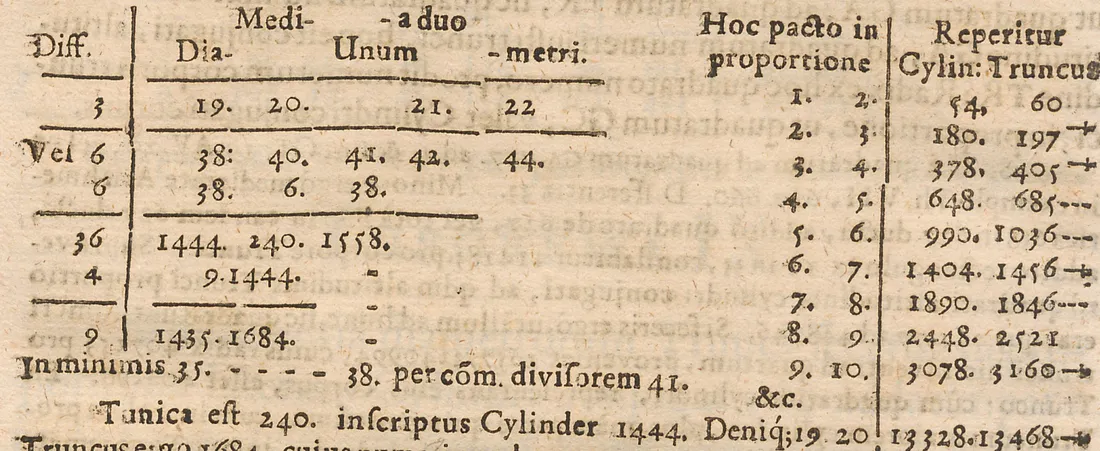
| Diff. | Dia- | Medi- | Unum | — a duo | — metri. |
|---|---|---|---|---|---|
| 3 | 19. | 20. | 21. | 22 | |
| Vel 6 | 38: | 40. | 41. | 42. | 44. |
| 6 | 38. | 6. | 38. | ||
| 36 | 1444. | 240. | 1558. | ||
| 4 | 9. | 1444. | — | ||
| 9 | 1435. | 1684. | — | ||
| In minimis 35. | — — — — | 38. per cōm. divisorem 41. |
| Hoc pacto in proportione | Reperitur Cylin: | Truncus | |
|---|---|---|---|
| 1. | 2. | 54. | 60 |
| 2. | 3. | 180. | 197 + |
| 3. | 4. | 378. | 405 + |
| 4. | 5. | 648. | 685 − |
| 5. | 6. | 990. | 1036 − |
| 6. | 7. | 1404. | 1456 + |
| 7. | 8. | 1890. | 1846 − |
| 8. | 9. | 2448. | 2521 |
| 9. | 10. | 3078. | 3160 + |
| &c. | |||
| Deniq; 19 | 20 | 13328. | 13468 + |
| Diff. | Dia- | One | mean | — two | — meters. |
|---|---|---|---|---|---|
| 3 | 19. | 20. | 21. | 22 | |
| Or 6 | 38: | 40. | 41. | 42. | 44. |
| 6 | 38. | 6. | 38. | ||
| 36 | 1444. | 240. | 1558. | ||
| 4 | 9. | 1444. | — | ||
| 9 | 1435. | 1684. | — | ||
| In least terms 35. | — — — — | 38. by the common divisor 41. |
| In this way, in the ratio | the cylinder is found | the frustum | |
|---|---|---|---|
| 1. | 2. | 54. | 60 |
| 2. | 3. | 180. | 197 + |
| 3. | 4. | 378. | 405 + |
| 4. | 5. | 648. | 685 − |
| 5. | 6. | 990. | 1036 − |
| 6. | 7. | 1404. | 1456 + |
| 7. | 8. | 1890. | 1846 − |
| 8. | 9. | 2448. | 2521 |
| 9. | 10. | 3078. | 3160 + |
| etc. | |||
| Finally 19 | 20 | 13328. | 13468 + |
Tunica est 240. inscriptus Cylinder 1444. Truncus ergo 1684, cuius numeri quadratum 2 835 856 multiplicatum in 33, & factus divisus per 38. prodit 2611972, & hinc radix 1616 + pro corpore. Trunci, qualium corpus Cylindri conjugati est 1558. pars minor centesimâ secundâ in excessu est.
The coat is 240, the inscribed cylinder 1444, and so the frustum 1684, the square of which number, 2 835 856, multiplied by 33, and the product divided by 38, gives 2611972, and from this the root 1616 + for the body of the frustum, of parts of which the body of the conjugate cylinder is 1558: the excess is less than a fifty-second part.
Consideratio Analogiæ.
Consideration of the analogy.
Hactenus fuerunt Theoremata aliquot, quibus utitur Calculus inquirendæ proportionis inter Conicum Truncum & suum Cylindrum conjugatum. Ex hoc verò calculo multa desumuntur consideratione dignissima. Nam primùm per Corollaria II. & III. praxesque varias inter se comparatas, apparet, non semper eandem esse proportionem Trunci ad Cylindrum, in vna aliqua conjugatione, sed variari cum variata proportione Diametrorum Trunci. Et in Corollario quidem II. inventus est decrescere Truncus manente Cylindro: in Corollario verò III crevit truncus, rursum manente Cylindro. Nam in infima linea excessit Cylindrum parte minus centesima, superius parte minus tricesima octava, inde tricesima tertia, & sic semper maiori, usque ad summam lineam, ubi erat pars omninò decima in excessu. Necesse autem est, si continuetur calculus ulteriùs, Truncum tandem fieri iterum minorem cylindro, in eadem conjugatione. Quæritur ergo quis Truncus in qualibet conjugatione sit maximus, quis item cylindro conjugato æqualis. Secundò apparuit ex tribus Corollarijs & calculo adjuncto, Vicissitudinem hîc aliquam esse inter conjugationes proportionis dupla maioris, & inter conjugationes, minoris. Nam in qua conjugatione regnat proportio dupla, in ea primùm omnium, Truncus omnis videtur minor existere cylindro, licet insensibiliter, sic, ut cylinder ipse, veluti Truncorum omnium primus, & proportio diametrorum ejus, quæ est proportio æqualitatis, sit Truncorum omnium maximus & sibi ipse æqualis; in qua verò conjugatione regnat proportio maior duplà, trunci omnes, etiam proximi ipsi cylindro, sensibiliter minores fiunt cylindro conjugato: an ergò vicissim, in qua proportio regnat minor duplà, Trunci primùm cylindro evadant maiores, usque ad certam metam; inde rursum decrescant, fiantque tandem cylindro suo æquales, deinde minores; donec tandem Trunci penitus evanescant, manente cylindro conjugationis? Tertiò, cum omnium coniugationum cæterarum cylindri sint minores cylindro coniugationis duplà proportione usæ: crescant verò trunci aliquarum coniugationum supra suos cylindros coniugatos: quæritur num hic excessus tantus sit, ut æquet vel superet cylindrum per coniugationes omnes maximum, & si hoc, quæ sint ergo diametrorum proportiones, in quibus truncus fiat cylindro maximo æqualis? Hæc igitur sequentibus aliquot Theorematis nobis sunt expedienda, quantum quidem eius per meam scientiam fieri poterit: sunt enim ad æstimationem & comparationem doliorum cumprimis necessaria.
These, then, were some theorems used by the calculation for finding the ratio between a conical frustum and its conjugate cylinder. And from this calculation many things most worthy of consideration are drawn. For first, by Corollaries II and III and the various practices compared with one another, it appears that the ratio of frustum to cylinder is not always the same in any one conjugation, but varies as the ratio of the frustum’s diameters varies. And in Corollary II the frustum was found to decrease while the cylinder stayed the same; but in Corollary III the frustum grew, the cylinder again staying the same. For in the lowest line it exceeded the cylinder by less than a hundredth part, higher up by less than a thirty-eighth, then a thirty-third, and so always by a greater part, up to the top line, where the excess was a full tenth. But if the calculation is continued further, the frustum must at last become less than the cylinder again, in the same conjugation. It is asked, then, which frustum in any conjugation is the greatest, and which is equal to the conjugate cylinder. Second, it appeared from the three corollaries and the calculation added that there is some alternation here between conjugations of more than double ratio and conjugations of less. For in the conjugation where the double ratio reigns, in that first of all every frustum seems to be less than the cylinder, though imperceptibly, so that the cylinder itself, as the first of all the frustums, with its ratio of diameters, which is the ratio of equality, is the greatest of all the frustums and equal to itself; but in a conjugation where a ratio greater than double reigns, all the frustums, even those next to the cylinder itself, become perceptibly less than the conjugate cylinder. Is it then, conversely, that in one where a ratio less than double reigns, the frustums first become greater than the cylinder, up to a certain limit, then decrease again, and become at last equal to their cylinder and then less, until finally the frustums vanish altogether, the cylinder of the conjugation remaining? Third, since the cylinders of all the other conjugations are less than the cylinder of the conjugation using the double ratio, while the frustums of some conjugations grow beyond their conjugate cylinders: it is asked whether this excess is so great as to equal or exceed the cylinder that is greatest over all conjugations; and if so, what then are the ratios of the diameters in which a frustum becomes equal to the greatest cylinder? These things, then, we must work out in the following theorems, as far at least as my knowledge allows; for they are above all necessary to the estimation and comparison of barrels.
Theorema X.
Theorem X.
In omni conjugatione, Trunci per augmentum proportionis diametrorum tandem fiunt minores quacunque data quantitate solida.
In every conjugation the frustums, by the increase of the ratio of the diameters, at last become less than any given solid quantity.
Sit coniugatio quæcunque, cuius proportio CG ad GA: dico dari truncum, ut CTA, eiusdem coniugationis, scilicet in quo sit CT, ad TA, ut CG ad GA, minorem quacunque proposita quantitate solida. Hoc verò demonstratu est facile. Nam minui possunt latera figuræ CT, TA, semper manente inter ea proportione, quæ est inter CG ad GA, eòusque dum CT, TA æquent junctæ diagonion CA, quando tria latera VC, CT, TA juncta, æquant quartum VA, quæ est proportio diametrorum CT, ad VA, quanta potest esse in hac coniugatione, maxima: quo casu truncus omnis in basin seu in planitiem circuli VA subsidit. Superficies verò quantacunque, minor est omni quantitate solida.
Let there be any conjugation, whose ratio is CG to GA. I say that there is a frustum of the same conjugation, such as CTA, namely one in which CT is to TA as CG to GA, less than any proposed solid quantity. This is easy to prove. For the sides CT, TA of the figure can be diminished, the ratio between them always remaining that of CG to GA, until CT and TA together equal the diagonal CA, when the three sides VC, CT, TA together equal the fourth, VA, which is the greatest ratio of the diameters CT to VA there can be in this conjugation; in which case the whole frustum sinks into its base, that is, into the plane of the circle VA. And a surface, however great, is less than any solid quantity.
Theorema XI.
Theorem XI.
Cylinder æqualis Trunco æquealto, basin habet compositam ex duarum basium Trunci & earum medij proportionalis Trientibus singulis.
A cylinder equal to a frustum of equal height has a base made up of a third each of the frustum’s two bases and of their mean proportional.
| 3. 5. | 15. bis 30. | |
| 3. 5. | Diff. 2. 2. | 4 |
| 9. 25. — 34. | 34 |
| 3. 5. | 15. twice 30. | |
| 3. 5. | Diff. 2. 2. | 4 |
| 9. 25. — 34. | 34 |
Nam rectangulum sub diametris Trunci, est æquale quadrato mediæ proportionalis inter diametros, per 17. VI. Eucl. & duo talia rectangula, vnâ cum quadrato differentiæ, constituunt duo quadrata duarum diametrorum, sub quibus rectangula continentur per 7. II. Eucl. Tria ergo rectangula, vna cum quadrato differentiæ, sunt æqualia tribus quadratis, & duarum diametrorum in basibus, & mediæ proportionalis. Rectangulum igitur unum, cum triente quadrati differentiæ, æquat tertiam partem summæ quadratorum proportionalium, & sic iunctos singulos singulorum Trientes. Vt vero rectangulū, cum triente dicto, ad quadrata basium trunci, sic corpus trunci ad corpora Cylindrorum æquealtorū, super trunci basibus, per XVII. p. imæ. Quare etiam ut tres dicti trientes, ad quadrata basium, sic corpus trunci (& sic etiam cylindri trunco æqualis) ad corpora Cylindrorum super trunci basibus æquealtorum. Cùm autem talium bases ipsæ, sint ut corpora; etiam sic erit basis cylindri, trunco æqualis, ad bases duas trunci: itaque constabit ex earum & mediæ proportionalis trientibus singulis.
For the rectangle under the frustum’s diameters is equal to the square of the mean proportional between the diameters, by Euclid VI, 17; and two such rectangles, together with the square of the difference, make the two squares of the two diameters under which the rectangles are contained, by Euclid II, 7. Three rectangles, then, together with the square of the difference, are equal to three squares, of the two diameters of the bases and of the mean proportional. So one rectangle, with a third of the square of the difference, equals a third of the sum of the proportional squares, and so a third of each of them together. And as the rectangle with the said third is to the squares of the frustum’s bases, so is the body of the frustum to the bodies of the cylinders of equal height on the frustum’s bases, by XVII of the first part. So also as the said three thirds are to the squares of the bases, so is the body of the frustum (and so also of the cylinder equal to the frustum) to the bodies of the cylinders of equal height on the frustum’s bases. And since the bases of such cylinders are as their bodies, so too will the base of the cylinder equal to the frustum be to the frustum’s two bases; so it will be made up of a third each of them and of the mean proportional.
Clavius lib V Geometriæ Practicæ, cap. III. utitur hoc theoremate non nihil transformato, quod & supra tetigi: sed principia demonstrationis adhibet difficiliora, nec evidenter cum meis connexa; lucis ergo causa meis principijs uti malui.
Clavius, in Book V of his Practical Geometry, chapter III, uses this theorem somewhat transformed, as I touched on above too; but he uses more difficult principles of proof, not plainly connected with mine; so for clarity’s sake I have preferred to use my own principles.
Exemplum. Sint diametri 19. 22, duc utramque in seipsam, & in se mutuò: erunt quadrata 361. & 484 & medium proportionale 418. Summa omnium 1263, cuius pars tertia 421 pro corpore Trunci, ut 361 est corpus Cylindri minoris.
Example. Let the diameters be 19 and 22; multiply each by itself and by each other: the squares will be 361 and 484, and the mean proportional 418. The sum of all is 1263, whose third part, 421, is for the body of the frustum, as 361 is the body of the lesser cylinder.
Theorema XII.
Theorem XII.
Cylindri habentis altitudinem eandem cum Trunco recto, & diagonion eandem, diameter basis est mediū arithmeticum inter diametros basium Trunci.
The base diameter of a cylinder having the same height as a right frustum and the same diagonal is the arithmetic mean between the diameters of the frustum’s bases.
Sit cylinder CEAS, diagonium habens CA, & super ea truncus rectus CTAV, cuius altitudo TR, æqualis altitudini cylindri EA vel CS. Dico basis cylindri diametrum CE, medium esse arithmeticum inter CT, AV, diametros basium trunci. Cùm enim truncus ponatur rectus, & latera acclivia CV, TA, æqualia, æquales vero etiam EA, & CS, & anguli S, E, recti, quippe in sectione cylindri per axem: quare etiam VS & TE, latera triangulorum VSC, TEA, erunt æqualia Est autem æqualis CE ipsi SA: quantum igitur CE excedit CT, sc quantitate TE; tantum etiam ipsa AV excedit AS vel CE, quantitate sc. æquali VS Est igitur CE medium arithmeticum inter CT, VA. q. e. d.
Let there be the cylinder CEAS, with diagonal CA, and on it the right frustum CTAV, whose height TR is equal to the height EA or CS of the cylinder. I say that CE, the diameter of the cylinder’s base, is the arithmetic mean between CT and AV, the diameters of the frustum’s bases. For since the frustum is supposed right, and its sloping sides CV, TA equal, and EA and CS also equal, and the angles at S and E right, being in the section of a cylinder through its axis: VS and TE, sides of the triangles VSC, TEA, will also be equal. And CE is equal to SA. By as much as CE exceeds CT, then, namely by the quantity TE, by so much AV exceeds AS or CE, namely by the equal quantity VS. CE is therefore the arithmetic mean between CT and VA; which was to be proved.
Theorema XIII.
Theorem XIII.
Excessus trunci, habentis eandem cum Cylindro altitudinem, eandemque diagonion, proportionem ad illum habet, quam pars duodecima quadrati differentiæ ad quadratum de diametro Cylindri.
The excess of a frustum having the same height and the same diagonal as a cylinder has to the cylinder the ratio of a twelfth of the square of the difference to the square of the cylinder’s diameter.
Concipiatur cylinder, basi CT, altitudine eadem TR, quam habet truncus CTAV: erit huius cylindri proportio ad cylindrum, basi CE, altitudine eadem, quæ quadrati CT ad quadratum CE: & ut hæc quadrata ad communem differentiam, sic cylindri CT, CE ad limbum, quem maior cylinder CE, minori CT circumponit. Sed differentia quadratorum constat rectangulis duobus sub CT, TE, & quadrato TE, quæ est dimidia differentia CT, AV, dimidia scilicet AB, hoc est AR. Vicissim cylindro basi CT, circumjecta est tunica trunci CTAV, cuius Tunicæ proportio ad inscriptum Cylindrum CT est eadem, quæ rectanguli sub AB, BV (vel CT.) cum Triente quadrati de AB, ad quadratum CT. Rectangulum verò sub AB, CT est æquale duobus rectangulis sub ET, TC; quia AB est dupla ipsius ET. Ablatis igitur his utrinque æqualibus; illic quidem, quadratum CE maioris, superaddit quadrato CT, quadratum AR, hoc est, quartam partem quadrati AB: Hic vero superadditur eiusdem quadrati AD Triens. Sed Triens quadrantem superat Vnciâ: unâ igitur unciâ de quadrato AB plus additur hic quàm illic. Tanto igitur maior est Tunica Trunci, limbo cylindri super basi CE. Quare communi utrinque cylindro super basi CT addito, trūcus CTAV, cylindro CEAS maior erit, parte dicta.
Let a cylinder be imagined with base CT and the same height TR as the frustum CTAV: the ratio of this cylinder to the cylinder with base CE and the same height will be that of the square of CT to the square of CE; and as these squares are to their common difference, so are the cylinders CT, CE to the rim that the greater cylinder CE puts round the lesser CT. But the difference of the squares consists of two rectangles under CT, TE, and the square of TE, which is half the difference of CT and AV, namely half of AB, that is, AR. In turn, round the cylinder with base CT is put the coat of the frustum CTAV, and the ratio of this coat to the inscribed cylinder CT is the same as that of the rectangle under AB, BV (or CT) with a third of the square of AB, to the square of CT. And the rectangle under AB, CT is equal to two rectangles under ET, TC, since AB is twice ET. Taking these equals away on both sides, there the square of the greater CE adds to the square of CT the square of AR, that is, a quarter of the square of AB; but here a third of the same square AD is added. And a third exceeds a quarter by a twelfth: so here one twelfth of the square of AB more is added than there. By so much, then, is the frustum’s coat greater than the rim of the cylinder on the base CE. So, the cylinder on the base CT, common to both, being added, the frustum CTAV will be greater than the cylinder CEAS by the said part.
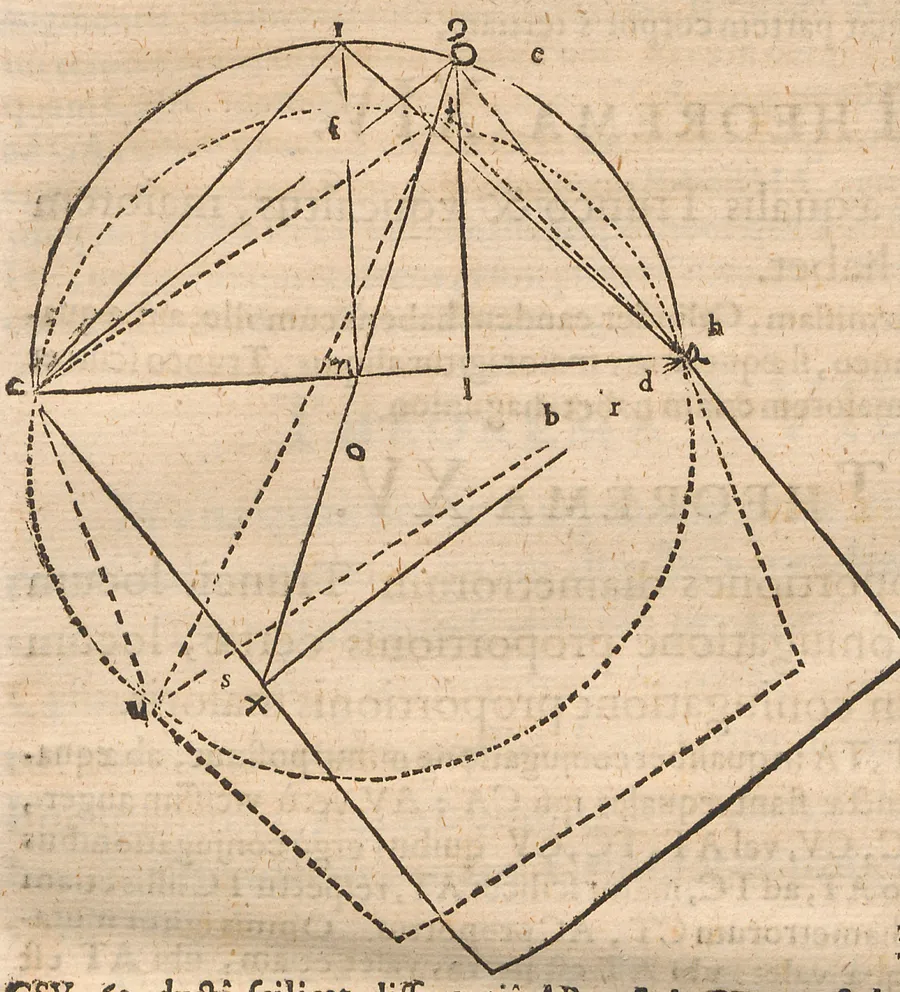
Exemplum. Truncus habeat diametros, CT 19, AV 22. Erit, ex prædictis, cylinder CTRS Trunco inscriptus, ut 361, quadratum de 19. Truncus verò CTAV addet ei Tunicam TRA, CSV, 60. ductâ scilicet differentiâ AB. 3. & in CT. 19, & in partem sui tertiam 1, hoc est in 20: fierque corpus Trunci CTAV 421. Medium verò arithmeticum inter 19 & 22 est 20 semis, & habet quadratum 420 cum quadrante, pro corpore cylindri CE. Nam differentiæ AB 3 dimidium TE, sesqui, multiplicatum in minorem TC 19 bis, creat 57: idem TE sesqui, in seipsum, creat duo cum quadrante. Summa limbi TE circa TC, 59 & quadrans: quem adde cylindro CT 361. prodit, ut dictum, 420 cum quadrante. Cylinder igitur CEAS, minor est Trunco CTAV, tribus quadrantibus unius, qui sunt pars duodecima de quadrato 9, totius differentiæ AB 3.
Example. Let the frustum have the diameters CT 19 and AV 22. The cylinder CTRS inscribed in the frustum will be, by the foregoing, as 361, the square of 19. And the frustum CTAV will add to it the coat TRA, CSV, 60, the difference AB, 3, being multiplied both by CT, 19, and by its own third part, 1, that is, by 20; and the body of the frustum CTAV will be 421. And the arithmetic mean between 19 and 22 is 20½, which has the square 420¼, for the body of the cylinder CE. For TE, 1½, half the difference AB, 3, multiplied by the lesser TC, 19, twice, makes 57; and the same TE, 1½, by itself makes 2¼. The sum of the rim TE about TC is 59¼; add it to the cylinder CT, 361: the result, as said, is 420¼. The cylinder CEAS, then, is less than the frustum CTAV by three quarters of one, which are the twelfth part of 9, the square of the whole difference AB, 3.
Corollarium & Analogia.
Corollary and Analogy.
Auctâ differentia diametrorum Trunci, manente altitudine & cylindro æquealto super eadem diagonio, augetur etiam hic excessus trunci. Atqui potest augeri differentia AB, usque dum fiat æqualis medio arithmetico inter diametros, quando scilicet CT in punctum vanescit, VA verò fit duplum diametri CE, in basi cylindri dicti: tunc enim venitur ad terminum truncorum omnium, scilicet ad Conum, qui diagonion eandem habet cum latere, creante superficiem Coni.
When the difference of the frustum’s diameters is increased, the height and the cylinder of equal height on the same diagonal remaining, this excess of the frustum increases too. And the difference AB can be increased until it becomes equal to the arithmetic mean between the diameters, namely when CT vanishes into a point and VA becomes twice the diameter CE of the base of the said cylinder: for then we come to the limit of all frustums, namely to the cone, which has the same diagonal as the side that creates the surface of the cone.
Talis verò Conus, altitudine eâdem cum cylindro CE, basi verò, cuius diameter sit dupla, uti dictum, ad diametrum cylindri CE, est ad illum suum cylindrum in proportione sesquitertia. Cùm enim diametrorum sit proportio dupla, circulorum erit quadrupla, quare & Cylindrorum æquealtorum super ijs basibus, si cylinder, staret super basi Coni. Per Th III. & XVII. p. primæ. At coni corpus, per IV. illius, est subtriplum Cylindri huius quadranti, basi sc. & altitudine ijsdem.
And such a cone, with the same height as the cylinder CE and a base whose diameter is twice, as was said, the diameter of the cylinder CE, is to its cylinder in the ratio 4 : 3. For since the ratio of the diameters is 2 : 1, that of the circles will be 4 : 1, and so too that of cylinders of equal height on those bases, if a cylinder stood on the base of the cone, by Theorems III and XVII of the first part. But the body of the cone, by IV of that part, is a third of this fourfold cylinder, with the same base and height.
Hic igitur terminus est, quem nullus Truncus assequitur. Nullus inquam truncus Cylindro æquealto, medium arithmeticum habenti in diametro basis, adjicit partem corporis tertiam.
This, then, is the limit that no frustum reaches. No frustum, I say, adds a third part of its body to a cylinder of equal height that has the arithmetic mean for the diameter of its base.
Theorema XIV.
Theorem XIV.
Cylinder æqualis Trunco & æquealtus, maiorem illo diagonion habet.
A cylinder equal to a frustum and of equal height has a greater diagonal than it.
Nam per præmissam, Cylinder eandem habens cum illo, aut æqualem, minor est Trunco, si æquealtus; maior igitur aliquis, Trunco scilicet æquealto æquali, maiorem etiam habet diagonion.
For by the previous theorem a cylinder having the same or an equal diagonal is less than the frustum if of equal height; so a greater one, namely one equal to a frustum of equal height, has a greater diagonal too.
Theorema XV.
Theorem XV.
Omnes proportiones diametrorum Trunci, locum habentes in coniugatione proportionis certæ, locum etiam habent in coniugatione proportionis maioris.
All the ratios of the frustum’s diameters that have place in a conjugation of a certain ratio also have place in a conjugation of greater ratio.
Nam quia CT, TA in qualibet conjugatione minui possunt, ab æqualitate, usque dum junctæ fiant æquales ipsi CA: AV verò vicissim augeri, usque dum æquet AC, CV, vel AT, TC, CV quibus ergò conjugationibus minor est proportio AT, ad TC, maior scilicet AT, respectu TC: illis etiam plus variari potest diametrorum CT, AC proportio. Omnis igitur mutatio proportionis, quæ valet, ubi AT est parva, valet etiam, ubi AT est maior; sed ibi ubi AT est maior, plures valent.
For since in any conjugation CT and TA can be diminished from equality until together they become equal to CA, and AV in turn increased until it equals AC, CV, or AT, TC, CV: in those conjugations in which the ratio of AT to TC is less, that is, AT greater relative to TC, the ratio of the diameters CT, AC can vary more. So every change of ratio that holds where AT is small holds also where AT is greater; but where AT is greater, more hold.
Propter hunc igitur concursum Conjugationum variarum, in ijsdem proportionibus diametrorum, locum habet sequens comparatio.
Because of this meeting of various conjugations in the same ratios of diameters, then, the following comparison has its place.
Theorema XVI.
Theorem XVI.
Omnis Cylinder, altior maximo, super eadem diagonio, habet ex Cylindris maximo humilioribus, socium sibi æqualem, quem subcontrarium dicemus.
Every cylinder taller than the greatest, on the same diagonal, has among the cylinders lower than the greatest a companion equal to it, which we shall call its counterpart.
Nam cum proportio basium permutata est proportionis altitudinum; Cylindri æquales existunt Respiciatur igitur Schema XIX, in quo sit CGA Cylinder maximus, basi CG, altitudine GA. Sumatur altior illo CHA, dico inveniri humiliorem, ut CBA, cuius BA altitudo, sit ad HA altitudinem prioris, ut est basis vel quadratum CH, ad quadratum CB. Nam ubi maius datur & minus, ibi datur & æquale. Sed CH quadratum crescit à quantitate nulla, continuè cum lineis CQ, CI, CH, CG, CB, CP, usque ad quadratum diametri CA, faciens proportiones omnis generis. Vicissim altitudo, initio sumpto à longitudine diametri AC, decrescit cum lineis AQ, AI, AH, AG, AB, AP, per omnes itidem proportiones, sic ut fiat proportio quacumque data proportione maior, donec altitudo absumatur in punctum A. Ergò ubi decrementa altitudinum AB, præcipitantur per omnes proportiones, in infinitum crescentibus proportionum augmentis, ibi incrementa quadratorum CB, magis magis minuuntur, & incrementa proportionum decrescunt. Et cum detur Cylinder humilior, quàm CHA, idemque maior eo, ut est CGA, eoque minori proportione HA ad GA, quam quadrati CG ad CH: descendendo igitur versus B, transitus erit per aliquod punctum, ubi proportio BA ad HA, quæ prius erat minor, (quippe plus crescens) fiat equalis proportioni quadrati BC ad quadratum HC, quippe minus crescens, cùm prius esset maior. Exempla sunt in calculo ad Th. IV. & V. Cylindrorum æqualium.
For since the ratio of the bases is reversed from the ratio of the heights, there exist equal cylinders. Look back, then, at Schema XIX, in which let CGA be the greatest cylinder, with base CG and height GA. Let a taller one, CHA, be taken. I say that a lower one is found, such as CBA, whose height BA is to the height HA of the first as the base or square of CH to the square of CB. For where a greater and a lesser are given, an equal is given too. But the square of CH grows from no quantity continually with the lines CQ, CI, CH, CG, CB, CP, up to the square of the diameter CA, making ratios of every kind. In turn, the height, starting from the length of the diameter AC, decreases with the lines AQ, AI, AH, AG, AB, AP, likewise through all ratios, so that a ratio greater than any given ratio comes about, until the height is used up in the point A. So where the decreases of the heights AB fall headlong through all ratios, the increases of the ratios growing to infinity, there the increases of the squares CB become less and less, and the increases of the ratios decrease. And since there is a cylinder lower than CHA and also greater than it, such as CGA, and so with a smaller ratio of HA to GA than of the square of CG to CH, then going down towards B the passage will be through some point where the ratio of BA to HA, which before was less (since it grows faster), becomes equal to the ratio of the square of BC to the square of HC, which grows more slowly, though before it was greater. Examples of equal cylinders are in the calculation at Theorems IV and V.
Theorema XVII.
Theorem XVII.
In vna qualibet coniugatione, quæ quadratum diametri habet minus, quam duplum quadrati altitudinis, omnes Trunci ab ipso Cylindro proximi, paulatim fiunt Cylindro coniugato maiores, non obstante quod minuitur eorum altitudo, postea decrescunt iterum, semper adhuc maiores Cylindro coniugato, quoad altitudinem habuerint maiorem, quam Cylinder coniugati subcontrarius.
In any one conjugation whose square of the diameter is less than twice the square of the height, all the frustums next to the cylinder itself gradually become greater than the conjugate cylinder, even though their height decreases; afterwards they decrease again, but are always still greater than the conjugate cylinder so long as they have a height greater than the counterpart of the conjugate cylinder.
In Schemate XIX. sit coniugatio, in qua quadratum diametri HC minus est duplo quadrati HA, & Cylinder huius coniugationis CHA; illi verò sit socius, hoc est æqualis corpore, ex alia coniugatione, Cylinder CBA, basi CB, altitudine BA. Dico primùm; omnes Truncos coniugationis CHA, quibus altitudo fuerit inter HA & BA, maiores esse Cylindris CHA vel CBA. Nam inter socios, CHA, CBA æquales, interest Cylinder maximus CGA, in quo quadratum CG est duplum quadrati GA. Omnes igitur Cylindri CGA, inter GHA & CBA, sunt maiores extremis ad H & B terminatis, per Th. V. huius: Et habent ij altitudines medias inter HA & BA, quemadmodum & Trunci. Per XIII. verò huius, Trunci æquealti Cylindris super eàdem diagonio CA, sunt iis maiores. Quare multò maiores sunt extremis minoribus ad I. B. terminatis.
In Schema XIX let there be a conjugation in which the square of the diameter HC is less than twice the square of HA, and the cylinder of this conjugation CHA; and let its companion, that is, equal in body, from another conjugation, be the cylinder CBA, with base CB and height BA. I say first that all the frustums of the conjugation CHA whose height lies between HA and BA are greater than the cylinders CHA or CBA. For between the equal companions CHA, CBA lies the greatest cylinder CGA, in which the square of CG is twice the square of GA. All the cylinders CGA, then, between GHA and CBA, are greater than the extremes ending at H and B, by Theorem V of this part; and they have heights between HA and BA, as do the frustums. And by XIII of this part frustums of equal height to cylinders on the same diagonal CA are greater than they. So they are much greater than the lesser extremes ending at I and B.
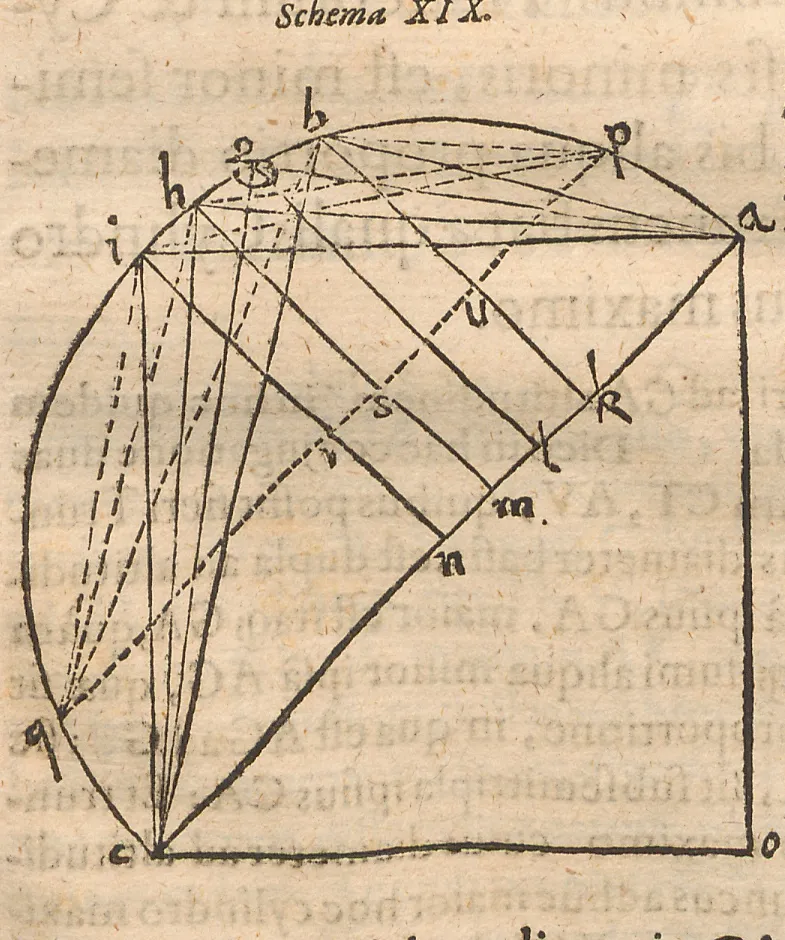
Theorema XVIII.
Theorem XVIII.
In coniugatione proportionis dupla minoris, Truncus æqualis Cylindro coniugato, habet altitudinem, minorem altitudine Cylindri, qui coniugati socius, eidemque æqualis est, coniugationis tamen diversæ.
In a conjugation of less than double ratio, the frustum equal to the conjugate cylinder has a height less than the height of the cylinder that is the companion of the conjugate cylinder and equal to it, but of a different conjugation.
Nam truncus æquealtus tali socio cylindro, qui conjugato sit æqualis, maior est illo, per XIII. Maior igitur est etiam conjugato suo cylindro. Qui igitur coniugato suo est æqualis corpore, non erit eiusdem cum illo altitudinis. Aut igitur altior aut humilior. Non verò altior, per XVII. præmissam: Ergo humilior. Ex eo verò Trunci, per X huius, fiunt minores cylindro conjugato, donec tandem evanescant.
For a frustum of equal height to such a companion cylinder, which is equal to the conjugate one, is greater than it, by XIII; so it is also greater than its conjugate cylinder. One that is equal in body to its conjugate, then, will not be of the same height as that one. So it is either taller or lower. But not taller, by XVII above; so lower. And from there, by X of this part, the frustums become less than the conjugate cylinder, until at last they vanish.
Corollarium.
Corollary.
Posito quod dolia constent puro Trunco conico duplicato: dolia oblonga, ventribus modicis, capaciora sunt cylindricis eàdem figuræ longitudine, ventre carentibus: nunquam verò fit, ut habeant ventres adeò immanes & prodigos, per quos rursum fiant minus capacia dolijs cylindricis eàdem figuræ longitudine.
Supposing barrels to consist of a pure doubled conical frustum: oblong barrels with moderate bellies are more capacious than cylindrical ones of the same length of figure without a belly; but it never happens that they have bellies so huge and extravagant as to make them in turn less capacious than cylindrical barrels of the same length of figure.
Theorema XIX.
Theorem XIX.
In omnibus conjugationibus Truncorum & Cylindri, quibus diameter basis minoris, est minor semidupla lateris acclivis, datur bis aliqua proportio diametrorum Trunci, per quam Truncus fiat æqualis Cylindro ex omnibus conjugationibus maximo.
In all conjugations of frustums and cylinder in which the diameter of the lesser base is less than √2 times the sloping side, there is twice some ratio of the frustum’s diameters by which the frustum becomes equal to the cylinder that is greatest over all conjugations.
Sit GC, diameter basis Cylindri, ad GA altitudinem (in hoc quidem Theoremate) minor quàm semidupla. Dico in hac conjugatione duas occurrere proportiones diametrorum CT, AV, quibus possit fieri Truncus æqualis cylindro maximo, cuius diameter basis, est dupla ad altitudinem Nam si GC minor est semiduplà ipsius GA, maior est itaque GA, quàm subsemitripla ipsius CA: potest itaque sumi aliqua minor ipsâ AG, quæ sit AT, & ad AT comparari TC, in ea proportione, in qua est AG ad GC; sic ut perpendiculum ex T, hoc est TR, sit subsemitripla ipsius CA: Et truncus ATCV, fiet æquealtus cylindro maximo, cuius diameter ad altitudinem semidupla. Erit itaque talis truncus adhûc maior hoc cylindro maximo, per Th. XIII. huius partis. Et quia, per XIV. huius, cylinder æquandus, si fuerit Trunco æquealtus, diagonium habet maiorem: diagonium igitur habens minorem, scilicet eandem cum Trunco æquali futuro, debet habere altitudinem Trunco maiorem, ut quod amisit, abbreviatione diagonij, recuperet incremento altitudinis: Id est, Truncus illi futurus æqualis, debet fieri minor eo, qui est æquealtus cylindro maximo, super eadem diagonio constructo. Id autem fieri potest duobus modis. Etenim, cum Cylinder in vna qualibet conjugatione sit Truncorum omnium principium; Sit verò in conjugationibus hic propositis, cylinder minor cylindro maximo, erunt etiam Trunci, à cylindro suo conjugato proximi, eòque altiores, cylindro maximo minores. Inde verò per augmentum AB differentiæ diametrorum CT, AV, crescunt, usque dum fiant maiores cylindro maximo, ut jam est demonstratum. In hoc igitur incremento ipsius AB, quoad TR minor fuerit altitudine GA, cylindri sui conjugati, maior verò altitudine cylindri maximi; contingit semel, Truncum æqualem fieri cylindro maximo. At non crescunt in infinitum trunci eiusdem conjugationis, crescente AB, sed per X & XVIII. huius, iterum decrescunt: qua in variatione contingit secundò, Truncum fieri æqualem cylindro maximo. Et quia, qui æquealtus erat maximo (cuius TR sub-semitripla ipsius AC) maior erat illo maximo; minoris igitur factus altitudinis, quàm cylinder maximus, fiet illi aliquando iterum æqualis Adhuc igitur est minuenda TA amplius. Minutâ vero TA, & cum ea TC proportionaliter, minuitur quadratum TA: Manet vero quadratum CA: augetur igitur rectangulum TC, AV residuum: sed eius latitudo TC minuitur, ut dictum: vicissim igitur, & duobus quidem nominibus, augetur longitudo rectanguli AV: qua ratione constituitur proportio certa TC ad AV, qua usus Truncus, fit æqualis cylindro maximo secundò. Quod erat demonstrandum.
Let GC, the diameter of the cylinder’s base, be to GA, its height (in this theorem, that is), less than √2 : 1. I say that in this conjugation two ratios of the diameters CT, AV occur by which a frustum can be made equal to the greatest cylinder, whose base diameter is √2 times its height. For if GC is less than √2 times GA, GA is greater than CA divided by √3: so some line less than AG can be taken, AT, and TC compared with AT in the ratio of AG to GC, so that the perpendicular from T, TR, is CA divided by √3; and the frustum ATCV will be of equal height to the greatest cylinder, whose diameter is √2 times its height. Such a frustum will then still be greater than this greatest cylinder, by Theorem XIII of this part. And since, by XIV of this part, the cylinder to be equalled, if of equal height to the frustum, has a greater diagonal, one having a smaller diagonal, namely the same as the frustum that is to be equal, must have a greater height than the frustum, to recover by the increase of height what it lost by the shortening of the diagonal. That is, the frustum that is to be equal to it must become less than the one of equal height to the greatest cylinder built on the same diagonal. And this can happen in two ways. For since in any one conjugation the cylinder is the beginning of all the frustums, and in the conjugations proposed here the cylinder is less than the greatest cylinder, the frustums next to their conjugate cylinder, and so taller, will also be less than the greatest cylinder. But from there, by the increase of AB, the difference of the diameters CT, AV, they grow until they become greater than the greatest cylinder, as has now been proved. In this increase of AB, then, while TR is less than the height GA of its conjugate cylinder and greater than the height of the greatest cylinder, it happens once that the frustum becomes equal to the greatest cylinder. But the frustums of the same conjugation do not grow without end as AB grows; by X and XVIII of this part they decrease again; and in this variation it happens a second time that the frustum becomes equal to the greatest cylinder. And since the one of equal height to the greatest (whose TR is AC divided by √3) was greater than that greatest, once made lower than the greatest cylinder it will at some point become equal to it again. TA must therefore be diminished further. And when TA is diminished, and TC with it proportionally, the square of TA is diminished; but the square of CA remains; so the remaining rectangle TC, AV is increased; but its breadth TC is diminished, as said; so in turn, and on two counts, the length AV of the rectangle is increased; and in this way a certain ratio of TC to AV is set up, by using which the frustum becomes equal to the greatest cylinder a second time. Which was to be proved.
Theorema XX.
Theorem XX.
Trunci variarum coniugationum, eandem habentes inter se diametrorum proportionem, quo propius assecuti fuerint altitudine Cylindrum super eadem diagonio maximum, hoc erunt maiores; quo altiores illo, hoc minores.
Frustums of various conjugations having the same ratio of diameters among themselves will be the greater the nearer they come in height to the greatest cylinder on the same diagonal, and the less the taller they are than it.
Inopinabile & hoc est. Quis non dixerit maiorem esse Truncum, cuius altitudo sit IA, trunco alio, cuius altitudo GA: si eadem utrique diagonios GA, eademque proportio basium minorum ad maiores? Atqui diversum est verum. Sit enim Cylinder maximu, cuius CG diameter basis, ad GA altitudinem, per Th. V, semidupla: & sit truncus, cuius diameter minor in CG lineà, maior in AX (continuatà) sitque earum proportio quæcunque, mediumque inter illas arithmeticum GC, per Th. XII. Cùm igitur basium binarum inter se per diversos Truncos eadem ponatur esse proportio: erit etiam differentiæ earum ad medium arithmeticum proportio per omnes eadem. Ac cum omnis talis Truncus superet cylindrum æquealtum in proportione Vnciæ de quadrato differentiæ diametrorum trunci, ad quadratum medij eorum arithmetici, per Th. XIII. huius; maior igitur erit hic excessus trunci, ubi maior cylinder. Sed cylinder CGA est omnium, super eâdem diagonio maximus: ergo excessus Trunci huius seu Vncia dicta, erit omnium reliquarum per reliquos truncos, eandem diametrorum proportionem habentes, maxima. Ac proinde, quamvis maior sit altitudo trunci quam GA: quia tamen minor cylinder huius altitudinis; minor etiam erit truncus.
This too is unexpected. Who would not say that a frustum whose height is IA is greater than another frustum whose height is GA, if both have the same diagonal GA and the same ratio of the lesser bases to the greater? Yet the truth is otherwise. For let there be the greatest cylinder, whose base diameter CG is to its height GA as √2 : 1, by Theorem V; and let there be a frustum whose lesser diameter is in the line CG and greater in AX (extended), and let their ratio be any whatever, and GC the arithmetic mean between them, by Theorem XII. Since, then, the same ratio of the two bases to each other is supposed through the different frustums, the ratio of their difference to the arithmetic mean will also be the same through them all. And since every such frustum exceeds the cylinder of equal height in the ratio of a twelfth of the square of the difference of the frustum’s diameters to the square of their arithmetic mean, by Theorem XIII of this part, this excess of the frustum will be greater where the cylinder is greater. But the cylinder CGA is the greatest of all on the same diagonal; so the excess of this frustum, or the said twelfth, will be the greatest of all the others through the other frustums having the same ratio of diameters. And therefore, although the height of the frustum is greater than GA, yet because the cylinder of this height is less, the frustum too will be less.
Verbi causa, sumatur proportio diametrorum trunci omnium maxima, hoc est, infinita, sumatur inquam Conus pro Trunco, finis omnium truncorum. Sit Coni altitudo IA, cuius quadratum est semissis quadrati AC. Sitque basis cylindri CIA æquealti, linea CI æqualis altitudini AI. Et quia CI est mediū arithmeticum inter diametrum trunci, earum verò altera est 0. erit igitur reliqua, sc. diameter basis Coni, dupla ipsius CI. Hic igitur pro corpore huius coni ducenda est pars tertia de AI in quadratū duplæ CI, quod est quadruplum quadrati CI: duplum ergo quadrati CA.
For example, let the greatest ratio of a frustum’s diameters of all be taken, that is, an infinite one; let a cone, I say, be taken for the frustum, the end of all frustums. Let the cone’s height be IA, whose square is half the square of AC. And let the base of the cylinder CIA of equal height be the line CI, equal to the height AI. And since CI is the arithmetic mean between the frustum’s diameters, and one of them is 0, the other, namely the diameter of the cone’s base, will be twice CI. Here, then, for the body of this cone a third of AI must be multiplied by the square of twice CI, which is four times the square of CI, and so twice the square of CA.
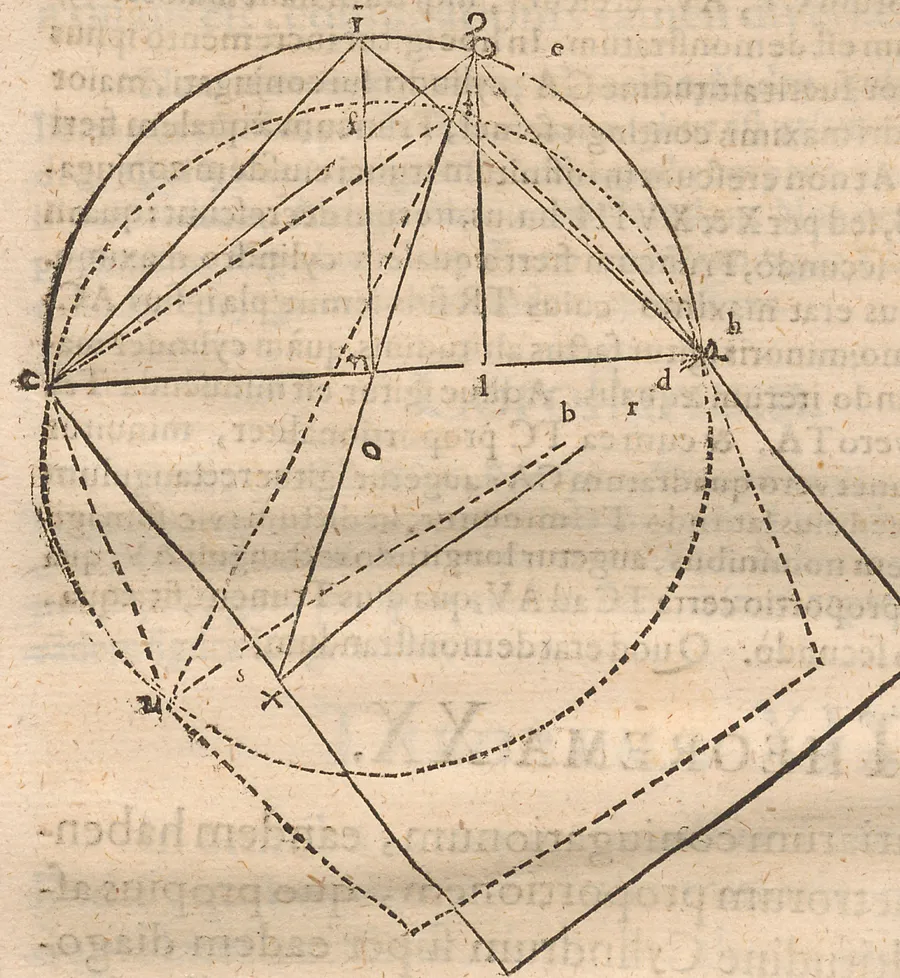
At Conus alius (rursum pro trunco eiusdem proportionis diametrorum) altitudinem habens GA, cuius quadratum est triens de quadrato CA, similiter duplam ipsius GC, habebit diametrum basis, quadratum ergò quadruplum; Est autem quadratum GC bes quadrati AC; quatuor ergo besses, sunt octo tertiæ, quæ duplum seu sex tertias prioris coni superant duabus tertijs, cum ècontra illius quadratum altitudinis, semissem habens quadrati GA, huius altitudinis quadratum, quod est triens quadrati CA, superet tantum unâ sexta quadrati CA. Nec hoc tamen detrimentum omne est censendum: quia non quadrata, sed altitudines ipsæ ducuntur in bases; imò nec altitudines ipsæ, sed trientes tantùm. Maius igitur lucrum est Coni in basi CG longiori, quam damnum in GA altitudine breviori.
But another cone (again taken for a frustum with the same ratio of diameters), with height GA, whose square is a third of the square of CA, will likewise have a base diameter twice GC, and so a square four times as great. And the square of GC is two thirds of the square of AC; so four two-thirds are eight thirds, which exceed the double, or six thirds, of the first cone by two thirds; whereas, on the other hand, the square of the first one’s height, having half the square of CA, exceeds the square of this one’s height, which is a third of the square of CA, by only a sixth of the square of CA. Nor yet must all of this loss be counted: because it is not the squares but the heights themselves that are multiplied by the bases, and indeed not even the heights themselves, but only their thirds. The gain of the cone in the longer base CG, then, is greater than the loss in the shorter height GA.
Theorema XXI.
Theorem XXI.
Ex omnibus truncis conjugationis eiusdem, maximus est ille, qui habet altitudinem Cylindri maximi, subsemitriplam scilicet Diagonii: Ab hoc vero fastigio cæteri omnes, tam qui altiores, quam qui humiliores, iterum decrescunt.
Of all the frustums of the same conjugation the greatest is the one that has the height of the greatest cylinder, namely the diagonal divided by √3; and from this peak all the others, both taller and lower, decrease again.
Demonstrationem legitimam aut refutationem, si opus est, expediant, Snellius, aut Adrianus Romanus, Apollonii Belgæ. Parergon quidem est hic, & Episagma, quod scopum attinet libelli; cognationis tamen causa cum præcedenti hîc adscriptum: cuius similitudo cum hoc, primam mihi fidem fecit: etsi trunci præcedentis Th, non sic coniugati sunt, ut nos hactenus hanc vocem usurpavimus; super eadem tamē & ipsi diagonio sunt descripti, & habent eandem inter se proportionem basium: quemadmodum cæteri coniugati habent eandem inter se proportionem diametri basis minoris ad latus acclive.
Let Snellius or Adriaan van Roomen, the Apolloniuses of the Low Countries, work out a lawful proof, or a refutation if need be. This is indeed a by-work here, and an addendum as far as the aim of the little book goes; yet it is written in here for kinship’s sake with the previous theorem, whose likeness to this gave me my first belief in it: although the frustums of the previous theorem are not conjugate in the sense in which we have so far used that word, yet they too are described on the same diagonal and have the same ratio of bases among themselves, just as the other, conjugate ones have the same ratio of the diameter of the lesser base to the sloping side.
Altera dixis est ex proprietate coniugationis cylindri maximi, & quod in præcedentibus demonstravi, esse aliquam altitudinem trunci coniugati, maiorem altitudine cylindri maximi, aliquam illà minorem; quarum utrarumque trunci sint æquales cylindro maximo: illum ipsum verò, qui est æquealtus maximo, truncus cylindro, corpus habere maius: & utrinque tam versus cylindrum coniugatum, quam versus truncos humilimos, decrescere truncos. Causa igitur nulla apparet, cur alibi in vicinia consistat meta corporis incrementorum, quam in hac ipsa.
A second showing comes from the property of the conjugation of the greatest cylinder, and from what I proved above: that there is some height of a conjugate frustum greater than the height of the greatest cylinder, and some less, the frustums of both of which are equal to the greatest cylinder; but that the frustum of equal height to the greatest cylinder itself has a greater body; and that on both sides, both towards the conjugate cylinder and towards the lowest frustums, the frustums decrease. No reason appears, then, why the limit of the increases of the body should lie anywhere else in the neighbourhood than here.
Adde indicium calculi. Sit coniugatio, in qua diameter CI, æquet altitudinem IA, & sit huius coniugationis truncus, æquealtus cylindro CGA, hic maximo, sc. cuius diameter CG, semidupla ad GA altitudinem. Ergo minor trunci diameter erit in CG, est autem æqualis lateri acclivi, quippe ponitur ad id esse, ut CI, ad IA. Est igitur CF diameter minor, secans IN, perpendicularem ex centro N, in puncto F, & FA latus acclive. Vt igitur CL ad CG sic CN ad CF. Sed CL est bes de GA, & quadratum CL quatuor nonæ de quadrato CA; & quadratum CN est quarta pars de quadrato CA, denique quadratum CG est bes de quadrato CA. Vt autem CL, quatuor nonæ, ad bessem CG, sic pars quarta CN ad CF tres octavas. Ergo quadratum CF erunt tres octavæ quadrati CA: tantum verò est etiam quadratum altitudinis FA. Ablatæ igitur tres octavæ de quadrato CA, relinquunt quinque octavas, rectangulo sub CF diametro minore & opposita diametro maiore, quæ cum AX coincidit, excurrens ultra X. Cùm ergo quadratum CF, & rectangulum diametrorum CF & maioris, habeant latitudinem eandem CF; longitudines earum erunt ut plana ipsa, scilicet ut tria ad quinque. Hæc est igitur proportio diametrorum trunci qui ex hac coniugatione est æquealtus cylindro maximo. Quare, per XIII huius, ut quadratum 16, medii eorum arithmetici 4, sc. ipsius CG, ad Vnciam quadrati 4, differentiæ diametrorum 2, (vncia verò de 4 est triens) sic corpus cylindri CGA maximi ad excessum CFA trunci æquealti: truncus ergò excedit cylindrum maximum triente unius sedecimæ, seu parte quadragesima octavâ corporis cylindri CGA. Quæratur igitur proportio cylindri maximi CGA ad cylindrum coniugatum CIA. Est quadratum basis CI, semissis quadrati CA; sed quadratum CG, est bes quadrati CA: quare proportio basium CI ad CA ut 3 ad 4. Vicissim quadratum altitudinis IA est semissis, quadratum altitudinis GA est triens quadrati CA: proportio igitur quadratorum, IA ad GA est ea quæ 3. ad 2. vel quæ 9 ad 6: ipsarum igitur linearum IA ad GA proportio est dimidia, sc. quæ 30000 ad 24495- vel huius ad 20000. Componitur autem proportio corporum ex proportione basis & proportione altitudinum. Ductis igitur in se mutuò terminis analogis, proportio cylindri CIA ad cylindrum CGA, provenit eadem, quæ 9000 ad 9798-. Supra Theor. III, Columnarum ex his conjugationibus, proportio erat quæ 2828- ad 3080-. Quòd si hunc numerum cylindri CGA, commuto in 16, seu in 48 trientes, numerum priorem, erit in hac proportione numerus cylindri CIA 44. Est ergo cylinder CIA, ad truncum CFA conjugatum, ut 44 ad 49, & truncus maior parte paulò plus nonâ. Id verò consonum est huic Theoremati & Corollario III. Th. IX. huius partis; ibi enim cum esset proportio diametrorum, quæ 2 ad 3, hoc est quæ 20. ad 30, truncus excedebat parte paulò plus undecimà, crescens: crevit igitur usque dum esset proportio quæ 3. ad 5, id est, quæ 18 ad 30, tunc maximè truncus excessit parte plus nonâ, ut hic probatum. Vlterius, quando fuit proportio, quæ 1. ad 2. hoc est quæ 15 ad 30, truncus iterum decrevit, ut excederet parte tantum nonà. Quod igitur in vna conjugatione fit, ut truncus æquealtus cylindro maximo, plurimum excrescat super cylindrum conjugatum, id in omnibus fieri consentaneum est.
Add the evidence of calculation. Let there be a conjugation in which the diameter CI equals the height IA, and let there be a frustum of this conjugation of equal height to the cylinder CGA, here the greatest, namely the one whose diameter CG is √2 times its height GA. The frustum’s lesser diameter, then, will be in CG, and it is equal to the sloping side, since it is supposed to be to it as CI to IA. So CF is the lesser diameter, cutting IN, the perpendicular from the centre N, at the point F, and FA is the sloping side. As CL to CG, then, so CN to CF. But CL is two thirds of GA, and the square of CL four ninths of the square of CA; and the square of CN is a quarter of the square of CA; and finally the square of CG is two thirds of the square of CA. And as CL, four ninths, is to CG, two thirds, so is CN, a quarter, to CF, three eighths. So the square of CF will be three eighths of the square of CA; and the square of the height FA is as much. Three eighths, then, taken from the square of CA, leave five eighths for the rectangle under CF, the lesser diameter, and the opposite, greater diameter, which coincides with AX, running out beyond X. Since, then, the square of CF and the rectangle of the diameters CF and the greater have the same breadth CF, their lengths will be as the planes themselves, namely as three to five. This, then, is the ratio of the diameters of the frustum of this conjugation that is of equal height to the greatest cylinder. So, by XIII of this part, as the square 16 of their arithmetic mean 4, namely of CG, is to a twelfth of the square 4 of the difference 2 of the diameters (and a twelfth of 4 is a third), so is the body of the greatest cylinder CGA to the excess of the frustum CFA of equal height: the frustum, then, exceeds the greatest cylinder by a third of a sixteenth, or a forty-eighth part of the body of the cylinder CGA. Let the ratio of the greatest cylinder CGA to the conjugate cylinder CIA be sought, then. The square of the base CI is half the square of CA, and the square of CG is two thirds of the square of CA: so the ratio of the bases CI to CA is as 3 to 4. In turn, the square of the height IA is a half, and the square of the height GA a third, of the square of CA: so the ratio of the squares IA to GA is that of 3 to 2, or 9 to 6; and so the ratio of the lines IA to GA themselves is its square root, namely that of 30000 to 24495−, or of this to 20000. And the ratio of bodies is compounded of the ratio of the base and the ratio of the heights. Multiplying the corresponding terms together, then, the ratio of the cylinder CIA to the cylinder CGA comes out the same as that of 9000 to 9798−. Above, at Theorem III, the ratio of the columns of these conjugations was that of 2828− to 3080−. And if I change this number of the cylinder CGA into 16, or 48 thirds, the number of the first, in this ratio, will be 44 for the cylinder CIA. So the cylinder CIA is to its conjugate frustum CFA as 44 to 49, and the frustum greater by a little more than a ninth part. And this agrees with this theorem and with Corollary III to Theorem IX of this part; for there, when the ratio of the diameters was that of 2 to 3, that is, of 20 to 30, the frustum exceeded by a little more than an eleventh part, and was growing; so it grew until the ratio was that of 3 to 5, that is, 18 to 30, when the frustum exceeded most, by more than a ninth part, as is proved here. Further on, when the ratio was that of 1 to 2, that is, 15 to 30, the frustum had decreased again, so as to exceed by only a ninth part. What happens in one conjugation, then, that the frustum of equal height to the greatest cylinder grows most beyond the conjugate cylinder, it is reasonable to think happens in all.
Theorema XXII.
Theorem XXII.
In conjugationibus, quæ quadratum diametri habent duplum quadrati altitudinis aut maius, trunci omnes sunt minores cylindro maximo, conjugato scilicet suo: & hoc tanto plus, quanto recesserimus à proportione dupla.
In conjugations that have the square of the diameter twice the square of the height or more, all the frustums are less than the greatest cylinder, which is their conjugate; and the more so the further we depart from the double ratio.
In Schemate XIX. sit CGA, conjugatio proportionis duplæ quadrati CG ad q. GA, & sit CA proportionis minoris, & subcontrarij cylindri ad H & B: sunt igitur omnes cylindri inter H & B, & proinde etiam trunci illis æquealti, maiores cylindro ad H vel B terminato, & paulo infra B usque in A, omnes trunci minores cylindris H & B, per XV, & XVI præmissas.
In Schema XIX let CGA be the conjugation of the double ratio of the square of CG to the square of GA, and let CA be one of lesser ratio, with counterpart cylinders at H and B: all the cylinders between H and B, then, and so also the frustums of equal height to them, are greater than the cylinder ending at H or B; and a little below B, down to A, all the frustums are less than the cylinders H and B, by XV and XVI above.
Quo propius verò fuerit H ipsi G, hoc etiam propius erit B ipsi G, & hoc minor arcus HB, in quo trunci maiores: tandem ergò cylinder CGA est idem, ipse & suus subcontrarius, vicem & H & B sustinens. Quemadmodum igitur omnes cylindri post B, minores sunt ipso I, & trunci omnes paulò infra B, sic etiā hic omnes cylindri post G, & cum ijs trunci æquealti, erunt minores ipso CGA conjugato. Quod enim illic trunci non in B sed paulo infra B incipiunt evadere minores; causa est, quia in ipso B datur cylindro truncus æquealtus, conjugationis CIA. At hic in ipso G, non datur truncus cylindro æquealtus ex conjugatione CGA; primi igitur à Cylindro CGA trunci, statim sunt humiliores lineà GA, plus amittentes per altitudinem, quam acquirant per adjectionem trientis.
And the nearer H is to G, the nearer too will B be to G, and the smaller the arc HB in which the frustums are greater; at last, then, the cylinder CGA is the same, itself and its own counterpart, standing in place of both H and B. Just as, then, all the cylinders after B are less than I itself, and all the frustums a little below B, so here too all the cylinders after G, and with them the frustums of equal height, will be less than the conjugate CGA itself. For the reason why there the frustums begin to become less not at B but a little below B is that at B itself there is a frustum of the conjugation CIA of equal height to the cylinder. But here at G itself there is no frustum of the conjugation CGA of equal height to the cylinder; the first frustums from the cylinder CGA, then, are at once lower than the line GA, losing more by height than they gain by the addition of the third.
Eadem analogia apparet etiam sic. Nam trunci conjugationis hujus, omnes ab ipso Cylindro, sunt illo humiliores, quippe conjugationis suæ capite. Qui cum sit ipse Cylindrorum maximus, omnes igitur ei conjugati Trunci sunt eo ordine minores, per Th: XXI. quo ordine absunt ab altitudine illius: maximus igitur inter illos Cylinder ipse: quippe seipsum solus inter illos, æquans altitudine.
The same analogy also appears thus. For the frustums of this conjugation, all those from the cylinder itself, are lower than it, since it is the head of its conjugation. And since it is itself the greatest of the cylinders, all the frustums conjugate to it are less, by Theorem XXI, in the order in which they are distant from its height: the greatest among them, then, is the cylinder itself, as alone among them equal in height to itself.
Hæc est demonstratio inconvincibilis per analogiam, sed quia Geometræ minus assuefecerunt se ad analogias, age operosiorem & planè Geometricā tentemus demonstrationem, revocato Schemate XXI: In quo sit truncus CTAV, cōjugatiōis CGA: & continuetur CT, donec secet circulum in E: connectanturque puncta EA, cylinder ergo CEA minor est cylindro CGA, per Th. V. Ei verò æquealtus est Truncus CTAV, ex constructione, quia EA, TR, æquales. Maior est igitur truncus cylindro CEA, triente quadrati de AR, per XIII. præmissam. Probandum est, proportionem GA ad AE maiorem esset, quam proportionem quadrati CE cum triente quadrati AR vel ET, ad quadratum CG; sic ut cylinder CEA plus amiserit per humilitatem EA, quam lucratus est per trientem quadrati ET. Primùm itaque quadratum TR vel AE minus est quadrato TA, ipso quadrato toto AR.
This is a proof by analogy that cannot be refuted; but since geometers have not much accustomed themselves to analogies, come, let us try a more laborious and plainly geometrical proof, calling back Schema XXI. In it let there be the frustum CTAV of the conjugation CGA; and let CT be extended until it cuts the circle at E, and let the points E, A be joined. The cylinder CEA, then, is less than the cylinder CGA, by Theorem V. And the frustum CTAV is of equal height to it, by construction, since EA and TR are equal. So the frustum is greater than the cylinder CEA by a third of the square of AR, by XIII above. It must be proved that the ratio of GA to AE is greater than the ratio of the square of CE with a third of the square of AR or ET to the square of CG, so that the cylinder CEA has lost more by the lowness of EA than it gained by the third of the square of ET. First, then, the square of TR or AE is less than the square of TA by the whole square of AR.
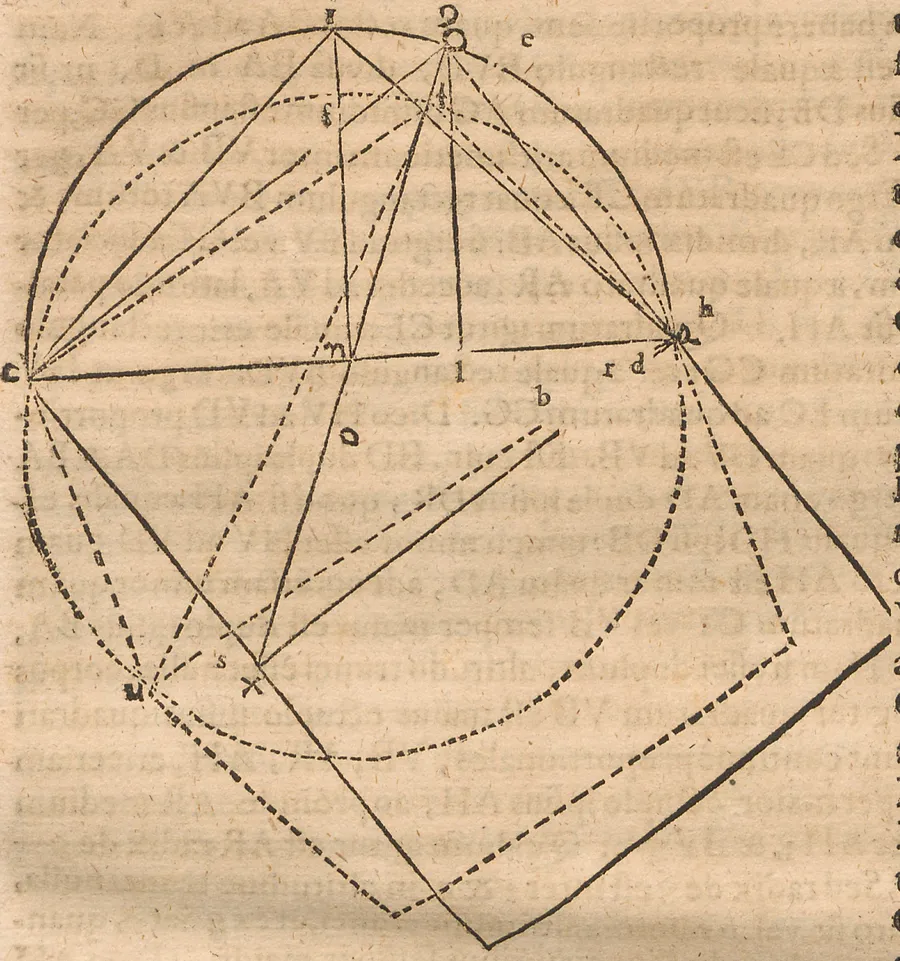
Sed & quadratum CE minus est quadrato GE cum triente quadrati AR, ipso hoc triente quadrati AR. Differentiam igitur illic inter terminos, facit aliqua quantitas, quæ est tripla quantitatis, quæ hic terminos differre facit. Et sunt præterea hi termini maiores duplis illorum terminorum. Nam cùm quadratum CG sit duplum quadrati AG, hic quadratum CE, maius est quadrato CG, & quadratum AE, minus quadrato GA. Cùm autem inter aliquos terminos ut 25, 26. differentiam facit aliqua quantitas, ut 1, eius vero quantitatis triplum, ut 3, differentiam facit inter terminos, minores dimidijs, vel saltem posteriorem posterioris dimidium, ut inter 10. 13. proportio minorum terminorum, est maior sextuplà proportionis maiorum; ut 10 ad 13, vel 20 ad 26, proportionem habet maiorem, quàm sextuplam proportionis 25 ad 26: & multo esset maior, si etiam posterior terminus 13 minor fuisset dimidio posterioris 26. Manente enim æquali differentia, quo minores fiunt termini, hoc magis augetur proportio. Est ergo proportio quadrati TA ad quadratum TR vel EA, maior sextuplà proportionis quadratorum CE & trientis de AR, ad CE. Ipsarum igitur linearum TA ad TR vel EA, proportio est maior tripla quadratorum CE & trientis de AR ad quadratum CE.
And the square of CE is less than the square of GE with a third of the square of AR by that third of the square of AR. The difference between the terms there, then, is made by a quantity that is three times the quantity that makes the terms differ here. And besides, these terms are greater than twice those terms. For since the square of CG is twice the square of AG, here the square of CE is greater than the square of CG, and the square of AE less than the square of GA. And when between some terms, such as 25 and 26, some quantity, such as 1, makes the difference, and three times that quantity, such as 3, makes the difference between terms less than their halves, or at least the second less than half the second, as between 10 and 13, the ratio of the lesser terms is greater than six times the ratio of the greater: as 10 to 13, or 20 to 26, has a ratio greater than the sixth power of the ratio 25 to 26; and it would be much greater if the second term 13 too had been less than half the second, 26. For with an equal difference remaining, the smaller the terms become, the more the ratio increases. The ratio of the square of TA to the square of TR or EA, then, is greater than the sixth power of the ratio of the squares of CE and a third of AR to CE. So the ratio of the lines TA to TR or EA themselves is greater than the cube of that of the squares of CE and a third of AR to the square of CE.
Eodem modo demonstrabimus etiam, quadratum de CE ad quadratum CG minorem habere proportionem, quam rectas GA ad AT. Nam quadratum CG est æquale rectangulo BVD, divisa BA in D, ut sit AD dimidium ipsius DB, sicut quadratum AG dimidium est ipsius GC, per Th. VII. huius. Sed CE est medium arithmeticum inter VB & VA, per Th. XII. huius. Ergo quadratum CE æquat rectangulum BVA totum, & insuper quadratum AR, dimidiæ ipsius AB: si ergo ad BV vel CT adijciatur parallelogrammum, æquale quadrato AR, accedet ad VA, latitudo parallelogrammi, quæ sit AH. Quadratum igitur CE æquale erit rectangulo BVH. Sed & quadratum CG erat æquale rectangulo BVD. Ergo ut HV ad VD, sic quadratum EC ad quadratum CG. Dico HV ad VD proportionem esse minorem, quam DV ad VB. Est enim BD dupla ipsius DA, & BA dupla ipsius AR: ergo etiam AD dupla ipsius DR; quodsi AH æqualis esset ipsi AD, eoque æqualis HD ipsi DB: tamen minor esset HV ad VD, quam DV ad VB: Iam verò AH est minor quàm AD, adeoque etiam minor quàm DR. Nam quadratum CT vel VB semper maius est duplo ipsius BA, per Th. X. huius. Nam si esset duplum, altitudo trunci esset nulla, corpus nullum: semper igitur quadratum VB est maius octuplo ipsius quadrati AR Cùm igitur sint continuè proportionales, VB, AR, AH, erit etiam ipsa recta VB semper maior octuplo ipsius AH, ac proinde AR medium proportionale inter AH 1, & BV 8+. Qualium igitur est AR radix de 8+ talium AH est 1. Sed radix de 8 est inter 2 & 3. in altitudine trunci nulla, corpore nullo, & cito fit, vel in minima altitudine trunci, ut ex 8 fiat 9, quando radix eius est 3, & in altitudinibus maioribus semper maior. Ergo AH ubi maxima, inter dimidiam & tertiam partem ipsius AR consistit, fitque, per augmentum altitudinis truncorum conjugatorum, quacunque parte ipsius AR minor, sic ut tandem cum ipsa AB evanescente (trunco in merum cylindrum transeunte) fiat infinitæ parvitatis portio de AR. Atqui si absque AH esset, proportio AV ad VD esset minor dimidia ipsius DV ad VB, quia AD est dimidium ipsius DB: & cùm proportio DV ad VB sit dupla ipsarum GC ad CT, vel GA ad AT: ergo si absque AH esset, proportio AV ad VD, & sic etiam quadratum EC ad quadratum CG, semper esset in minori proportione, quam rectæ GA ad AT.
In the same way we shall also prove that the square of CE has a smaller ratio to the square of CG than the straight lines GA to AT. For the square of CG is equal to the rectangle BVD, BA being divided at D so that AD is half of DB, as the square of AG is half that of GC, by Theorem VII of this part. But CE is the arithmetic mean between VB and VA, by Theorem XII of this part. So the square of CE equals the whole rectangle BVA and besides the square of AR, half of AB. If, then, a parallelogram equal to the square of AR is applied to BV or CT, the breadth of the parallelogram, AH, will be added to VA. The square of CE, then, will be equal to the rectangle BVH. And the square of CG was equal to the rectangle BVD. So as HV to VD, so is the square of EC to the square of CG. I say that the ratio of HV to VD is less than that of DV to VB. For BD is twice DA, and BA twice AR; so AD too is twice DR; and if AH were equal to AD, and so HD equal to DB, HV to VD would still be less than DV to VB. But AH is less than AD, and so also less than DR. For the square of CT or VB is always greater than twice BA, by Theorem X of this part. For if it were twice, the height of the frustum would be nothing and its body nothing; the square of VB, then, is always greater than eight times the square of AR. Since, then, VB, AR, AH are in continued proportion, the line VB itself will also always be greater than eight times AH, and so AR the mean proportional between AH, 1, and BV, 8+. Of such parts, then, as AR has the root of 8+, AH has 1. But the root of 8 lies between 2 and 3, at a frustum height of nothing and a body of nothing; and it quickly happens, even at the least height of the frustum, that 8 becomes 9, when its root is 3, and at greater heights always greater. So AH, where greatest, lies between a half and a third of AR, and by the increase of the height of the conjugate frustums becomes less than any part of AR, so that at last, with AB itself vanishing (the frustum passing into a mere cylinder), it becomes an infinitely small portion of AR. But if AH were not there, the ratio of AV to VD would be less than half that of DV to VB, because AD is half of DB; and since the ratio of DV to VB is the square of that of GC to CT, or GA to AT: so if AH were not there, the ratio of AV to VD, and so also of the square of EC to the square of CG, would always be in a smaller ratio than the straight lines GA to AT.
Cùm autem inter AR & AH, per diversos truncos, sint omnis generis proportiones: fit alicubi, sc. in truncis proximè æquealtis cylindro, ut AH non tantum adijciat, ut proportio HV ad VA æquet proportionem GA ad AT. & tunc res est certa, duo enim elementa sunt proportionis GA ad AE, alterum AT ad EA vel TR, alterum GA ad AT, duobus elementis proportionis, quadrati GE cum triente quadrati AR, ad quadratum GC, singula singulis maiora.
But since between AR and AH, through different frustums, there are ratios of every kind, it happens somewhere, namely in frustums of very nearly equal height to the cylinder, that AH adds only so much that the ratio of HV to VA equals the ratio of GA to AT. And then the matter is certain: for the two elements of the ratio of GA to AE, the one AT to EA or TR, the other GA to AT, are each greater than the two elements of the ratio of the square of GE with a third of the square of AR to the square of GC.
In truncis igitur proximis à cylindro conjugato decrevit altitudo maiori proportione, quam qua crevit basis cylindri, æquantis truncum: atque hoc solum demonstrandum fuit, dato enim initio truncorum cylindro minorū, deinceps trunci continuè minuuntur, donec evanescant. Sequentes tamen casus pertinent ad demonstrationis maiorem evidentiam.
In the frustums next to the conjugate cylinder, then, the height has decreased in a greater ratio than that in which the base of the cylinder equal to the frustum has grown; and this alone had to be proved: for once the beginning of the frustums is given as less than the cylinder, the frustums go on decreasing continually until they vanish. The following cases, however, belong to the greater clearness of the proof.
Vel æquatur proportio HV ad VD proportioni GA ad AT, in truncis humilioribus; & sic proportionum dictarum elementa posteriora, sunt æqualia, sed priora adhûc inæqualia, & plus triplo maior excessus rectæ AT super TR, in comparatione cum TR, quam triens quadrati AR, in comparatione cum quadrato GE, & id sine compensatione tota igitur altitudinum proportio, adhûc maior est proportione altitudinis basium.
Either the ratio of HV to VD is equal to the ratio of GA to AT, in lower frustums; and so the second elements of the said ratios are equal, but the first still unequal, and the excess of the line AT over TR, compared with TR, more than three times greater than the third of the square of AR compared with the square of GE, and that without compensation; the whole ratio of the heights, then, is still greater than the ratio of the bases.
Vel denique superat proportio HV ad VB, proportionem GA ad AT, sed in truncis adhuc humilioribus, quando CE longa efficitur, TR brevis: ubi quadratum AR magis magisque æquatur quadrato TR, idque tandem superat, magnam efficiens proportionem inter TR & TA; quæ quidem statim initio, & semper, est maior triplo proportionis inter quadratū CE cum triente quadrati AR, & inter solitarium quadratum CE: cum econtra triens quadrati RA, non in eodem proportionis incremento, augeat quadratum CE, quippe hoc ipsum per se crescens. Et cùm citò fiat, ut elementum proportionis altitudinum, quod est proportio AT ad TR, fiat maior tertia parte proportionis GA ad AT: ex eo deinceps semper fit, ut excessus elementi huius in proportione altitudinum, non tantum compenset, sed etiam superet magis magisque excessum elementi illius, in proportione basium: Hic enim totus as crescens quadrati AR, auget proportionem terminorum minorum & decrescentium; illic triens saltem, æqualiter crescens, auget proportionem terminorum maiorum & crescentium. Plus igitur hic potest proportionis augmenti pars tertia, quam illic totum proportionis augmentum.
Or, finally, the ratio of HV to VB exceeds the ratio of GA to AT, but in still lower frustums, when CE is made long and TR short; where the square of AR becomes more and more equal to the square of TR, and at last exceeds it, making a great ratio between TR and TA; which indeed from the very beginning, and always, is greater than three times the ratio between the square of CE with a third of the square of AR and the square of CE alone; whereas, on the other hand, the third of the square of RA does not increase the square of CE in the same increase of ratio, since that itself grows on its own. And since it soon happens that the element of the ratio of the heights, which is the ratio of AT to TR, becomes greater than a third part of the ratio of GA to AT, from then on it always happens that the excess of this element in the ratio of the heights not only compensates for, but more and more exceeds, the excess of that element in the ratio of the bases. For here the whole growing square of AR increases the ratio of lesser and decreasing terms; there only a third, growing evenly, increases the ratio of greater and growing terms. A third part of the increase of the ratio, then, can do more here than the whole increase of the ratio there.
Hæc igitur de illa conjugatione fuerunt demonstranda, in qua quadratum CG, duplum est quadrati GA. Quod si quadratū CG fuerit maius duplo illius; multo ista omnia magis obtinent. Nam quod analogiam attinet, Truncorum talium cylindri æquealti, (in Sch. XIX. CBA) sunt æqualium sed altiorum cylindrorū CHA subcontrarij, de quibus Th. XVIII. demonstratum, quod trunci ab illis incipiant fieri minores, etiam ij, qui cylindros altos CHA conjugatos habent: quanto magis illi, qui sunt cum his illorum subcontrarijs CBA, conjugationis eiusdem, & qui hic demum oriuntur, primo ortu facti humiliores conjugato cylindro CBA.
These things, then, had to be proved of the conjugation in which the square of CG is twice the square of GA. And if the square of CG is more than twice it, all this holds much more. For as regards the analogy, the cylinders of equal height to such frustums (in Schema XIX, CBA) are the counterparts of the equal but taller cylinders CHA, of which it was proved in Theorem XVIII that the frustums begin to become less from them, even those that have the tall cylinders CHA as their conjugates: how much more those that are of the same conjugation as their counterparts CBA, and which arise only here, made lower than the conjugate cylinder CBA at their first rising.
Iam verò quod reliquam domonstrationem concernit: cùm in Schemate XXI, cylindri ipsi, conjugationum capita, ponantur humiliores esse cylindro GA: crescit igitur in ijs CG, sed incrementis decrescentibus, minuitur GA sed decrementis crescentibus. Diminutà verò GA & secundum eam & TA, etiam AB differentia diametrorum, licet crescentium, crescit, sed incrementis decrescentibus, per Th. X. huius Fit igitur diminutio corporis cylindri conjugati, per curtationem ipsius TR, magna, quippe & secundum basin CG magnam, & secundum differentiam ipsium TR & AG multo maiorem: appositio verò ad corpus cylindri conjugati, secundum Trientem quadrati AR, & augmentum quadrati CE per BA, fit parva & minoris æstimationis. Retexat, qui vult, omnia demonstrationis præmissæ elementa adhunc modum; inveniet non minus lucis, quam supra Th. IX. huius, ex calculo emicuit, super huius partis veritate.
Now as regards the rest of the proof: since in Schema XXI the cylinders themselves, the heads of the conjugations, are supposed lower than the cylinder GA, CG grows in them, but by decreasing increases, and GA decreases, but by increasing decreases. And when GA is diminished, and TA in accordance with it, AB too, the difference of the diameters, though these grow, grows, but by decreasing increases, by Theorem X of this part. The reduction of the body of the conjugate cylinder by the shortening of TR, then, is great, both because of the great base CG and because of the much greater difference of TR and AG; but the addition to the body of the conjugate cylinder, by the third of the square of AR and the increase of the square of CE by BA, is small and of less account. Let anyone who wishes unravel all the elements of the foregoing proof in this way; he will find no less light than shone out from the calculation above at Theorem IX of this part, on the truth of this part.
Corollarium.
Corollary.
Posito, quod dolia Vinaria constent truncis conicis puris, in ijs quidem, quæ curta sunt, venter omnis diminuit æstimationem capacitatis; in Austriacis verò perinde ferè est, sive ventrem habeant, sive cylindricam figuram propius imitentur: quia nunquam usu venit, ut venter in tantam excrescat amplitudinem, ut habeat profunditatem duplam diametri orbis lignei: quo casu sanè, per Corollaria ad Th. IX, amitteret plusquàm quartam partem. Sed nec unquàm profunditas fit sesquialtera diametri orbis lignei, quo casu venter amitteret partem circiter tricesimam. At si sesquitertia, quod valde insolens, jam attenuatum est damnum ventris ad partem septuagesimam.
Supposing that wine barrels consist of pure conical frustums: in short ones, indeed, every belly lessens the estimate of capacity; but in Austrian ones it is almost the same whether they have a belly or imitate the cylindrical shape more closely: because it never happens that the belly grows to such a width as to have a depth twice the diameter of the wooden head, in which case indeed, by the corollaries to Theorem IX, it would lose more than a quarter. Nor does the depth ever become one and a half times the diameter of the wooden head, in which case the belly would lose about a thirtieth part. And if four thirds, which is very unusual, the loss from the belly is already reduced to a seventieth part.
Atque hæc est altera illa, & nobilissima quidem proprietas dolij Austriaci. Sicut enim Th. V. nihil magnum potuit ei nocere variata nonnihil figura per errorem artificis, propterea, quod Lege & More ducibus, ad figuram omnium capacissimam aspiravit artifex, incidens in figuras capacissimæ proximas, in quibus, ut proximis, defectus, ex legibus circuli, non est observabilis inter initia: sic nunc etiam nihil ferè in hoc dolio variat venter amplus an strictus, res cumprimis grata opifici; quia non ita facile est, ut proportionem tabularum ad orbes, sic ventris amplitudinem pro lubitu exprimere: nec ad amussim prævidet, quantus dolij venter sit evasurus, redigereturque in angustum, si lex amplitudinem certam ventrium præscriberet. Quòd igitur lege tali tam molestâ non est opus, id commoditati proportionis Tabularum ad Orbes, quam observat Austria, acceptum est ferendum.
And this is that second, and indeed most noble, property of the Austrian barrel. For just as by Theorem V nothing much could harm it when its shape was varied somewhat by the cooper’s error, because, with law and custom as his guides, the craftsman aimed at the most capacious shape of all and hit upon shapes next to the most capacious, in which, being next to it, the shortfall, by the laws of the circle, cannot be observed at first: so now too it makes almost no difference in this barrel whether the belly is wide or narrow, a thing above all welcome to the craftsman; because it is not so easy to give the belly the width one pleases as it is to give the proportion of the staves to the heads; nor does he foresee exactly how great the barrel’s belly will turn out, and he would be put in a tight spot if a law prescribed a fixed width of belly. That there is no need of such a troublesome law, then, must be credited to the convenience of the proportion of staves to heads that Austria observes.
Theor. XXIII. Problema Geometris propositum.
Theorem XXIII. A problem put to geometers.
Data proportione diametrorum Trunci, coniugationem invenire, in qua talis truncus æquet Cylindrum conjugationis maximæ.
Given the ratio of a frustum’s diameters, to find the conjugation in which such a frustum equals the cylinder of the greatest conjugation.
Primùm in ipsa conjugatione Cylindri maximi, jam truncus omnis, & sic etiam truncus datam habens proportionem diametrorum, est minor cylindro maximo, per Th. XXI. huius. Ergo coniugatio quæsita, est supra G, conjugationem cylindri maximi, versus conjugationē trunci, maximo æquealti, datam diametrorum proportionem habentis. Vt si truncus æquealtus cylindro maximo CGA, fuerit CFA, & conjugatus ei cylinder CIA, Fuerit verò etiam in conjugatione CGA, truncus CTA, & fuerit, ut CF ad diametrum oppositam parallelam per AX, sic etiam CT ad AV, corpus trunci CTA, conjugationis G, minus erit cylindro maximo CGA. Conjugatio ergo quæsita cadet supra conjugationem G, versus I. Quare quæsitus truncus habebit altitudinem maiorem quam GA. Et cylindri æquealti diameter basis, quæ medium est arithmeticum inter diametros trunci quæsiti, longitudinem habebit minorem quam CG. Dico conjugationem quæsitam esse etiam ultra I, & altitudinem trunci quæsiti maiorem quàm AI, quod mirum videatur. Nam quia datur proportio diametrorum trunci, semper etiam datur earum proportio ad medium suum arithmeticum. Vt igitur CF ad CG, sic erit etiam quæsiti trunci diameter minor, ad sui æquealti cylindri diametrum. Atqui minor hæc est, quàm CG, & remotior ab A: minor igitur etiam illa, quàm CF, & remotior ab A: minor ergo proportio CF ad FA, vel CI ad IA, quam diametri trunci quæsiti ad latus suum acclive, hoc est, diametri cylindri conjugati ad suam altitudinem. Maior ergo quæsitæ coniugationis altitudo, quàm AI, minor diameter, quàm IC. Hactenus demonstratio: reliquum huius Problematis Adriano Romano, & si quis alius est, cui Geber placet, expediendum transmitto.
First, in the conjugation of the greatest cylinder itself every frustum, and so also the frustum with the given ratio of diameters, is already less than the greatest cylinder, by Theorem XXI of this part. So the conjugation sought is above G, the conjugation of the greatest cylinder, towards the conjugation of the frustum of equal height to the greatest that has the given ratio of diameters. As, if the frustum of equal height to the greatest cylinder CGA is CFA, and its conjugate cylinder CIA, and there is also in the conjugation CGA the frustum CTA, and as CF is to the opposite parallel diameter through AX, so is CT to AV, the body of the frustum CTA of the conjugation G will be less than the greatest cylinder CGA. The conjugation sought, then, will fall above the conjugation G, towards I. So the frustum sought will have a height greater than GA. And the base diameter of the cylinder of equal height, which is the arithmetic mean between the diameters of the frustum sought, will have a length less than CG. I say that the conjugation sought is even beyond I, and the height of the frustum sought greater than AI, which may seem strange. For since the ratio of the frustum’s diameters is given, their ratio to their arithmetic mean is always given too. As CF to CG, then, so will the lesser diameter of the frustum sought be to the diameter of its cylinder of equal height. But this is less than CG, and further from A: so that too is less than CF, and further from A: so the ratio of CF to FA, or CI to IA, is less than that of the diameter of the frustum sought to its sloping side, that is, of the diameter of the conjugate cylinder to its height. So the height of the conjugation sought is greater than AI, and its diameter less than IC. So far the proof: the rest of this problem I hand over to Adriaan van Roomen to work out, and to anyone else who has a liking for Geber.
Cùm enim truncus omnis sit maior cylindro suo æquealto, in proportione Vnciæ de quadrato differentiæ diametrorum, ad quadratum diametri cylindri æquealti: Quare quadratum CA sic jubemur dividere, ut pars vna, aucta portione per differentiam diametrorum datà, & ducta in latus partis alterius, æquet quadratum CG, ductum in rectam GA. Consultus hac de re Geber, respondit ex Cossa sua, inveniendam altitudinem tantam, ut, tribus post illam continuè proportionalibus existentibus, in proportione, ut est ipsa ad CA, primæ aliqua certa multitudo, æquet datum numerum absolutum, cum aliqua certa multitudine tertiarum: huiusmodi verò æquationes in Geometria adhuc quærunt cossistæ, nec, me iudice, invenient unquam.
For since every frustum is greater than its cylinder of equal height in the ratio of a twelfth of the square of the difference of the diameters to the square of the diameter of the cylinder of equal height, we are told to divide the square of CA in such a way that one part, increased by a portion given by the difference of the diameters and multiplied by the side of the other part, equals the square of CG multiplied by the line GA. Consulted on this, Geber answered from his algebra that a height must be found so great that, with three quantities in continued proportion after it, in the ratio of it to CA, a certain multiple of the first equals a given absolute number together with a certain multiple of the third: and algebraists are still seeking such equations in geometry, and, in my judgement, will never find them.
Theor. XXIV. Problema Geometris propositum.
Theorem XXIV. A problem put to geometers.
Data coniugatione, in qua quadratum diametri in basi Cylindri, minus est duplo quadrati altitudinis, invenire proportiones duas diametrorum, quæ Truncos coniugationis eiusdem efficiat æquales Cylindro maximo.
Given a conjugation in which the square of the diameter of the cylinder’s base is less than twice the square of the height, to find the two ratios of the diameters that make frustums of the same conjugation equal to the greatest cylinder.
Data sit coniugatio CIA, in qua quadratum CI, minus sit duplo quadrati IA, oportet invenire truncorum coniugatorum diametros, æquantium cylindrum CGA maximum. Erit igitur altitudo trunci unius, maior quàm GA altitudo cylindri maximi, alterius minor, per XXI. huius. Per consequens igitur, illius proportio diametrorum erit minor proportione diametrorum æquealti cylindro CAG maximo, huius maior: uterque suum habebit cylindrum æquealtum: qui non erunt subcontrarii ipsi, sed subcontrariis proximi: quia si essent subcontrarii, essent æquales, per XVI huius. At cùm illorum trunci sint proportionis inæqualis diametrorum, quippe in eadem coniugatione diversas habentes altitudines; inæquales igitur adjicerent vncias quadratorum, differentiis suis, per XIII huius: itaque trunci ipsi fierent inæquales. At requirimus æquales, utrumque quippe uni CGA æqualem.
Let the conjugation CIA be given, in which the square of CI is less than twice the square of IA: the diameters of the conjugate frustums equal to the greatest cylinder CGA must be found. The height of one frustum, then, will be greater than GA, the height of the greatest cylinder, and that of the other less, by XXI of this part. Consequently, the ratio of the diameters of the former will be less than the ratio of the diameters of the frustum of equal height to the greatest cylinder CAG, and that of the latter greater: each will have its cylinder of equal height; and these will not be counterparts of each other, but next to counterparts: because if they were counterparts, they would be equal, by XVI of this part. But since their frustums have unequal ratios of diameters, having different heights in the same conjugation, they would add unequal twelfths of the squares of their differences, by XIII of this part; so the frustums themselves would become unequal. But we require them equal, each being equal to the one CGA.
Hactenus demonstratio: reliquum Cossistæ conficiant. Data enim esto CF, quæ quæritur: datur igitur & FA ex conjugatione, & quadratum eius: quare & rectangulum diametrorum, & hoc diviso per datam CF diametrum minorem, etiam diameter maior: quare nota erit & differentia maioris & minoris, & eius quadrati vncia, & quadrans; quo subtracto à quadrato AF, restabit quadratum altitudinis; quod cum quadrato GA comparatum, ostendet corporum proportionis partem unam. Sic data utràque diametro, datur cylindri, qui habet trunci CFA altitudinem, diameter basis, eius sc: quadratum, per XII huius: cui adjecta Vncia prius inventa, facit compositum, quod cum quadrato CG comparatum, ostendet corporum proportionis partem alteram. Oportet verò partes istas proportionis corporum, esse subcontrariè æquales, ut in unum conflatæ constituant proportionem æqualitatis.
So far the proof: let the algebraists finish the rest. For let CF, which is sought, be given: FA too, then, is given from the conjugation, and its square; and so also the rectangle of the diameters, and, this being divided by the given lesser diameter CF, the greater diameter too; and so the difference of the greater and the lesser will be known, and a twelfth and a quarter of its square; and when the quarter is subtracted from the square of AF, the square of the height will remain, which compared with the square of GA will show one part of the ratio of the bodies. So, both diameters being given, the base diameter, that is, its square, of the cylinder that has the height of the frustum CFA is given, by XII of this part; and the twelfth found before, added to it, makes a sum which compared with the square of CG will show the other part of the ratio of the bodies. And these parts of the ratio of the bodies must be inversely equal, so that combined into one they make the ratio of equality.
Tollite Cossistæ, quam fixi, crucem ingenij, & me sequimini: invenietis, nisi me aversa respexit Minerva, continuè proportionalium primas secundas & quintas, æquari numero absoluto cum proportionalium tertijs & quartis, certo quibusque numero sumptis. Nec igitur Geometrica est æquatio, sed stochastica Nic. Raimari Vrsi, aut mechanica Iusti Byrgij: nec problema, qualia Pappus ex more antiquorum, Plana appellavit, id est, absolutè Geometrica & scientifica; sed solidum, & cum conditione Geometricum, datis sc. duabus medijs, continuè proportionalibus, quod explicatum scientificum habet nullum. Et præterea non una est resolutio huius æquationis; demonstratum enim est, Truncos huiusmodi esse duos.
Take up, algebraists, the cross of the mind that I have set up, and follow me: you will find, unless Minerva has looked on me with averted face, that the first, second and fifth of continued proportionals, each taken a certain number of times, are equal to an absolute number together with the third and fourth of the proportionals. So the equation is not geometrical, but the trial-and-error one of Nicolaus Reimers Ursus, or the mechanical one of Jost Bürgi; nor is the problem of the kind Pappus, after the custom of the ancients, called plane, that is, absolutely geometrical and scientific, but solid, and geometrical only on a condition, namely given two means in continued proportion, which has no scientific solution. And besides, this equation has more than one solution; for it has been proved that there are two such frustums.
Theorema XXV.
Theorem XXV.
Si diversarum conjugationum Trunci habuerint eandem inter se proportionem diametrorum, constituti super eadem diagonio: proportio corporum erit composita ex tribus elementis, ex proportione Cylindrorum coniugationis, & ex proportionibus Cylindri cuiusque ad suum Truncum conjugatum, prioris quidem Cylindri eversa, posterioris vero directa.
If frustums of different conjugations have the same ratio of diameters among themselves and are set up on the same diagonal, the ratio of their bodies will be compounded of three elements: of the ratio of the cylinders of the conjugations, and of the ratios of each cylinder to its conjugate frustum, that of the first cylinder reversed and that of the second direct.
Sit truncus CFA, conjugationis CIA, truncus verò CTA, conjugationis CGA, super eadem diagonio CA; & habeat se CF ad diametrum maiorem per AX prolongatam, sicut se habet CT ad AV: dico corporis CFA proportionem ad corpus CTA trunci, compositam esse ex proportionibus tribus, 1. CIA ad CGA, 2. CFA ad CIA, 3. CGA ad CTA. Simplex est subsumptio ad axioma tritissimum, quod quatuor quantitatibus ordine collocatis, proportio primæ ad quartam, sit composita ex proportionibus interjectis: tantum in collocatione cautio est adhibenda: quia enim de proportione satagimus truncorum inter se, oportet truncorum alterum collocare loco quarto, alterum loco primo, cylindros in medio, cuique suum coniugatum proximum. Nam per Coroll. ad Th. III. columnarum, & sic etiam cylindrorum datur proportio, sc. CIA ad CGA. Sed per Th IX. datur proportio eversa CIA ad CFA, scilicet CFA ad CIA, & proportio directa CGA ad CTA: datæ verò proportionis corporibus deinceps collocatis, resultat dicta series,
Let there be the frustum CFA of the conjugation CIA and the frustum CTA of the conjugation CGA, on the same diagonal CA; and let CF be to the greater diameter extended through AX as CT to AV. I say that the ratio of the body CFA to the body of the frustum CTA is compounded of three ratios: 1. CIA to CGA; 2. CFA to CIA; 3. CGA to CTA. It is a simple application of the most familiar axiom, that when four quantities are set in order, the ratio of the first to the fourth is compounded of the ratios in between: only care must be taken in setting them out: for since we are concerned with the ratio of the frustums to each other, one of the frustums must be set in the fourth place and the other in the first, with the cylinders in the middle, each next to its conjugate. For by the corollary to Theorem III the ratio of the columns, and so too of the cylinders, is given, namely CIA to CGA. And by Theorem IX the reversed ratio of CIA to CFA, namely CFA to CIA, is given, and the direct ratio of CGA to CTA: and when the bodies of given ratio are set out in turn, the said series results.
Corollarium & Praxis.
Corollary and Practice.
Ritè collocatis terminis, quibus exprimuntur proportiones tres, multiplica tres antecedentes, duos inter se & factum in tertium; sic etiam age cum tribus consequentibus, & comprehendent, qui prodeunt, proportionem quæsitam.
The terms by which the three ratios are expressed being rightly set out, multiply the three antecedents, two together and the product by the third; do the same with the three consequents; and the products will contain the ratio sought.
Sit CIA conjugatio æqualitatis, CGA conjugatio proportionis semiduplæ linearum, duplæ quadratorum. Est igitur in Corollario Th. III. proportio CIA ad CGA ut 2828 ad 3080. vel 101 ad 110. In Corollario verò I ad Th. IX. cum est proportio diametrorum, quæ 1 ad 2: Truncus est ad cylindrorum priorem CIA ut 60 ad 54, hoc est ut 10. ad 9. In Corollario altero, cum est eadem proportio diametrorum quæ 1. ad 2., cylinder posterior CFA est ad Truncum ut 15 ad 11+, Ergò
Let CIA be the conjugation of equality, and CGA the conjugation of the ratio √2 : 1 of the lines, 2 : 1 of the squares. In the corollary to Theorem III, then, the ratio of CIA to CGA is as 2828 to 3080, or 101 to 110. And in Corollary I to Theorem IX, when the ratio of the diameters is that of 1 to 2, the frustum is to the first cylinder CIA as 60 to 54, that is, as 10 to 9. In the other corollary, when the ratio of the diameters is the same, 1 to 2, the second cylinder CFA is to the frustum as 15 to 11+. So

| Truncus. | Cylindri. | Trunco. | ||
|---|---|---|---|---|
| 10.— 9. | 15 — 11+ | Termini Antec. 10. 101. 15. factus 15150 | Truncus CFA | |
| 101 — 110 | conseq. 9. 110. 11+ facto 10890+ | Tr. CTA; |
| Frustum. | Cylinders. | Frustum. | ||
|---|---|---|---|---|
| 10 — 9. | 15 — 11+ | Antecedent terms 10. 101. 15. product 15150 | Frustum CFA | |
| 101 — 110 | consequents 9. 110. 11+ product 10890+ | Fr. CTA |
In minimis, ut 505 ad 363+ sic Truncus CFA ad Tr. CTA.
In least terms, as 505 to 363+, so is the frustum CFA to the frustum CTA.
Corollarium II.
Corollary II.
In conjugationibus Æqualitatis & duplæ quadratorum vel semiduplæ linearum proportionis, ratio corporum per diversas diametrorum proportiones est ista.
In the conjugations of equality and of the ratio 2 : 1 of the squares, or √2 : 1 of the lines, the ratio of the bodies through the different ratios of the diameters is this.
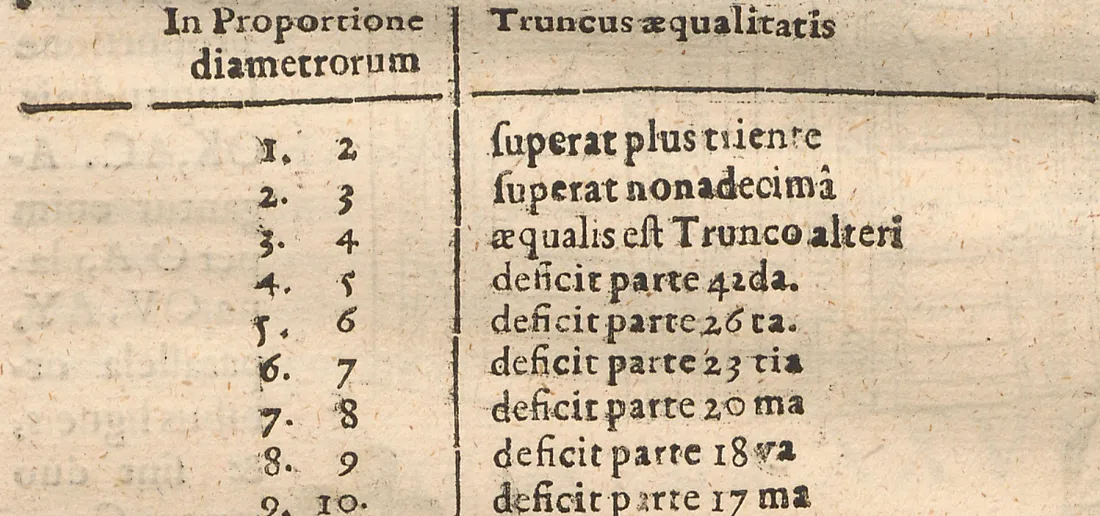
| In Proportione diametrorum | Truncus æqualitatis |
|---|---|
| 1. 2 | superat plus triente |
| 2. 3 | superat nonadecimâ |
| 3. 4 | æqualis est Trunco alteri |
| 4. 5 | deficit parte 42da. |
| 5. 6 | deficit parte 26ta. |
| 6. 7 | deficit parte 23tia |
| 7. 8 | deficit parte 20ma |
| 8. 9 | deficit parte 18va |
| 9. 10. | deficit parte 17ma |
| In the ratio of diameters | The frustum of equality |
|---|---|
| 1. 2 | exceeds by more than a third |
| 2. 3 | exceeds by a nineteenth |
| 3. 4 | is equal to the other frustum |
| 4. 5 | falls short by a 42nd part |
| 5. 6 | falls short by a 26th part |
| 6. 7 | falls short by a 23rd part |
| 7. 8 | falls short by a 20th part |
| 8. 9 | falls short by an 18th part |
| 9. 10. | falls short by a 17th part |
Exinde continuè plus deficit, usque dum cylinder, conorum omnium principium, deficiat parte vndecima.
From there it falls short continually more, until the cylinder, the beginning of all the cones, falls short by an eleventh part.
In proportionibus verò diametrorum maioribus: prævertitur truncus coniugationis duplæ, evanescendo.
But in greater ratios of the diameters the frustum of the double conjugation gets ahead, by vanishing.
Corollarium III.
Corollary III.
Posito, dolia esse ex puris truncis Conicis duplicatis, si eandem habuerint proportionem diametrorum, capacius plerumque est, quod Austriacam figuram, proportionis sc. semiduplæ diametri orbis lignei ad dimidiam tabularum longitudinem; quàm Rhenense, quod æqualem habet diametrum dimidiæ tabularum longitudini. Rarissimè verò & forte nunquam fit, ut æquentur capacitate; quia vix vnquam profunditates ventrium ad diametrum orbis lignei, attingunt proportionem sesquitertiam.
Supposing barrels to be made of pure doubled conical frustums, if they have the same ratio of diameters, the one of Austrian shape, that is, with the diameter of the wooden head √2 times half the length of the staves, is mostly more capacious than the Rhenish, which has a diameter equal to half the length of the staves. But it very rarely, and perhaps never, happens that they are equal in capacity, because the depths of bellies hardly ever reach the ratio 4 : 3 to the diameter of the wooden head.
Hactenus de figura Dolij Austriaci, sequitur;
So much for the shape of the Austrian barrel; there follows
De virga cubicâ eiusque certitudine.
On the cubic rod and its reliability.
Theorema XXVI.
Theorem XXVI.
In dolijs, quæ sunt inter se figuræ similis: proportio capacitatum est tripla ad proportionem illarum longitudinum, quæ sunt ab orificio summo, ad imum calcem alterutrius Orbis lignei.
In barrels of similar shape to one another, the ratio of the capacities is the cube of the ratio of those lengths that run from the top of the bung-hole to the lowest edge of either wooden head.
Sint dolia diversæ magnitudinis, specie eadem SQKT, XGCZ, quorum orificia OA, diametri orbium ligneorum QK, ST & GC, XZ, eorumque ima T, K & Z. C. longitudines OK, OT æquales, sic & AC, AZ Dico, capacitates doliorū, esse in tripla proportione longitudinis OK, AC. Agantur enim per O. A, plana OV, AY, parallela orbibus ligneis, & sint duo trunci Conici, SV & VQ, sic XY, & YG inter se similes.
Let there be barrels of different size and the same kind, SQKT and XGCZ, whose bung-holes are O and A, the diameters of their wooden heads QK, ST and GC, XZ, and their lowest points T, K and Z, C; and let the lengths OK, OT be equal, and likewise AC, AZ. I say that the capacities of the barrels are in the cubed ratio of the lengths OK and AC. For through O and A let planes OV, AY be drawn parallel to the wooden heads, and let there be two conical frustums SV and VQ, and likewise XY and YG, similar to each other.
Quæ igitur de proportione dimidiorum doliorum sunt vera, illa etiam de duplicatis erunt vera. Sint igitur propositæ figuræ OVKQ AYCG, conici trunci, sintque latera figurarum OQ, VK, & AG, YC. Diametri Basium minorum QK, GC, diametri basium maiorum OV, AY; & OQKV, AGCY sectiones quadrilateræ figurarum per suos axes, similes inter se, earumque diagonij OK, AC.
What is true of the ratio of half barrels, then, will be true of whole ones too. Let the proposed figures be the conical frustums OVKQ, AYCG, and let the sides of the figures be OQ, VK and AG, YC; the diameters of the lesser bases QK, GC; the diameters of the greater bases OV, AY; and OQKV, AGCY the quadrilateral sections of the figures through their axes, similar to each other, and their diagonals OK, AC.
Ergò cum figuræ similes, sint ad seinvicem in tripla proportione analogorum laterum, erit proportionis AG lateris ad OQ latus, aut GC diametri, ad QK diametrum tripla, proportio GY corporis ad QV corpus. At in figuris planis trilateris AGC & OQK similibus, ut GC ad analogum QK, vel ut AG ad analogum OQ, sic etiam diagonios AC ad analogon diagonion OX. Quare etiam proportionis AC longitudinis ad OK longitudinem tripla est, proportio GY corporis ad QV corpus: & sic etiam totius GZ dolij ad totum QT dolium.
Since, then, similar figures are to each other in the cubed ratio of corresponding sides, the ratio of the body GY to the body QV will be the cube of the ratio of the side AG to the side OQ, or of the diameter GC to the diameter QK. But in the similar plane triangles AGC and OQK, as GC is to the corresponding QK, or AG to the corresponding OQ, so too is the diagonal AC to the corresponding diagonal OX. So the ratio of the body GY to the body QV is also the cube of the ratio of the length AC to the length OK; and so too of the whole barrel GZ to the whole barrel QT.
Corollarium I, & structura virgæ.
Corollary I, and the making of the rod.
Manifestum hinc est, si virga mensoria dividatur in partes æquales tantas, ut prima & infima illarum sit longitudo OK. dolioli, quod capit Amphoram unam: ad singulas verò partium æqualium adjiciantur numeri, qui sunt inter se in triplicata proportione numerorum divisionis æquabilis, nimirum ad finem primæ partis Vnitas, ad finem partium 2, numerus 8, ad 3, Numerus 27, ad 4. Numerus 64, ad 5 Numerus 125. & sic consequenter, & numeri reliqui, qui cadunt inter hos cubicos, ordinentur in spacia intermedia; sicut pars secunda subdividatur in particulas 7 alias, non æquales, sed proportionales, quibus apponi possint numeri 2. 3. 4. 5. 6. 7, medij inter 1. & 8. & sic de cæteris quod Virga in dolium ritè immissâ, numeri ad quos usque pertingit interior tabulæ superficies OA, principio virgæ in K, C vel T, Z stante, sint indices Amphorarum, quas capit dolium, proportionis nimirum eius, quam habet dolium, verbi causa, GZ, ad dolium QT Amphoræ unius.
It is plain from this that if the gauging rod is divided into equal parts so large that the first and lowest of them is the length OK of a small barrel holding one measure, and to each of the equal parts numbers are added which are to one another in the cubed ratio of the numbers of the even division, namely 1 at the end of the first part, 8 at the end of two parts, 27 at 3, 64 at 4, 125 at 5, and so on, and the other numbers that fall between these cubes are arranged in the spaces between, as the second part is subdivided into 7 more little parts, not equal but proportional, to which the numbers 2, 3, 4, 5, 6, 7, between 1 and 8, can be set, and so with the rest: then, when the rod is rightly put into the barrel, the numbers up to which the inner surface of the stave at OA reaches, the start of the rod standing at K, C or T, Z, are indexes of the measures the barrel holds, that is, of the ratio which the barrel, GZ for example, has to the barrel QT of one measure.
Corollarium II.
Corollary II.
Eodem recidit res, quod quidam in triangulo AGC, pro latere AC metiuntur laterum AG, GC summam, pro virga circumgestantes limbum ex pergamena convolutum, amphorarum numeros eadem lege inscriptum cuius evoluti principium apud calcem C affigunt, longitudinem à C in G & porrò ad A extendunt, de nota eius quæ tetigerit punctum A, pronunciantes numerum amphorarum. Nam marginis apud G, procurrentem longitudinem, & circulorum ligneorum, viminibus revinctorum, tabularumque & orbis lignei GC crassitiem, quam amplectuntur circumductu limbi, præsupponunt per omnia dolia similem.
It comes to the same thing that some, in the triangle AGC, measure in place of the side AC the sum of the sides AG and GC, carrying instead of a rod a rolled strip of parchment inscribed by the same law with the numbers of measures. They fix the start of it, unrolled, at the edge C, stretch its length from C to G and on to A, and pronounce the number of measures from the mark that touches the point A. For they presuppose that the length of the margin running out at G, and the thickness of the wooden hoops bound with withies, and of the staves and the wooden head GC, which they take in by carrying the strip round, are alike in all barrels.
Theorema XXVII.
Theorem XXVII.
Etiamsi binæ medietates dolij Austriaci non plane fuerint similes, sed orbium ligneorum alter paulo minor & angustior reliquo, dummodo longitudo in mensoria sit eadem, insensibilis erit capacitatum in vtraque medietate differentia.
Even if the two halves of an Austrian barrel are not quite alike, but one of the wooden heads is a little smaller and narrower than the other, provided the length on the gauging rod is the same, the difference of capacities in the two halves will be imperceptible.
Dictum enim est in Corollario ad Theor. V. secundæ partis, dolium Austriacum versari circa figurationem capacissimam, à qua figurationes omnes ad latus utrumque, hoc est, dolia tam longiora quàm breviora Austriaco, omnia sint minus capacia, quàm Austriacum. In ijs verò articulis, in quibus à minori ad maximum iterumque ad minus fit mutatio, lege aliqua circuli, semper est aliquousque insensibilis illa differentia. Quod igitur verum est de dolijs integris, eandem habentibus diagonion: id etiam verum erit de binis unius dolij truncis, ut de AYX, AVG; ut etsi orbium alter, puta GC, fuerit minor reliquo XZ; dummodò AC, AZ æquales, capacitas tamen sit utrinque ad omnem sensibilitatem æqualis.
For it was said in the corollary to Theorem V of the second part that the Austrian barrel is about the most capacious shape, from which all shapes on either side, that is, barrels both longer and shorter than the Austrian, are all less capacious than the Austrian. And at those points at which the change goes from less to greatest and again to less, by some law of the circle, that difference is always imperceptible for some way. What is true of whole barrels having the same diagonal, then, will also be true of the two frustums of one barrel, as of AYX and AVG: so that even if one of the heads, say GC, is smaller than the other, XZ, provided AC and AZ are equal, the capacity on both sides is equal to every perception.
Theorema XXVIII.
Theorem XXVIII.
At si longitudo virgæ per utrumque dolij truncum non sit æqualis, quod usu venit: medium proportionale inter utramque virgæ longitudinem, id est medius numerus inter duos ab una & ab altera medietate notatos, sine errore pro indice capacitatis usurpatur.
But if the length of the rod through the two frustums of the barrel is not equal, as happens, the mean proportional between the two lengths of the rod, that is, the middle number between the two marked from the one half and the other, is used without error as the index of capacity.
Nam minor longitudo inscriptum habet capacitatis, quæ est sui trunci, duplum; maior itidem sui trunci duplum habet inscriptum. Vtraque ergo longitudo, junctis numeris, inscriptum habent duplum capacitatis totius dolij. Medium igitur arithmeticum inter numeros utriusque longitudinis, quod æquevalet medio proportionali inter lineas, arguit simplum totius dolij.
For the lesser length has inscribed on it twice the capacity of its own frustum, and the greater likewise has inscribed twice that of its own frustum. The two lengths, then, with their numbers added, have inscribed twice the capacity of the whole barrel. So the arithmetic mean between the numbers of the two lengths, which is equivalent to the mean proportional between the lines, shows the single measure of the whole barrel.
Theorema XXIX.
Theorem XXIX.
Curvatura Tabularum, seu buccositas inter orificium medium & orbem vtrumque ligneum, in dolio Austriaco nihil derogat indicio Virgæ, in Oblongis doliis auget capacitatem à virga indicatam (per se quidem, cæteris paribus) in Curtis minuit.
The curvature of the staves, or bulge between the middle bung-hole and each wooden head, takes nothing from the rod’s reading in an Austrian barrel; in oblong barrels it increases the capacity shown by the rod (of itself, that is, other things being equal), in short ones it lessens it.
Nam etsi, per XXIX partis primæ, dolium figura Citrij, Pruni, Olivæ, Fusi Parabolici aut Hyperbolici, truncatorum, superat capacitate dolium Cylindraceum, vel meri trunci duplicati figuram habens, his gradibus, quo hic ordine figuræ sunt recensitæ; illud tamen & per se est per parum uti apparet ex Th. XXII p. primæ; & quicquid eius sensibile est, jam in virgæ numeros ingestum est. Nam primum dolium, cuius capacitas pro vnius Amphoræ indicio, virgæ fuit inscripta, similiter ut cætera omnia, suam habuit buccositatem: arguit igitur Virga dolia omnia buccositatis similis; quæ etsi non omnibus Austriacis est similis, omnibus tamen est aliqua, eoque minor error circa illam. At cum dolia fuerint longiora Austriacis, longior etiam in ijs flexus est tabularum ab orificio ad orbes, itaque maioris capacitatis, etiamsi similis vtrinque ponatur flexura; quemadmodum etiam, si breviora fuerint Austriacis, flexus iste est brevior. Atqui virga flexum longitudinis mediocris arguit, qualis est in dolio Austriaco: non assequitur igitur virga (cæteris paribus) longitudinem flexus in dolio oblongo; superat in dolio brevi.
For although, by XXIX of the first part, a barrel in the shape of a cut lemon, plum, olive, parabolic or hyperbolic spindle exceeds in capacity a cylindrical barrel, or one having the shape of a mere doubled frustum, by these degrees, in the order in which the shapes are listed here, yet that is of itself very little, as appears from Theorem XXII of the first part; and whatever of it is perceptible is already brought into the rod’s numbers. For the first barrel, whose capacity was inscribed on the rod as the mark of one measure, had its bulge like all the others: so the rod shows all barrels as of a like bulge; which, though it is not alike in all Austrian barrels, is yet some in all, and so the error about it is less. But when barrels are longer than Austrian ones, the bend of the staves from the bung-hole to the heads is also longer in them, and so of greater capacity, even if the bend is supposed alike on both sides; just as, if they are shorter than Austrian ones, this bend is shorter. But the rod shows a bend of moderate length, such as is in the Austrian barrel: so the rod (other things being equal) does not reach the length of the bend in an oblong barrel, and goes beyond it in a short one.
Schema XIX.↩︎
Schema XIX.↩︎